
Four birds in a pie
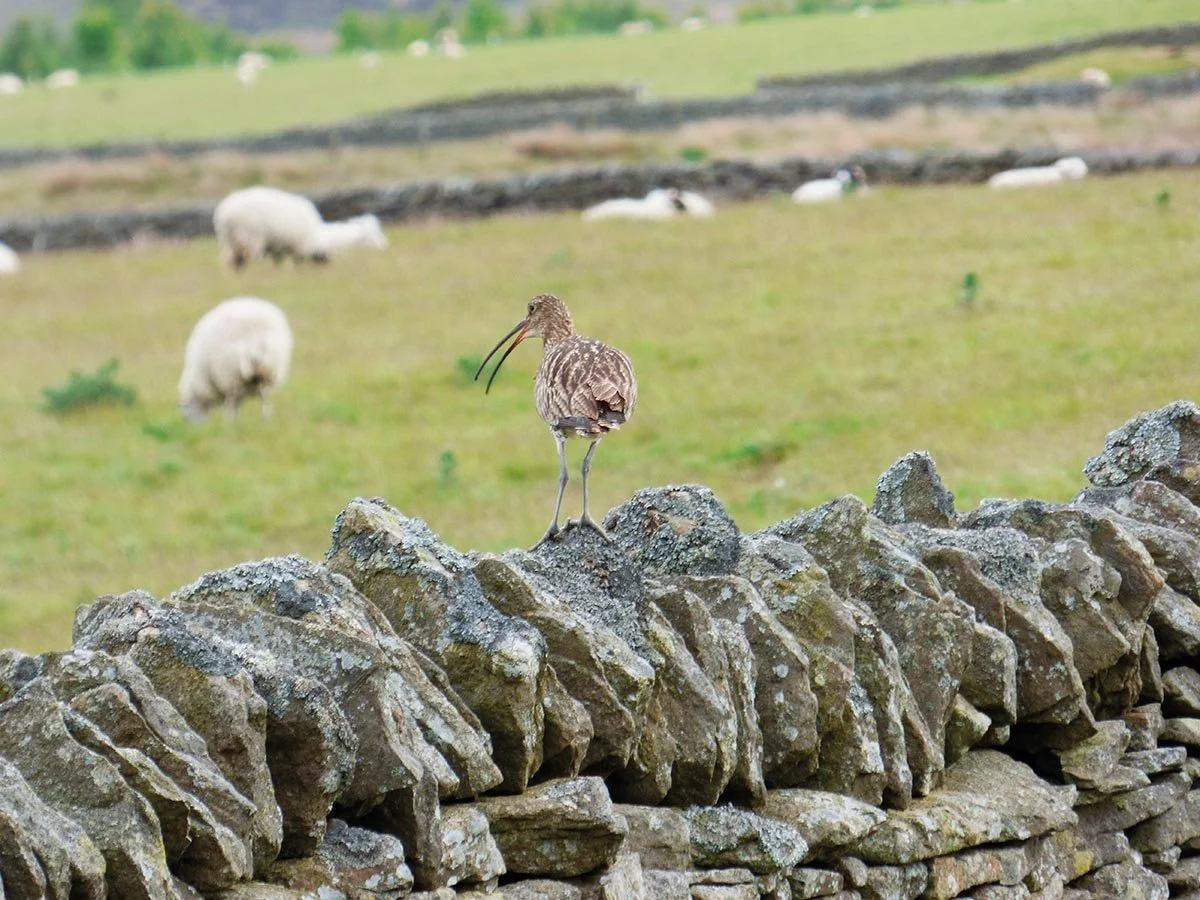
A curlew (Photo by Anthony Toole)
First published in edition 208 of The Northumbrian, Oct/Nov 2025
Anthony Toole encounters curlews, mine shafts and a house named for miners’ penny pies on a wildlife-rich walk taking a circular route from the historic village of Blanchland
One enters Blanchland almost by surprise. You know it’s there, but as you approach from whichever direction down steep, wooded slopes, it remains hidden until the last moment, when you find yourself in a village that is, almost certainly, unlike any other you may have seen. Surrounded by high moorland, it lies a mile-and-a-half northeast of where Beldon Burn and Nookton Burn combine to form the River Derwent. A similar distance further to the northeast lies Derwent Reservoir. The village is just north of the Northumberland-Durham border, which follows Beldon Burn and the Derwent before bisecting the reservoir.
The name and unique appearance of Blanchland reflect its medieval monastic origin. Henry I gifted the surrounding lands to the Norman de Bolbec family. In 1165, Walter de Bolbec gave a portion of the estate to the monks of the Premonstratensian order to build a monastery. These monks were followers of the German St Norbert, who had founded the first of his many monasteries in Premontre, France, during the early 12th century. The white habits worn by the monks gave the name to Blanchland.
After Henry VIII dissolved the monastery in 1539, the estate passed through a variety of owners and entered a period of decline. It was bought in 1704 by Lord Crewe, Bishop of Durham, and following his death his trustees carried on his work of rebuilding the village to house estate workers, using the template upon which the monastery had been laid out. During the 19th century, the growth of lead mining on the surrounding hills increased the population.
As a result of its photogenic and historic appearance, Blanchland has been the setting for television productions of some of the stories of Catherine Cookson and episodes of TV’s Vera. In 1996, it even took on the mantle of Thomas Hardy’s Wessex in a film version of his novel Jude the Obscure.
We began our walk behind the White Monk Refectory and Tea Room, where a wooden signpost crowned by a bird nesting box indicated a footpath leading out of the village. As we followed this, we found it to be unexpectedly steep and sustained, rising steadily for some 200 or 300 yards through mixed woodland. The trees were perhaps a couple of centuries old or more and included larch, beech, oak, birch, sycamore and very tall Scots pine. Some had been partially felled or half destroyed by high winds, yet the remaining half trees continued to grow with apparent vigour.
The path levelled for a short distance, then passed through a gate before steepening again for another stretch to join a broader track. After a few more uphill steps to avoid a closed gate with a No Entry sign, this eventually descended past a stone shed to the old mine workers’ cottages of Shildon, about ½ mile north of Blanchland. At the bottom of the slope, opposite the houses, stood the remains of the Shildon Engine House, built in the early 19th century to house a steam engine employed to pump water out of a nearby mine. This proved inefficient and was abandoned after a few years, the engine house converted into homes for miners.
During geological time periods, earth movements caused cracks in the sedimentary bedrocks of sandstone and limestone, which filled with hot solutions of lead and zinc salts. As these cooled, they crystallised into deposits of galena (lead sulphide) and sphalerite (zinc sulphide). Throughout the 18th and 19th centuries, the North Pennine orefield was the most productive of these minerals in the world, only closing when they became uneconomic in the 20th century. Old shafts and spoil heaps remain testament to a once-thriving industry.
The footpath north out of Shildon led up steps through another patch of woodland and out into a field. In the far wall, beyond a solitary tree, a stile brought us onto open moorland. The tree was enclosed by a fence as it stood above the first of a series of blocked-off mineshafts. Two more similarly enclosed shafts lay beyond the wall. As we approached these, a red kite flew above chased by two noisy curlews. As we followed the footpath alongside the wall and across Pennypie Fell, we, like the red kite, must have passed close to the nests of ground-nesting birds, for several agitated curlews and oystercatchers rose ahead of us and circled before settling to watch us warily from the wall. We crossed the moor as quickly as possible to create minimal disturbance and joined the broad, sandy bridleway that links Blanchland with Slaley Forest. This being a grouse moor, a row of shooting butts ran across the fell to the east and west of us.
We turned south along the bridleway, and just before reaching Pennypie House paused for lunch, sitting on a row of flat stones beneath a tree. I have come across two possible derivations of the strange name of this former farmhouse. I do not know which, if either, is correct. One links it to a penny toll that passers-by had to pay to use the bridleway. The other suggests that miners on their way to work could buy a pie for lunch for a penny.
Beyond Pennypie House, which is now used by gamekeepers, the bridleway split into two. We took the right fork, which led us past more fields of nesting curlews and oystercatchers. Also in evidence were meadow pipits, a pair of goldfinches, and a solitary skylark that called from so far above us that it disappeared.
We passed a walled and fenced enclosure that held the large pipes of a gas installation. Our bridleway now became a service road and brought us down to the next patch of woodland. A footpath along the side of a field passed an enormous beech tree that had been half destroyed by wind. We joined a farm track through Cote House Farm, which, as its name implies, had a dovecote in its yard and several white doves padding around the grounds. More bends in the track brought us back to Blanchland, 31/2 hours after leaving it. The distance walked had been around as many miles.