
Into the valley
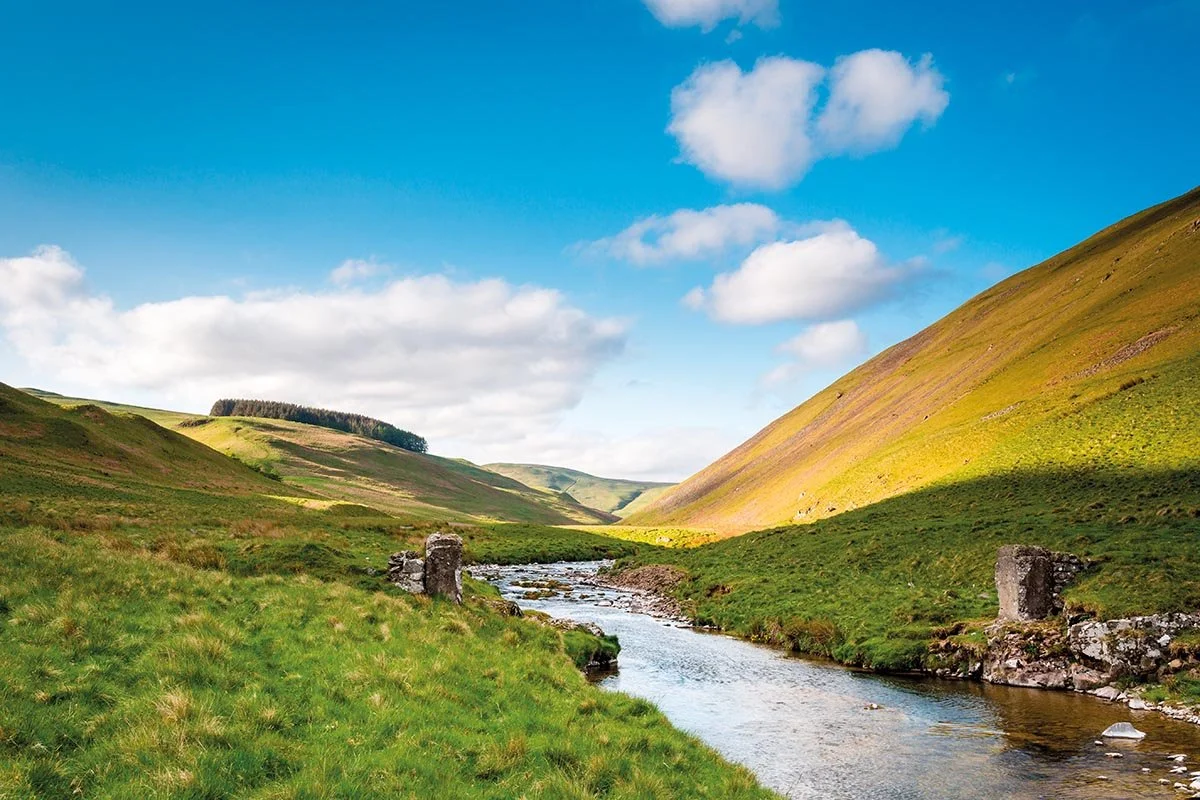
The Coquet Valley
First published in edition 206 of The Northumbrian, June/July 2025
John Grundy recalls days exploring the Coquet Valley in all conditions, from snow to summer picnic weather, and recommends we do the same
I don’t want to grumble (he grumbled) but the weather’s not been very nice recently. Today, for example, it’s cold and windy, so I’ve just been sitting here at my computer, gazing at the screen in a vague sort of way, looking for something to catch my attention.
And now at last I have – it’s a little group of photos I took in August 2015 of my wife and son having a picnic on the bank of the River Coquet, a few miles upstream from Alwinton. As you can see from the photo below, it really was high summer because my son is sporting the naked knees – something that in the North East only postmen and Gen Z men risk any earlier in the year – and my wife, with uncharacteristic fortitude, has failed to wrap a rug around her shoulders. I don‘t want to shock you, but this is clear proof that the temperature had soared, possibly even as high as the mid-teens.
I’m obviously not there because I am taking the photograph, but my presence in the scene is revealed by the neat little vacuum flask resting on the ground beside my seat. This saddens me because it is the very same flask I wrote about in a different article a couple of years ago, after I carelessly lost it having left it on the banks of another favourite river, the Breamish, in the Ingram Valley.
Anyway, the Coquet is also a favourite river, and the site of this picnic has long been a regular stopping place for the Grundy family; a typical and favourite part of this extraordinarily beautiful valley. To get to our spot you drive up the valley from Alwinton, past a beautifully located, simple place called Shilmoor Farm, about which I came across a nice little poem, or a nice little extract of a longer poem, I don’t know which it is. It goes like this:
The lambs they are feeding on lonely Shilmoor,
And the breezes blow softly o’er dark Simonside,
The birds they are lilting in every green bower,
And the streams of the Coquet now merrily glide.
Just beyond Shilmoor and round a bend is our little picnic spot. The river here sort of puckers up, squeezing between mighty boulders to form a series of small but powerful waterfalls into which generations of the Grundy family have dipped themselves with nervous squeals and futile but enthusiastic attempts to dam the stream. One hesitates to say it these days, when the news about rivers is liberally sprinkled with stories of sewage and polluted run-off, but the Coquet here seems to be pristine. I hope that is true, but as evidence that it might be, just below our little private ice-cold sauna there were bunches of kingcups clinging to the banks with their roots in the water, and assorted other wildflowers whose names are beyond me dotted the grassy edges. Rocks near the river, but relatively safe from being inundated, had fantastic mosses and lichens – something, I suspect, you only find in the purest air.
This is particularly true of the rocks that make up the beautiful and well-preserved circular sheepfold just behind our picnic spot – one of many in this valley and one of very many indeed in the wider Cheviot landscape. Are these circular structures unique to our area? Perhaps not, but I’ve never spotted them elsewhere.
They seem to have started to appear here in the Border hills along with the spread of sheep farms in the 18th and early 19th centuries. The thinking, I believe, is that the circular walls are more likely to deflect or throw off the snow than straight walls, so the sheep are less likely to be buried in the storms that were such a feature of the hills.
I told a story in a recent edition of The Northumbrian of two shepherds who perished in the snow on their way home in the upper valley of the River Aln, and the Coquet must have seen plenty of such events. For example, in the 1990s I did an interview for a programme on Radio 2 with a lady called Hannah Hutton, who sadly died quite recently. She was the wife of Joe Hutton, who was a shepherd and a magnificent player of the Northumbrian pipes. Hannah was also musical and a splendid singer of local songs, and the pair of them lived for many years at a farm called Rowhope, a bit higher up the Coquet from our picnic spot and off to the right in a side valley.
Joe had been a shepherd all his life and knew his flocks and the lie of his land like the back of his hand. However, one day, Hannah told me, it had snowed hard and unexpectedly and Joe felt the need to go up onto the fell to check on his flock. He went up the steep bank immediately behind their house, found his sheep were well, and turned round to come back down the same way. From where he was, he ought to have been able to see his cottage, but disoriented by the snow, he lost the path and ended back at the river a mile or so downstream from home. That’s how difficult the weather can be.
Hannah told me another story about the occasion she went down, she said, to visit her neighbour at the next cottage down the valley, but while she was there it snowed heavily and froze viciously so that the path back to her house was obliterated, and the banks of the river lethal with ice. “But you got back safely . . .” I said. “I did,” she said, “but I would never have made it if I hadn’t taken me ice axe . . .”
Tough folk these Northumbrian shepherd families! Even I, not at all a tough cookie, have experienced weather-related difficulties in this valley. I have to warn you that this next story contains elements of loss and sadness that might disturb more sensitive readers. Back in the 1980s, in my role as a listed building fieldworker, needing to visit all the items marked on the Ordnance Survey maps, I had walked miles, it seemed to me, possibly even many miles, back into the wild country north of the main valley to visit a cottage called Fairhaugh. Nowadays, it can be rented by up to eight people if they are happy to take a break entirely off-grid, and it looks super, but what I found 40 years ago, while undoubtedly very beautiful and extraordinarily isolated, appeared abandoned and in a state of disrepair.
So, there I was, miles from anywhere, but sensibly clad in the splendid climbing boots which I had bought 20 years earlier, at considerable cost, at George Fisher’s outdoor clothing store in Keswick. If I’d had a brother, I would have loved those boots as much as I loved him, so you can imagine my grief when my left foot was seized by a bit of Coquet Valley bog which sucked the sole clear of the rest of the boot. A sticky situation you might think, and you would be right. I pitifully attempted to re-attach the sole using a bootlace, but that failed, and I limped and plodged and waddled the many miles back to my car and had to drive home in my stockinged feet.
On another visit to the valley, I witnessed others suffering from the weather in this unpredictable landscape. You need to know that the Coquet at this point forms the northern edge of the Otterburn Military Training Area and on one occasion I was resting and enjoying my lunch on the bank of the river near Blindburn in intense and unexpected heat when a party of pink-faced and heavily laden squaddies appeared at my picnic spot and instantly hurled themselves to the ground in exhaustion and wild abandon.
They lay there panting and looking untidy when suddenly a black staff car drew up alongside them and a little fat officer in a beautifully pressed uniform got out and looked at them with distaste. He had a shooting stick which he opened and sat on, relaxed and in total command, while they all leapt up, lined up and stood pinkly and moistly to attention. He inspected them briefly and gave them an instruction at which they all set off upstream with their huge backpacks while he rested coolly on his shooting stick, took a drink from his flask and set off to meet them at a later stop. I felt like telling him off. But didn’t.
Being military land, the south side of the river is littered with signs warning the unwary walker about the dangers that lurk on an uncleared target area. I was standing by such a sign once which told me not to pick anything up or it might explode and kill me, when an over-enthusiastic horse came galloping towards me, eager to make my acquaintance. I had a choice: over-excited horse or unexploded ordnance. I leapt a wall (rich in lichen, of course) and lived to tell the tale.