Sand martins take over a sandy cliff
First published in edition 212 of The Northumbrian, June/July 2026
While swallows steal much of the attention each summer, their smaller cousin the sand martin tells a remarkable story of endurance, epic migration and hard-won survival, says Ian Kerr
Swallows always seem to receive so much attention in summer that it’s rather easy to overlook one of their close relatives, the sand martin.
They’re among the earliest summer migrant to arrive in Northumberland from their wintering areas in Africa. So much so that when I’m told during the chilly days of March that someone has just seen the first swallow in the village, it normally turns out to be a sand martin.
But one must be careful in rushing to judgment because this year a swallow turned up at Ulgham, near Morpeth, on the incredibly early date of February 26. It was two weeks earlier than ever recorded in Northumberland and long before sand martins put in a local appearance.
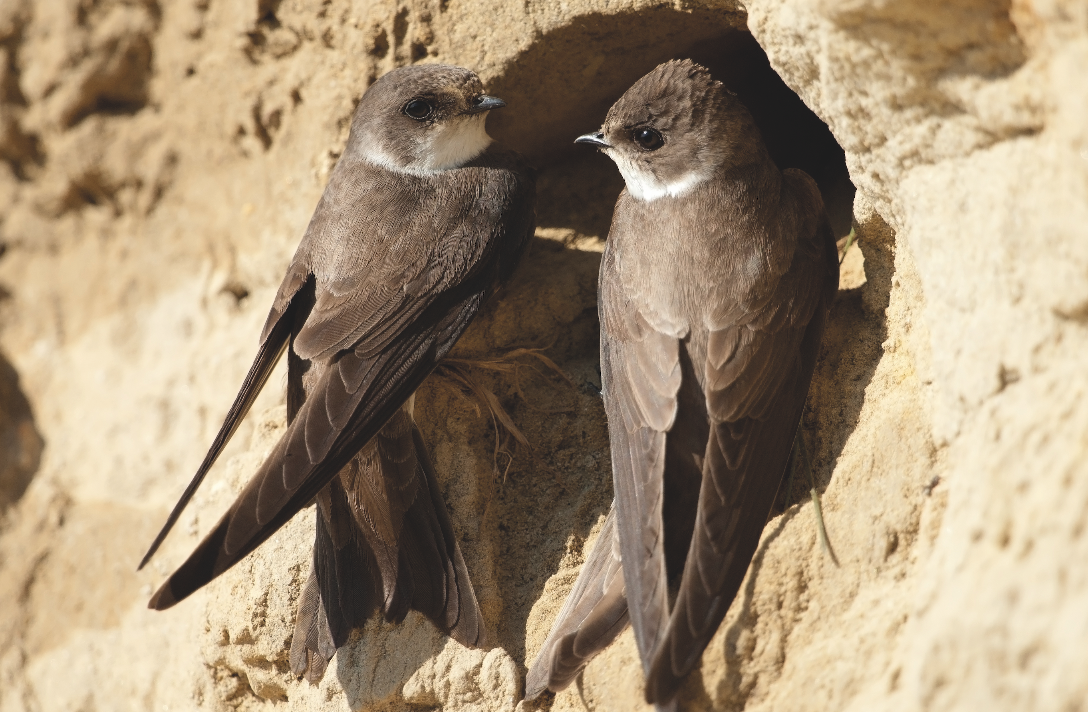
Sand martins are basically brown and white, whereas swallows, unless they are seen well in good light, give the impression of being black and white. Confusion is understandable as there is a superficial resemblance in both shape and flight, particularly if the bird is just flashing past.
With a brown back, tail and breast band and white under-parts, they are among the smallest of the wider swallow family. While superficially similar, the two species have very different lifestyles. They winter in widely separated areas of Africa and when they are here with us their breeding lives are totally different.
The martins spend their winters in tropical West Africa whereas our swallows go further on to South Africa as far as the Cape, taking advantage of abundant insect life in the warmth of the southern summer.
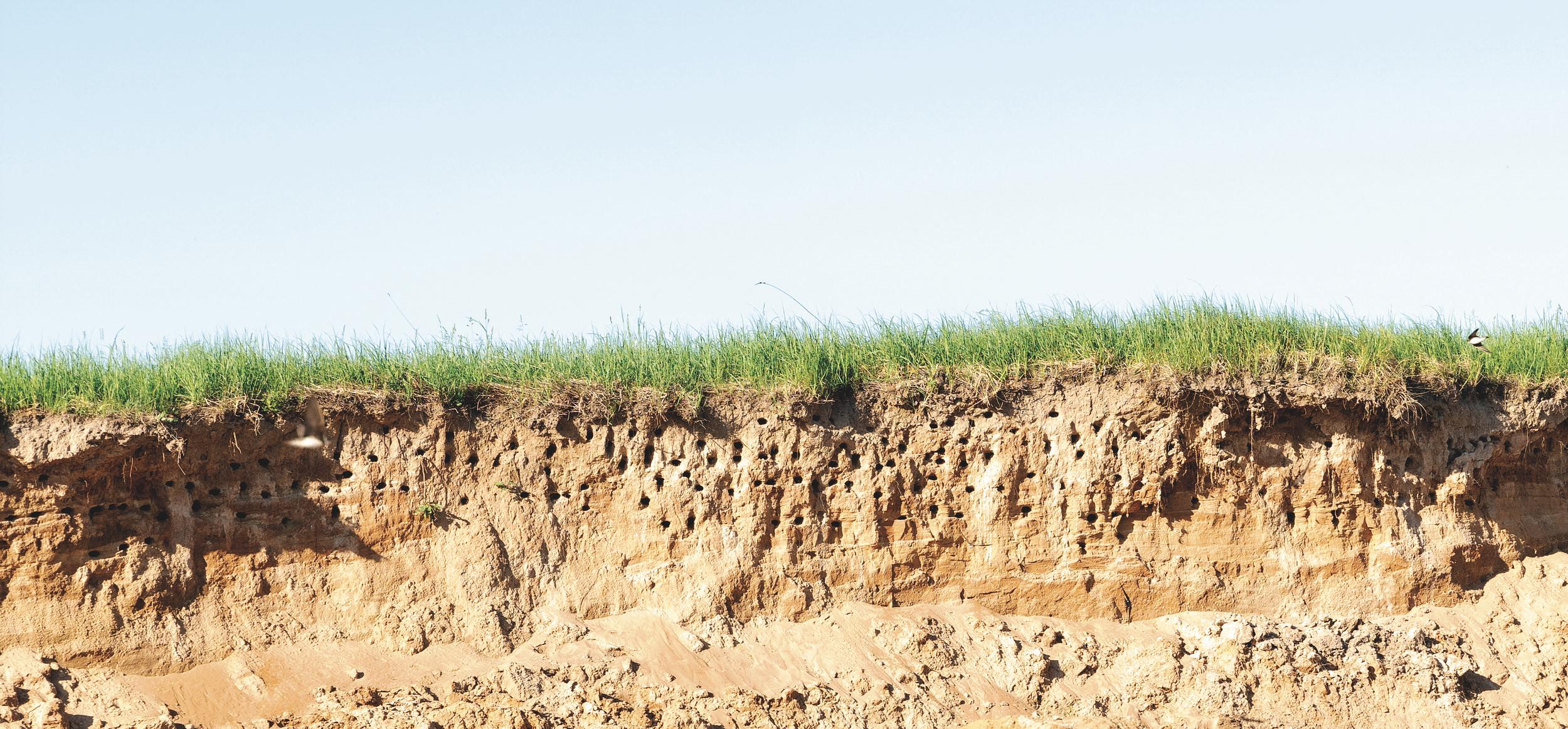
Once back here in spring, the difference in breeding habits between martins and swallows becomes very obvious. Martins congregate in colonies, digging out long tunnels in sandy soils to create a nesting chamber in safety and darkness often up to 3ft from the entrance hole.
Swallows nest singly, creating their open mud and grass nests on the narrowest of ledges and similar sites in a wide variety of buildings. Regular readers may recall that last year I was excited that, after a wait of more than three decades, swallows fledged four young from a shelf in my coalhouse. They then went on to raise a second brood of five in a nest built on the head of an upturned broom, which got me out of sweeping the paths for a few weeks!
These annual migrations to and from Africa have led over the decades to major problems for our sand martins. For example, suddenly during the 1970s the breeding populations of these small migrants suffered a catastrophic decline across Europe.
Prior to that ours in Northumberland often nested in big colonies in quarries, riverbanks, railway cuttings and coastal sites, sometimes with more than 1,000 pairs regularly present. Other more unusual colonies then existed on industrial spoil heaps at Prudhoe in the Tyne Valley and around Allendale; legacies of the old lime processing and lead mining enterprises. A few enterprising pairs were even recorded nesting in drainage holes in stone and concrete retaining walls along the banks of the Ouseburn at the eastern end of Newcastle Quayside.
At that time the numbers of sand martins returning to breed in Britain and elsewhere across their range crashed by more than 70%. This resulted from a long series of drought in the Sahel, the region south of the Sahara Desert, leading to a huge reduction in the numbers of flying insects on which they totally rely. Many perished, drastically reducing the numbers available to return to breeding areas.
A slow recovery was apparent during the 1980s as conditions around African wintering areas improved, but numbers have still not returned to their pre-1970s levels. The days of huge colonies seem to be over and breeding groups are now much smaller and breeding sites more scattered.
Since then, larger colonies include three near Hexham, with between 200 and 350 pairs at Fourstones on the North Tyne; at Corbridge; and at gravel pits near Chollerford. Most other colonies have held much smaller concentrations, often as few as 20 pairs, including one I regularly see on the boulder clay sea banks near Emmanuel Head on Holy Island.
Nesting is hard work. Using their small feet and claws, males and females both scrape out tunnels in earth and sand banks. It’s laborious and time-consuming, and unstable sites are prone to collapse, forcing them to begin all over again.
In sites where banks are more stable and tunnels survive from year to year, there’s competition among pairs to reach them first, defend them from all-comers, and save effort by clearing out fallen sand and earth and refurbishing nesting chambers with fresh grasses, feathers and other soft materials. Fights between pairs for possession are commonplace. Some males have been recorded invading nesting tunnels, killing and dragging out chicks to take possession.
Recently on many wildlife reserves and similar sites, sand martins have been given a helping hand. Artificial and stable nesting banks of sand and earth with long tunnels already drilled have proved attractive. In some, access hatches at the rear have enabled pairs to be closely monitored for breeding success and for chicks to be ringed. An artificial site of that kind has now been provided on the Ouseburn. Martins prospecting for suitable sites can simply fly in and take possession without any of that tough digging work.
In the dark nest chambers, four or five white eggs are laid. Like many hole and cavity-nesting birds, their eggs, being well hidden from predators, don’t require camouflaged colours, unlike those of other species, particularly ground-nesters, whose eggs blend in with their backgrounds.
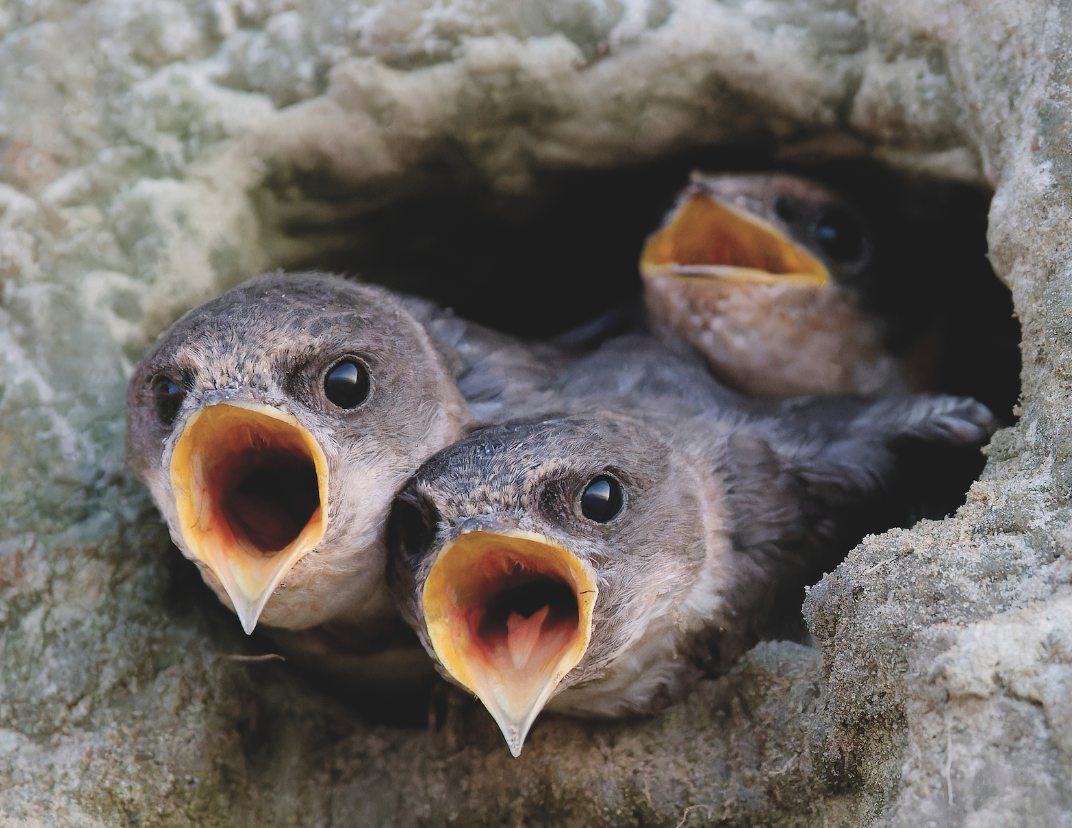
The pair incubates for around a fortnight. The young, which are fed by both parents on a diet of insects, are ready to leave after around three weeks. As they develop, they must continually exercise their wings by flapping, and in a very confined space this can be a problem.
When they are ready to fledge, they make their way to the entrance hole for their first glimpse of the outside world. Emerging from a hole, often high up and on riverbanks, young martins have only one chance and must be able to fly, even if it’s just a few feet to a safe perch. At this moment they are at their most vulnerable to both accidents and predators, which are attracted to colonies and the prospect of snatching an easy meal.
Pairs which have nested early in the season can go on to raise second broods, much like those other members of the family, swallows and house martins. Then by August many sand martins are already on their journey southwards towards Africa, often joining swallows in big roosts in reed-beds and similar sites. Most are gone by September with occasionally a few late birds lingering into early October.
After that, we won’t see them again until those early arrivals return to us the following March.