
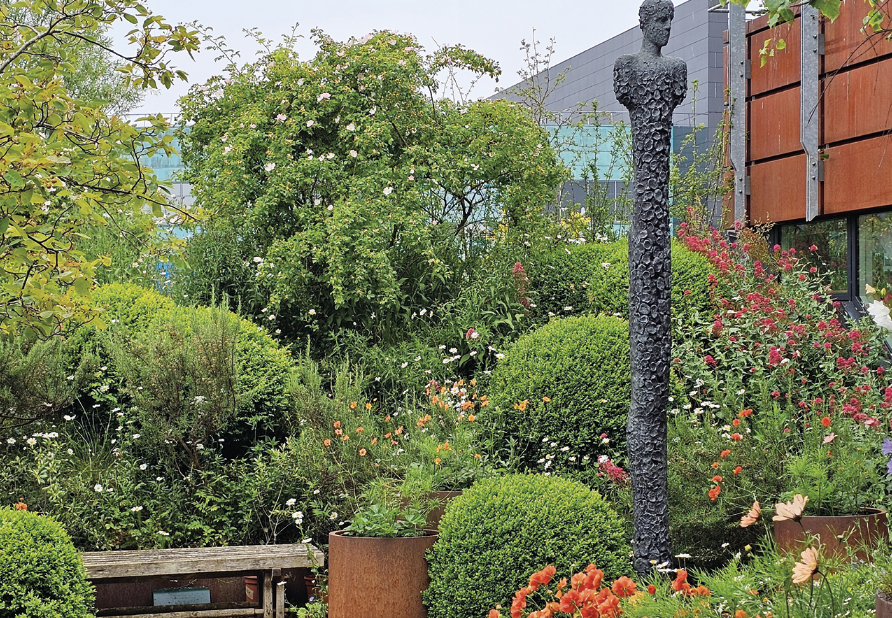
The Maggie’s garden and its striking bronze statue by Niko Widerberg
First published in edition 211 of The Northumbrian, April/May 2026
Behind a busy hospital yet seemingly cut off from the world, Newcastle’s Maggie’s Centre offers support for those facing cancer and a garden designed to soothe and restore, discovers Susie White
For anyone coping with a cancer diagnosis, Maggie’s in Newcastle is a refuge, free to anyone, no appointment or referral necessary. This open welcome is reflected in the place itself. The building designed by Cullinan Studio is innovative, its light-filled rooms colourful and relaxing. It lifts the spirits, and its garden is integral to the calming atmosphere.
Maggie’s was conceived by Maggie Keswick Jencks before she died of cancer in 1995. Her husband Charles Jencks was an architectural historian and landscape designer; among his public artworks, he designed Northumberlandia. Each centre is unique, designed to be hopeful and uplifting with “a view out to trees, birds and sky.”
Maggie’s Newcastle is behind the Freeman Hospital, yet once you enter its sheltered courtyard garden all sense of the city drops away. The garden that wraps around the building was designed by Chelsea Flower Show gold medal winner Sarah Price, who co-designed the gardens at London’s Olympic Park. Her style is rooted in a deep love of wild and natural environments, and is often described as “painterly”. There is a feeling of being embraced, the courtyard hugged by flowering meadows on tall banks which exclude the surrounding buildings and car parks. Nature is visible through the windows, and doors are left open in summer to sunlight and birdsong.
The garden was planted in 2014 and extended in 2024 to a second design by Sarah funded by the National Garden Scheme. This features a woodland area, a contrast to the sun-filled courtyard. An
avenue of fastigiate hornbeams and box-edged beds welcome visitors, and the looseness of the planting signals that this is no ordinary public garden. Greater knapweed and cowslips feed bees and butterflies. Ox-eye daisies weave through native ferns, lady’s mantle, valerian and grasses, taking over from the hellebores of late winter.
The entrance hunkers down between meadows held by high corten steel panels which echo the centre’s glass and corten facade. The meadow banks, cheerfully full of buttercups and white campion, red clover and plantain, disguise the building. Inside, it is full of light with glimpses to the garden beyond. The courtyard draws you in, a feeling of safety and seclusion created by the tiered garden that rises so that you feel held by the plants.
Underfoot is a fine, warm grey gravel, soft to walk on and to look at. The rusty patina of large round corten planters is the perfect balance for orange flowers; ‘Ballerina’ tulips in spring followed by orange geums and Cosmos ‘Apricotta’. Ox-eye daisies splay out beneath a multi-stemmed amelanchier, its coppery new foliage and delicate white flowers followed by little black berries loved by thrushes. A small birch tree in a pot donated in memory of a Maggie’s user is underplanted with Campanula persicifolia, and Dianthus carthusianorum and Lychnis coronaria self seed in the gravel. There’s scent from rosemary bushes and a carpet of creeping thymes in front of a new annex.
Plump balls of box set asymmetrically in the gravel are followed through by further box balls on the steep banks. Scented dog roses cascade above, a contrast in texture and shape, and red valerian studs the greenery with rich pink. A pretty little rose, blush white with a darker pink centre, is an unnamed donation, its open, single-petalled flowers matching the simplicity of the other insect plants. A tall bronze statue by Niko Widerberg is striking without being overwhelming.
Fiona Jones has been part of the team looking after the garden for 12 years, alongside Sue Fraser, Maxine Eaton and Emma O’Neill at various stages, who have devoted much time and care. Currently, Emma and new additions Bronwen Deane-James and Becky Lee care for the garden. “It’s a privilege to look after it and see how much it means to people,” says Fiona. “They find it incredibly soothing. There are semi-private little nooks where visitors can sit on benches and we are often asked what the plants are because people would like to put them in their own garden. We leave seedheads standing over winter for insects and it’s always appreciated, showing how awareness and attitudes have changed.”
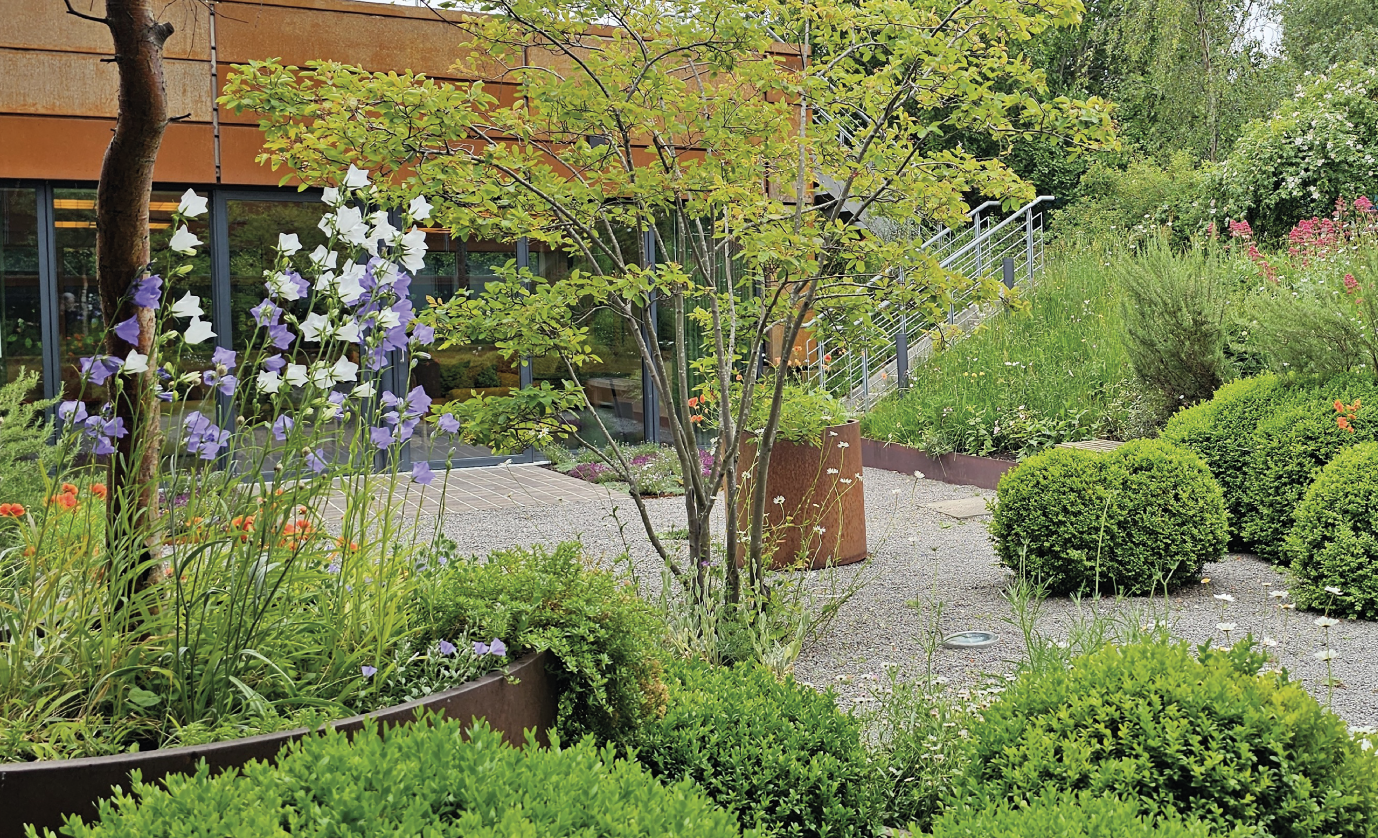
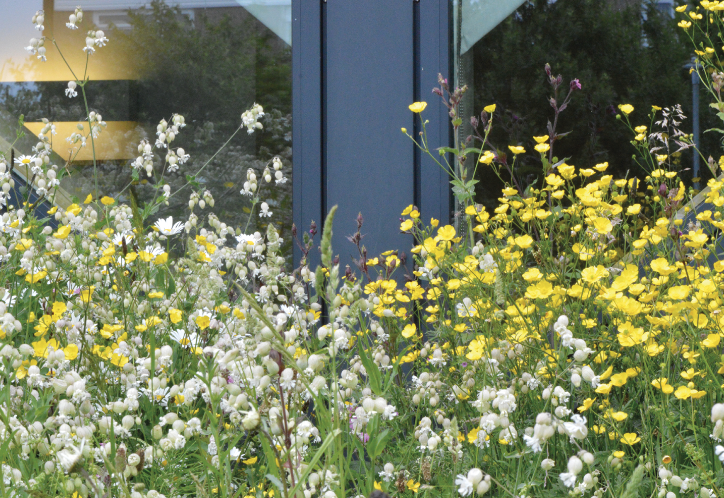
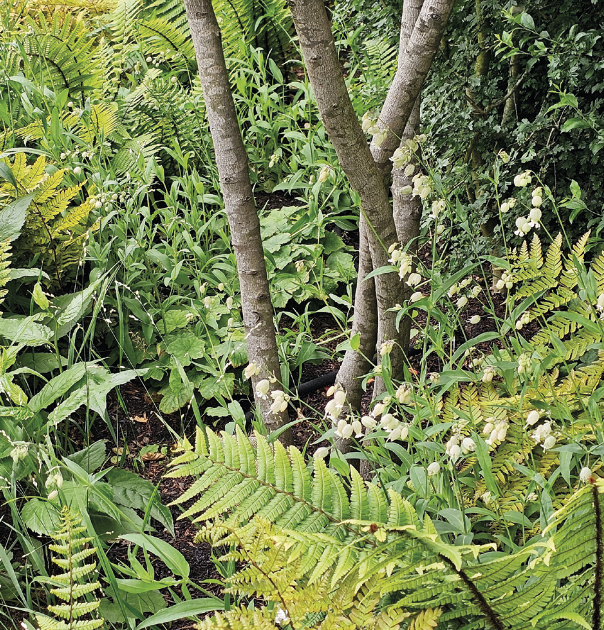
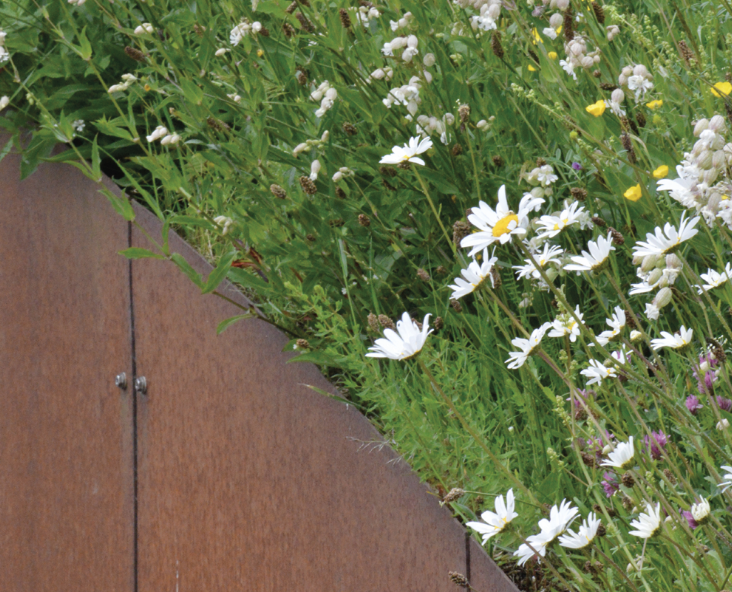
Above: Plump balls of box set asymmetrically in the soft grey gravel; Meadow banks, cheerfully full of buttercups and white campion; Ferns and Silene
fimbriata beneath amelanchiers; Meadows held by corten steel
The meadow needs cutting to prevent it becoming too nutrient-rich, just like the annual cut of any hay meadow. “We cut it in stages because it wouldn’t look good to visitors if we did it all in one go,” explains Fiona. “We try to do it artistically from September onwards, leaving it quite late before strimming it. Because we’re tight for space, much of that goes to the green waste collection, but Bronwen has been proactive in establishing a composting system for the rest of the garden. Compost bins are tucked behind a screen and a chipper was donated for woody material, the chippings used on the woodland path. We’re now trying to create a closed loop system.”
Fiona loves the new woodland area, which she says is cool and soothing on a hot day and a pleasure to work in. Beneath the trees are many shades of green, from arching ferns, fine sprays of wood melick, and white-flowered Silene fimbriata. It’s hard to imagine you’re in a city. The centre even has a planted roof featuring hornbeam, polypodium ferns and a beech hedge.
Some of Sarah’s designs have had to be tweaked for soil conditions. Parts of the avenue are extremely dry so more drought-tolerant plants have been added, such as Dianthus carthusianorum, Echinops ‘Veitch’s Blue’, a few Stipa tenuissima, and Geranium ‘Bill Wallis’. “This little geranium seems to cope with anything and is great for tricky, dry areas with little depth,” says Fiona. “Hopefully, these are all in the spirit and vision of Sarah’s design. As for the hedges, so far we haven’t had blight or box moth, but we are clipping less and we spray with TopBuxus.”
The garden attracts many birds. Goldfinches pick seed from the teasels in winter and oystercatchers call as they fly overhead. “That’s always surprising in such an urban setting,” says Fiona, “but I guess we’re not that far from the sea. I even discovered a hedgehog one year and there were plenty of places for it to nestle in. More than ever, I feel the connection and inter-dependence of nature and people; all of us as part of a worldwide community.”
In 2024, the centre received nearly 16,000 visits from people in need of support ranging from preparing for treatment, help with side effects, support after treatment, benefits advice, and coping with advanced cancer. There is help with managing stress, gentle exercise, nutrition, coping with bereavement, and more. To be able to wander into this beautiful garden and find some peace means a great deal to visitors and to the gardeners who maintain it.
Susie White is a garden and nature writer and a Country Diarist for The Guardian. Her new book, Nature’s Almanac: A Gift for Every Day of the Year is out now, published by Saraband

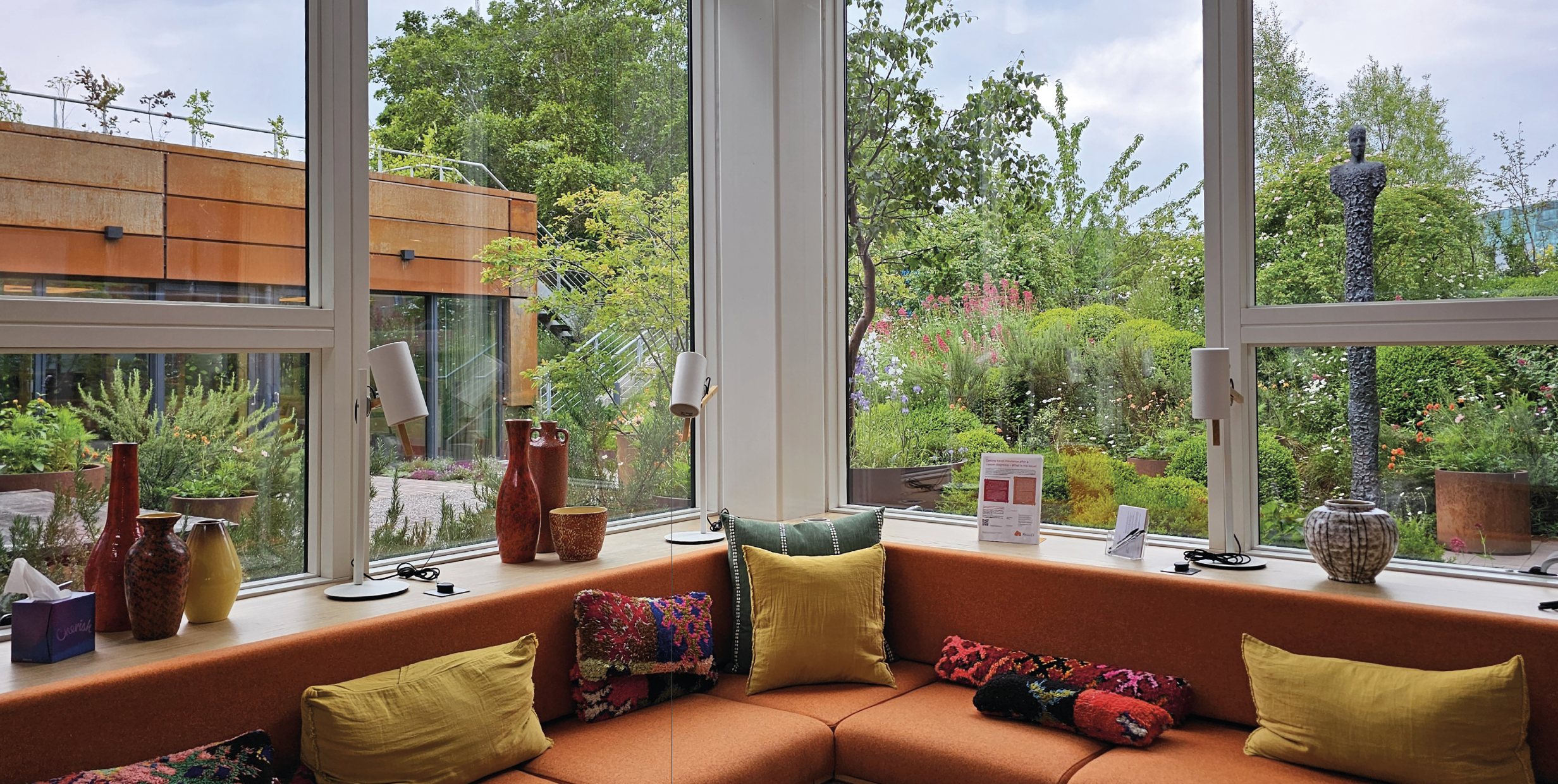
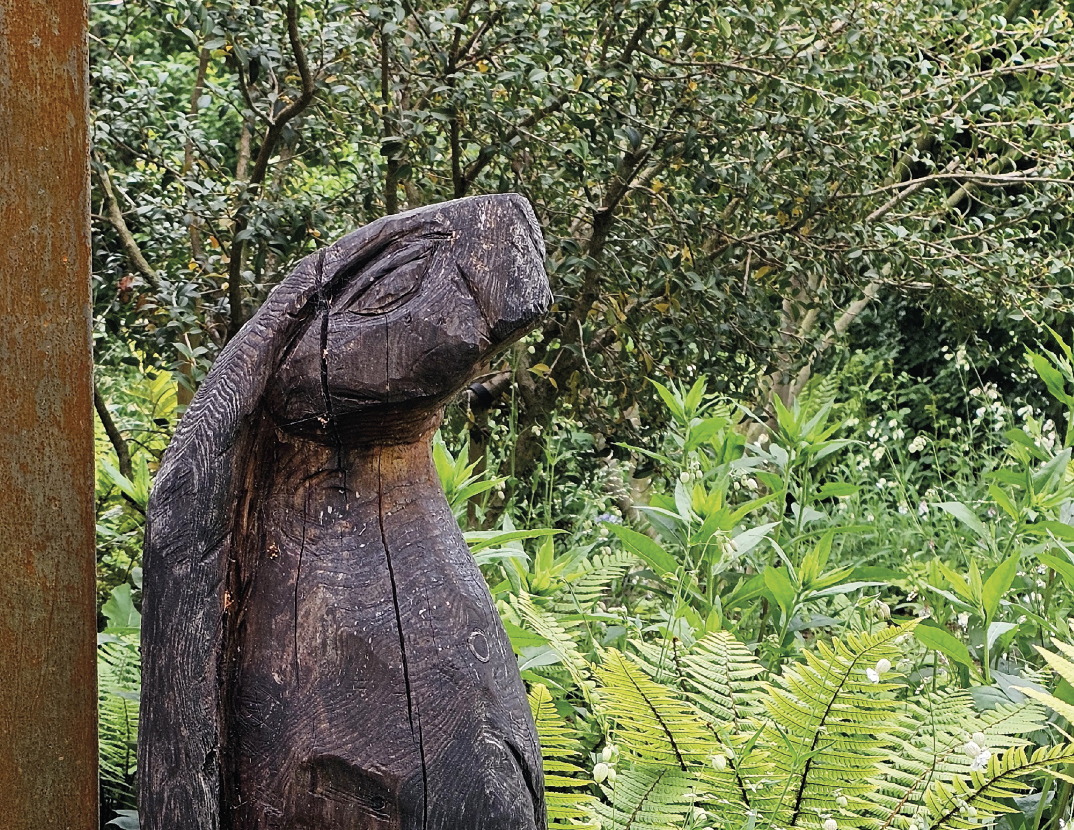
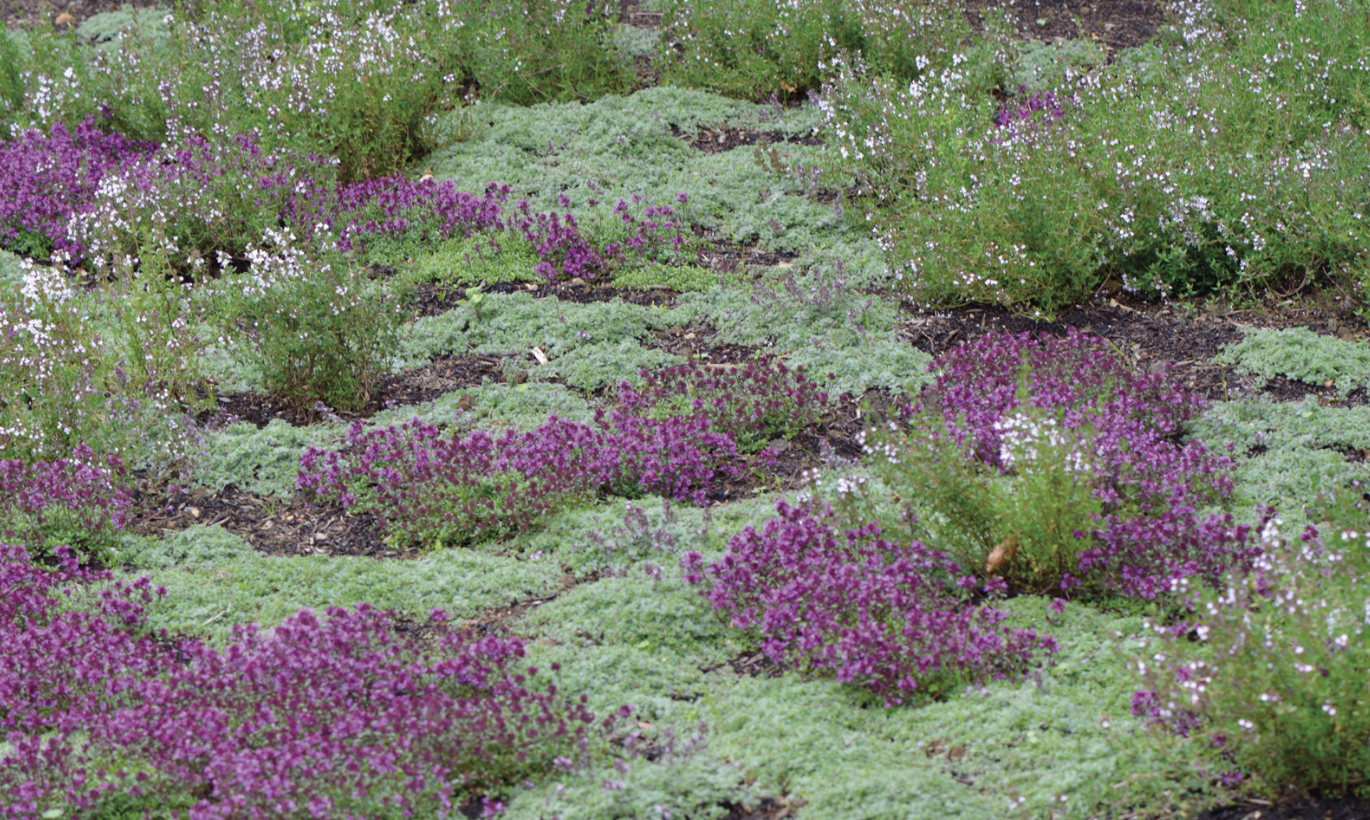
Above: The decorative corten steel facade; The garden from a colourful interior by David Wallace of Abercrombies; Soothing
shades of green in the woodland area; A carpet of creeping thymes