
A man for all seasons
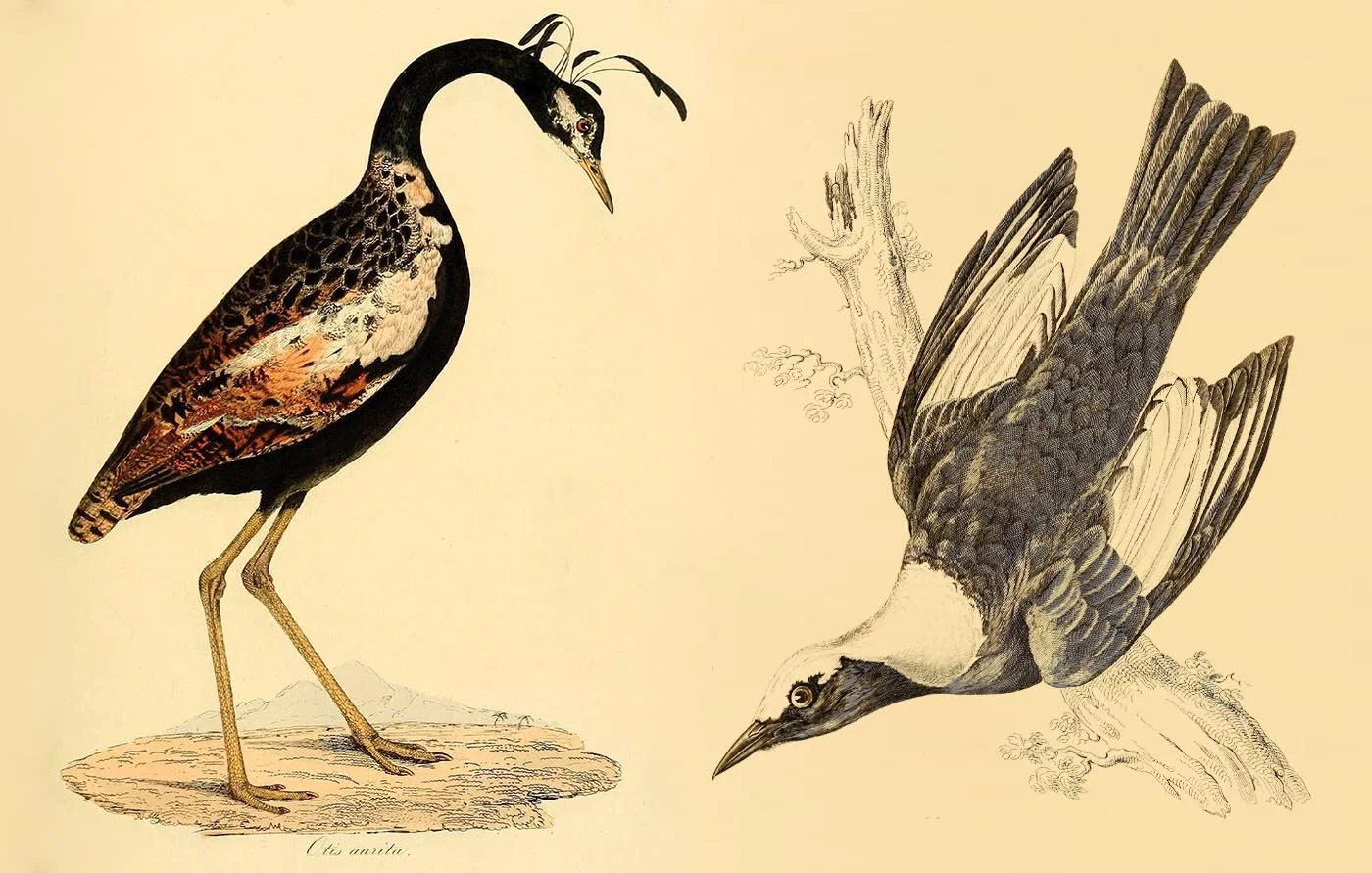
Left: Otis aurita (the lesser florican) from An Illustrated Encyclopedia of Birds.
Right: From Illustrations of British Ornithology.
First published in edition 204 of The Northumbrian, Feb/Mar 2025
Michael Lyons chronicles the life of the great Victorian naturalist and illustrator Prideaux John Selby, of Twizell, Northumberland
The early 19th century saw an explosion of interest in natural history, stimulated in Britain by global exploration and the expansion of its Empire. Charles Darwin’s long sea voyage on HMS Beagle between 1831 and 1836, and his collection and recording of many previously unknown life forms, exemplifies this trend. But there were many other naturalists, mostly working nearer to home busily collecting, studying and cataloguing both familiar and new species. Such a man was Prideaux John Selby of Twizell, near Warenford in north Northumberland, and as an ornithologist, entomologist, arboriculturist, and to a lesser extent an ichthyologist, he was truly a man for all seasons.
Born in Bondgate, Alnwick on July 23, 1788, the eldest son of George Selby of Beal and Twizell and his wife Margaret, he was educated at Durham Grammar School and University College, Oxford, where, as a ‘gentleman commoner’, he “merely attended college without the necessity or intention of preparing for a profession.” He left Oxford without a degree and when he came of age in 1809 Twizell House became his property, his father having died five years previously.
The following year he married Lewis Tabitha, second daughter of Bertram Mitford, the wealthy owner of the Mitford estate near Morpeth, and in due course they were blessed with three daughters – Lewis, Frances and Jane. The marriage was propitious in another way, for his wife’s elder brother, Captain Robert Mitford RN, was later to collaborate regularly with Selby as an artist and engraver. Indeed, it was Mitford who taught Selby the art of etching, he having learned it from another Northumbrian luminary, Thomas Bewick of Cherryburn.
According to his foremost biographer, Christine E Jackson, “Ornithology was the ruling passion of Selby’s early life: as a boy when he studied birds and drew his first pictures; as a young man when he built up his very large collection of British species and purchased skins from abroad; and in his thirties while he wrote the text and drew and etched the birds for his Illustrations of British Ornithology.”
On April 6, 1830, William Darling, father of Grace and keeper of Longstone Lighthouse in the outer Farne Islands, recorded in his journal: “I shot three Egyptian geese and sent a pair to Newcastle Museum, the other to Mr Selby, Tweizle House.” It seems William, himself a keen naturalist and birdwatcher, was one source of many servicing Selby’s seemingly boundless demand for bird carcasses and skins. It may appear incongruous that a man devoted to studying and portraying birds was responsible for the pursuit and downing of so many. But his activities in this respect were undertaken with a purpose; that being to enhance the knowledge and understanding of bird species.
Selby’s consummate achievement, Illustrations of British Ornithology, is a masterpiece of accuracy and detail. He set about compiling it in 1819, unaware that his labours would last the best part of 14 years. Containing 222 plates and 383 etched figures, what distinguished Selby’s work from his contemporaries were his life-size bird illustrations accompanied by careful descriptions.
Nearly all the illustrations were drawn from specimens in his own collection at Twizell. The bird skins he obtained locally and from further afield were prepared and stuffed by his butler, Richard Moffit, who apparently became a very proficient taxidermist as a result of this rather eccentric supplement to his domestic duties.
Illustrations of British Ornithology was published in 1833 in two volumes split into land and water birds. Selby included each bird’s habits and habitats, their different states of plumage, and a physical description of each species’ male, female and juvenile along with their measurements. He supplied many of the common names of British species used by subsequent authors; in fact, he was responsible for establishing more English names of birds than any other 19th century ornithologist. In pursuit of his ruling passion, he built up an impressive collection of stuffed and mounted birds at Twizell, an array that was only fully dispersed after his death in 1867.
Selby was in regular contact with many of the leading lights in natural history across the country, a number of whom were guests at Twizell House. Close to the Great North Road, it was a convenient stopping place for naturalists like the famed French-American John James Audubon; Sir William Jardine, the foremost Scottish practitioner; and Edward Lear, the writer of nonsense poems and lyrics, who provided illustrations for Selby and Jardine’s collaborative endeavours. Of Lear’s paintings of pigeons, Selby wrote:
“I do not think I ever saw feathering so well-depicted.”
Selby’s achievements ranged beyond the scientific, as he was a gentleman artist of considerable skill. He used the taxidermal models prepared by his butler to produce some of his best works, among the most accomplished of which were depictions of ducks and birds of prey, especially owls. However, using such stuffed models was artistically restrictive, and both Selby and his great friend Jardine looked on in wonder as they witnessed first-hand the freer methods of their American friend Audubon, who achieved far greater life and vitality in his drawings of the birds of his native country.
Following his exertions with Illustrations of British Ornithology, by 1834 Selby was ready for a complete change of focus and began to scour his Twizell estate for insects. He and Jardine referred to this pursuit as ‘mothing’, and it included breeding as well as collecting the insects. From moths and caterpillars (lepidoptera), he graduated to other insect genera including beetles (coleoptera), flies, mosquitos and midges (diptera), and bees, wasps, and ants (hymenoptera). As an entomologist, Selby applied the same zest, rigour and methodology as he had demonstrated with birds.
By May 1843 he had a substantial collection of around 900 species, and storage at Twizell became problematic. He even devised new methods to collect insects at night, such as his ingenious ‘bee skep’ or ‘straw hive’. An empty beehive was “well-anointed on the exterior with honey and supported on a forked stake about four feet from the ground, so that the insects can be easily got at and enclosed in the flappers as they alight and settle on it.”
Selby often recruited members of his family on his insect-foraging expeditions, especially his youngest daughter Jane who frequently joined her father on his candlelit nocturnal rounds. He even recruited a young admirer of Jane’s called Thomas Tancred to the cause and he soon became an enthusiastic convert.
Selby’s notebook recording all the insect species he found at Twizell now resides at the Great North Museum: Hancock in Newcastle, and though chiefly remembered as an ornithologist and arboriculturist, he had considerable influence on entomological studies of the mid-19th century.
His Twizell home was a perfect location. HIs friend, the entomologist Leonard Jenyns, thought it, “distinguished for its great variety of fine, healthy-looking forest trees, nearly all, I believe, planted by Selby himself.” Selby was also an innovator, devising a new method of safely moving large trees so that he could lay out his woodland to his preference. The scale of his vision is evident by the fact that in the spring of 1833 he oversaw the planting of 800 evergreens of various kinds. In his book British Foreign Trees published in October 1842, he wrote: “About thirty years ago, an extent of about sixty acres around the mansion at Twizell was planted in one season.” Neither was Selby sentimental about his trees, for he was careful to assess their economic potential for timber. An example of this is his timely foresight related to the rapid expansion of the new railways. With a main line passing within 2 miles of Twizell, he became a supplier of timber for its construction. Another product of his woodland greatly enjoyed by the Selby family was birch wine.
He also took on serious study of fish species inspired largely by his close friend Sir William Jardine, who became an accomplished ichthyologist. Keen anglers, the pair combined this passion with more scientific curiosity. As Selby wrote to his friend, “a work on the British fishes with correct figures of all the species is much wanted”, and this at a time when the life cycles of common fish like eel, trout and salmon were unknown. He provided Jardine with many drawings and paintings he used for his scientific publications on fish species.
Although demonstrating this impressive breadth of curiosity and expertise for these facets of the natural world, it is his contribution to ornithology for which Selby is most famous and particularly for his Illustrations of British Ornithology. As Christine Jackson concludes: “On this work his reputation rests today, and it established his fame and stature as a naturalist with his contemporaries.”