
Northumbrian Greats: Harry Hotspur
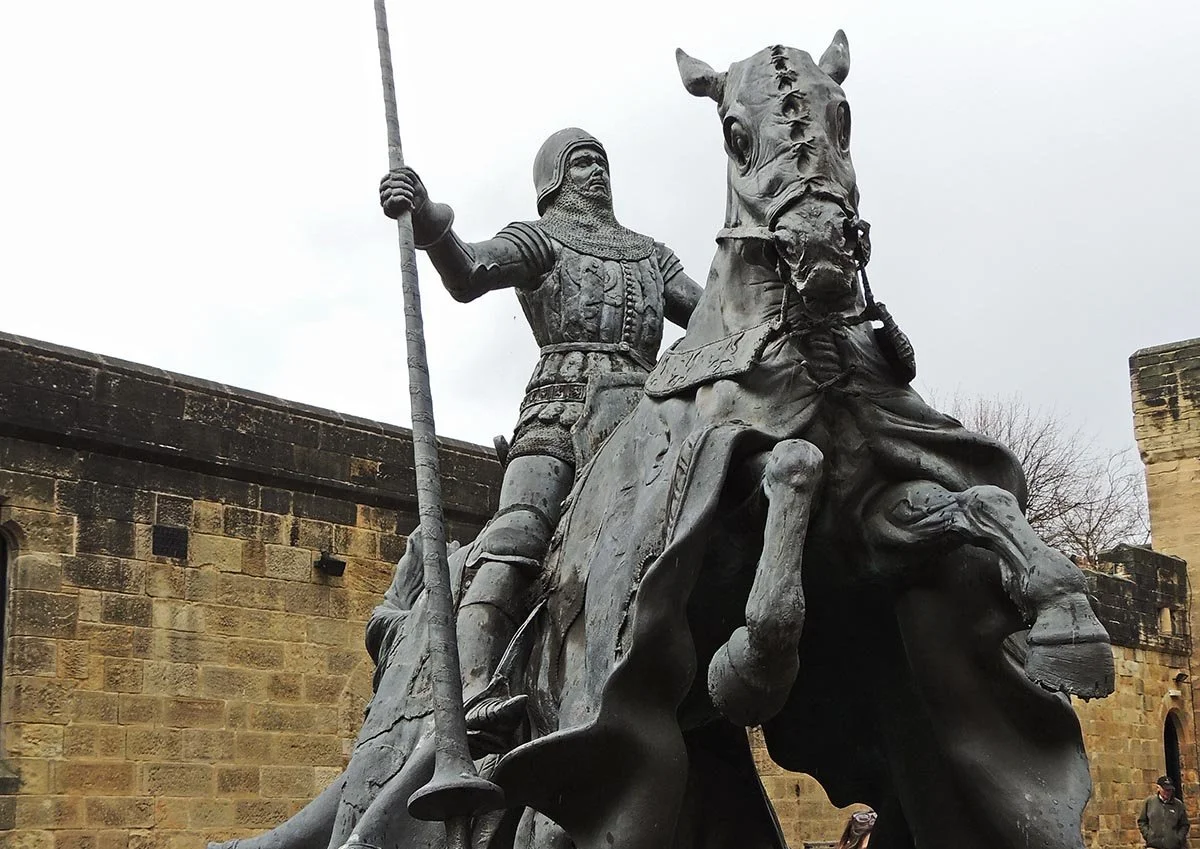
Hotspur’s statue at Alnwick Castle
First published in edition 204 of The Northumbrian, Feb/Mar 2025
In the latest in his series profiling great names through history, Stephen Roberts considers the life and legacy of Henry Percy
Sir Henry Percy (1364-1403) – also known as Hotspur or Harry Hotspur – would die rebelliously in battle facing off against his king, but would also inspire the name of a famous Premiership football team, Tottenham Hotspur, and its famed emblem of the fighting cock realms.
The Percy clan was founded by William de Percy (c.1030-96), who had arrived in England with the Conqueror in 1066. Famous events in our history reverberate through the family story. Richard Percy (c.1170-1244) was one of the barons who forced Magna Carta from King John in June 1215. An earlier Henry Percy (c.1272-1315) assisted Edward I, ‘Hammer of the Scots’, in his subjugation of Scotland and in 1309 purchased the Barony of Alnwick, which has remained the chief seat of the family ever since. The litany of significances continue as Henry’s son defeated and captured the Scottish king, David II, at Neville’s Cross (1346); his grandson fought at Crecy; and a great-grandson, another Henry (1342-1408), Hotspur’s father, was made 1st Earl of Northumberland in 1377.
The eldest son of this 1st Earl and Margaret Neville, Hotspur was born on May 20, 1364, at either Warkworth or Alnwick. He gained his reputation as a soldier fighting against the Scots on the northern border and in France, coming to be dubbed Hotspur, or ‘Haatspore’, for his impetuosity and daring (the name apparently bestowed on him by the Scots who begrudgingly acknowledged his willingness to attack and his impetuousness when doing so). He was knighted by Edward III in April 1377, about a month before his 13th birthday and a couple of months before the death of the king who’d kicked off what became The Hundred Years’ War against the French.
On Edward’s death, the crown passed to his ten-year-old grandson, Richard II. Hotspur, meanwhile, served in Ireland in 1380, in 1383 in Prussia, and as Warden of the East March (the eastern section of the border with Scotland) 1384-85, going on to accompany the young king on a Scottish expedition in 1385. His itinerant life next saw him bolstering the Calais garrison in April 1386, then commanding a naval force the following year, before he was made a Knight of the Garter in 1388, aged 24.
Back home and on familiar duties back on the East March, Hotspur commanded English forces against the Scots at the Battle of Otterburn on August 10, 1388, the Scots commanded by James, 2nd Earl of Douglas (c.1358-1388), who was killed. Despite Douglas’ death, Hotspur was defeated and captured, suffering the indignity of being ransomed.
Despite the setback of Otterburn, Hotspur’s reputation was undimmed. Marrying Elizabeth Mortimer around or after 1390, he led a diplomatic mission to Cyprus (June 1393), then served as Lieutenant of the Duchy of Aquitaine (1394-98), returning in the meantime to Calais in the summer of 1396. He was clearly a ‘go-to’ man as far as Richard II was concerned.
Despite this royal favour, Hotspur and his family supported Henry Bolingbroke’s claim against Richard II in 1399, Hotspur a prime mover behind Richard’s deposition. He then rebelled against Bolingbroke after he became Henry IV. These were fickle times – no wonder Shakespeare has Henry IV say ruefully that: “Uneasy lies the head that wears a crown” (Henry IV, Part II, Act III, Scene I).
Having previously been lavishly rewarded for their service by Richard II, Hotspur and his father were again the recipients of royal favour from the new king, Henry IV. Hotspur had responsibilities both on the East March, watching out for Scottish incursions, and on the Welsh Marches, where there was a rebellion by the Welsh patriot Owain Glyndŵr. Come March 1402, Hotspur was appointed Royal Lieutenant in North Wales, then on September 14, 1402, he combined with his father and George de Dunbar, 10th Earl of Dunbar and March, to defeat another Douglas, Archibald, the 4th Earl (c.1369-1424), at the Battle of Homildon Hill, where Douglas (cousin of the one killed at Otterburn) was taken prisoner. The endgame was approaching, however, and despite all the preferments showered on them by Henry IV, the Percys were about to turn their coats again.
Their list of grievances was long: they felt they had been short-changed despite their sterling service on the Scottish border; Dunbar had been treated better than them; they should have been permitted to hold on to Scottish prisoners for ransom rather than handing them over to the king; Glyndŵr’s rebellion might have been nipped in the bud with a spot of negotiation. Then there was Henry IV’s preferred use of his son, Prince Henry (the future Henry V), in Wales; and the failure to secure the ransom of Hotspur’s brother-in-law, Sir Edmund de Mortimer, who was still held by the Welsh. To say the Percys were seething was the proverbial understatement.
Hotspur was joined in rebellion by his uncle, Sir Thomas, Earl of Worcester, and together they marched on Shrewsbury, where they expected to fight Prince Henry’s army. The prince, however, was joined by the king, whereas Hotspur was let down by his own father, who was slow moving south. Thus, Hotspur faced the full force of the royal armies at a numerical disadvantage. The battle was fierce; the first fought on English soil in which the longbow made hay on both sides.
Hotspur met his end aged 39 at Shrewsbury (July 21, 1403), his rebellion against Henry IV ending in bloody defeat at Hateley Field. Hotspur’s death is variously described: that he was behaving true to his name when he was cut down by person or persons unknown; that he was killed by Prince Henry himself (Shakespeare’s embellishment); or that he fell victim to an arrow in the face, having unwisely lifted his visor for a look at the scene. The latter possibility is intriguing, for Prince Henry, having similarly lifted his visor, almost went the same way, an arrow penetrating his cheek to the right of his nose and lodging itself 6 inches back in the rear wall of his skull. He survived, however, the battle proving to be a decisive royal victory, while in death Hotspur remained true to his reputation, seeking out danger and losing his life in battle at the height of his fame.
His uncle was captured at Shrewsbury and executed soon after, while Hotspur himself was attainted in 1404, his lands and titles forfeit to the crown. The Earl of Northumberland, however, was not for giving up. He allied with Sir Edmund de Mortimer and Glyndŵr against the king (1405) before later joining Archbishop Scrope’s plot. However, he was killed at the Battle of Bramham Moor (February 19, 1408) whereupon his honours were forfeit, though they were later restored to his grandson in 1414.
This tendency for the Percys to get too close to the action was shown again during the 15th century Wars of the Roses, the same grandson falling at the Battle of St Albans (1455) and his son in turn at the bloodbath of Towton (1461).
Hotspur was buried at York Minster, though only after some trial and tribulation. The corpse was brought to the king, who is said to have wept, and the body buried locally until rumours of Hotspur’s survival caused it to be exhumed and posthumously ‘executed’, the head destined for York and the quarters scattered to the four points of the compass, one ending up in Newcastle.
The remains would eventually be given to his widow, who arranged a fitting burial in the minster. His name lives on in Tottenham Hotspur. He had lived in the area and his direct descendants owned lands in the vicinity of the club’s first ground, while Hotspur’s love of cockfighting gave birth to the club’s famous cockerel emblem. Meanwhile, his personality is colourfully portrayed in Shakespeare’s Henry IV, Part I, where he is the courageous, impetuous man of action in contrast to the itinerant Prince Henry (Hal), friend of the drunkard Falstaff. Shakespeare, as he often did, plays fast and loose with historical fact, and has Hotspur and Prince Hal the same age as they engage in single combat at Shrewsbury. In fact, Hotspur was 23 years Henry’s senior, and they almost certainly didn’t come to blows during that battle or at any other time. But it’s a good story, as was his life as a whole.
CHRONOLOGY
1365 - Henry Percy born in either Warkworth or Alnwick (May 20).
1377 - Hotspur knighted and his father Henry Percy becomes 1st Earl of Northumberland.
1384 - Hotspur appointed Warden of the East March.
1388 - The Battle of Otterburn sees Hotspur captured and ransomed.
1399 - Hotspur and the Percy family support Henry Bolingbroke against Richard II.
1402 - The Battle of Homildon Hill and death of Archibald Douglas.
1403 - Death of Henry Percy at the Battle of Shrewsbury (July 21) aged 39.