
Rest in peace
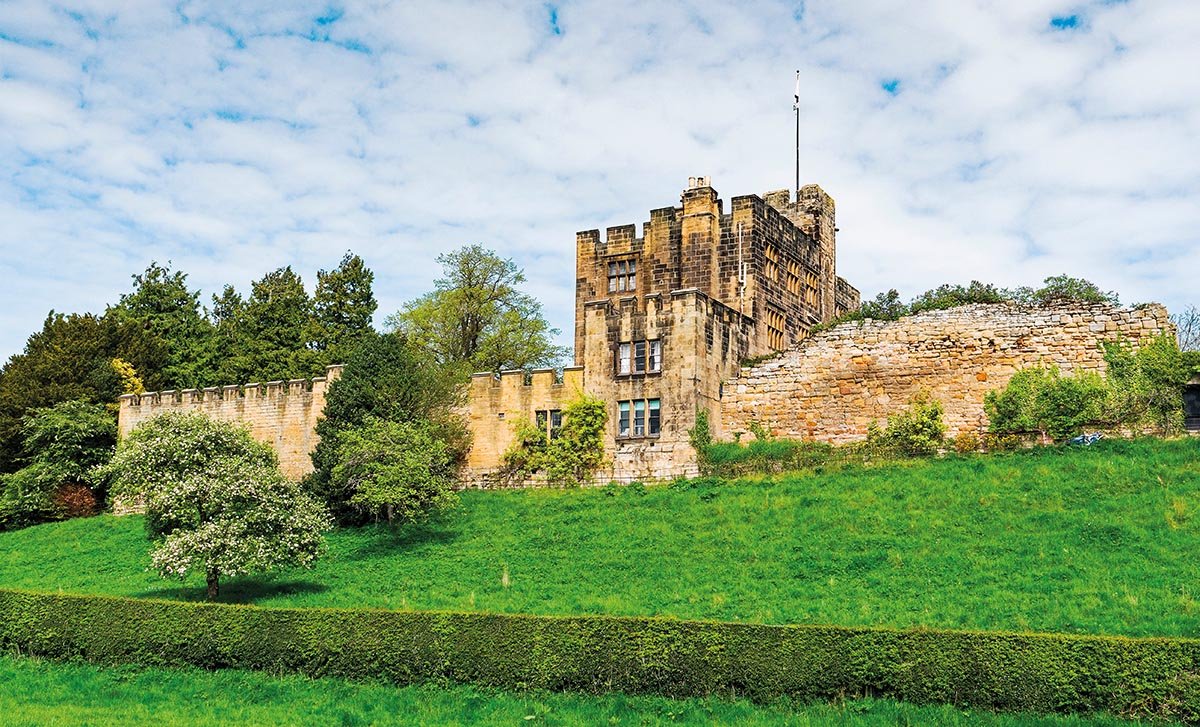
Bothal Castle
First published in edition 205 of The Northumbrian, Apr/Mar 2025
John Grundy explores the little village of Bothal – a hidden gem near Morpeth that he’d actually prefer you not to visit for fear of spoiling it, so just read this instead and leave it in peace
In its early years, Newcastle was a small town surrounded by a host of even smaller villages. Places like Benton, Denton and Kenton spring to mind, or Byker and Heaton. Gosforth was another. There were lots of them and the people in them lived out in the countryside and popped into Newcastle (or ‘town’ as they called it) every now and again to do a bit of shopping, see a bit of life, and visit Auntie whatsit perhaps.
Over the centuries, in its voracious way, Newcastle gradually expanded and devoured the villages in its path, turning them into mere suburbs instead of ancient independent settlements in their own right. It took a long time. Gosforth, where I live, was only subsumed into Newcastle in 1972, but even now we go “into town” as if it was some sort of separate entity where life, the shops (and aunties) are to be found.
Other towns, often founded by the Normans at about the same time as Newcastle, could have developed in the same way, but never did. Morpeth is a good example. It was founded in the 12th century with a Norman baron of its own, a castle, and a substantial church. It soon became a borough with a corporation, a market and an important bridging point over the River Wansbeck, but it never leapt onto the expansion bandwagon, and even today it is ringed by distinct, separate villages like Mitford, Pegswood, Hepscott, Longhirst – and Bothal.
I mention Bothal specifically because the other day my friend Jane – who has always lived in Newcastle but loves Northumberland and has close connections to Morpeth – mentioned in our WhatsApp group that she had been taken to Bothal by her goddaughter and she was astounded that she had neither seen nor heard of it before.
You’ll have guessed from this that it is a nice place. It’s not far from “town,” a couple of miles east of Morpeth (roughly the same distance as the middle of Gosforth is from the centre of Newcastle), and it lies at the bottom of a steep-sided valley on the north bank of the River Wansbeck. The riverbanks at this point are deeply wooded and the single road that passes through it goes nowhere else except back up to the main road between Morpeth and Ashington. The trees and the valley and the absence of anywhere else on the road mean that it is almost completely invisible from outside (hence my friend Jane’s lack of knowledge of it).
To be honest, I feel uncomfortable even writing about it. I get cross when other people do this – journalists or travel writers who produce articles about little-known or rarely visited treasures on the edge of the Mediterranean where you can sun yourself in perfect peace and enjoy traditional food on the terrace of a sublime olde-worlde but deserted tavern. Even as you’re reading about such places you can sense a thousand households searching the internet for ways to get there, guaranteeing it will never be peaceful again.
Well, let me warn you before you go that there are no taverns of any sort in Bothal, and no cafés or gift shoppes. There used to be a public toilet, I think, but even that seems to have gone now. In fact, there’s not much to do other than enjoy the peace, admire the church and the castle, and stroll down to the stepping stones across the river. If those things aren’t your bag, leave it in peace.
Having said that, it is a very nice place. It’s a conservation area – a little cluster of an unspoilt estate cottages, a rather splendid church, and an extremely splendid but little-known castle nestled among bright fields and beautiful trees.
The cottages along the road were built in 1885 and the village hall added 10 years later. They are all extremely pretty. Most of the estate villages in Northumberland are attractive, but in the main they are a bit plainer than Bothal. Many of them were built a generation or so earlier, between the 1830s and the 1850s, and their cottages are finely built but in the main plain: well-proportioned but quite severe.
The cottages in Bothal are not plain at all – they are full-on Victorian in a light and playful style. They have richly carved bargeboards on their porches and on their pointy roofs, and their windows have unusually rich decorative patterns. The gardens are sweet and the garden walls splendidly carved. I don’t know who designed them, but they stand rather alone among the county’s estate cottages.
When I was there the other day, I noticed rather a remarkable feature in one of the gardens. There was a massive, complete tree trunk lying in the grass. I think it might have been a redwood tree, about 20ft-30ft long, substantial in girth and treated as a garden in its own right with assorted plants growing out of it. It was like a nursery log in fact, such as you see lying on the floor of wild forests. I was tickled pink by it.
The estate that was responsible for the cottages was, and still is, based on the castle, whose history is long, deep and a bit too complicated for me to fully grasp (being a bear of very little brain). I’ll mention some of the names involved and a couple of significant events, but I have neither the intention nor the ability to explain the relationships between each of the families which have owned it.
So here goes … 1] It was originally owned by the Balliol family (who were given the land in 1095 by William Rufus, who was William the Conqueror’s son). 2] The Balliols passed it on (by marriage) to their neighbours, the Bertrams, who had another castle at nearby Mitford (apparently you can’t have too many castles). The Bertrams stayed put at Bothal for ages and in about 1343 they applied for licence to crennelate. Crennelations are battlements, so effectively they built the castle you can see today. It was (and is) a sort of combined gatehouse and keep of a sort that seems to have been fashionable at the time. Dunstanburgh Castle, which was rebuilt then, is the most famous example in this area.
In 1410 the Bertams experienced a bit of a family feud. This is an unpleasantness of the sort that occurs in many families, sadly, but it isn’t common for one member of the family to beseige his younger brother’s castle in order to get control of it. That, however, is what happened to Robert Bertram. The siege only lasted four days and failed, but a little while later the castle passed by marriage into the possession of 3] the Ogle family, which owned more stuff in Northumberland than you could shake a stick at. By 1576 Bothal was described as having the gatehouse/keep I’ve just mentioned, a great hall, a parlour, seven bedrooms, a gallery, a pantry, a larder, kitchen, bakehouse, brewhouse etc, etc – everything the castle owner needed, it seems. According to the Booke of Bothoole there were: “faire gardens and orchettss were growed all kinds of hearbes and flores and fine apples, plumbes of all kindes, peeres, damsels and nuttes…”
4] After that my brain starts to hurt. The Cavendish family moved in and over the centuries they morphed into the Cavendish-Bentincks who became the dukes of Newcastle before finally turning into, 5] the dukes of Portland, who own it still I think, unless I’m wrong.
All those names come from Notts and Derby. The families owned, lived in, or were associated with extraordinary houses like Chatsworth, Bolsover Castle, and Wellbeck Abbey, and it has been a long time since people with those names have lived in Bothal, but they did own and have continued to own pretty vast estates in our neck of the woods. In 1828 the 4th Duke of Portland installed a man called William Sample into the castle. His family are there still, along with the duke’s Welbeck Estate office. It’s private and I’ve never been in, but there are terrific glimpses of it from all around the place. I found myself feeling jealous and wondering why nobody had ever installed me in a castle. I feel I could play the part.
And then there’s the church. According to a notice on the door, it is currently in a vacancy, which I assume means that there is no vicar at the moment. I wasn’t able to go in, which is sad, but there are compensations, as the building is splendid from the outside – a rich mixture of 13th and 14th century details – and is set in the middle of a wonderfully atmospheric churchyard, which is wild and overgrown. A positive haven for wildlife with ancient trees and fine gravestones wrapped in unkempt vegetation, it abounds in trailing vines and the song and constant rustling of birds among the leaves.
So, there you are – Bothal. Not much to do, but what’s there is wonderful to look at, listen to and smell. Just don’t go too often or you might spoil it.