
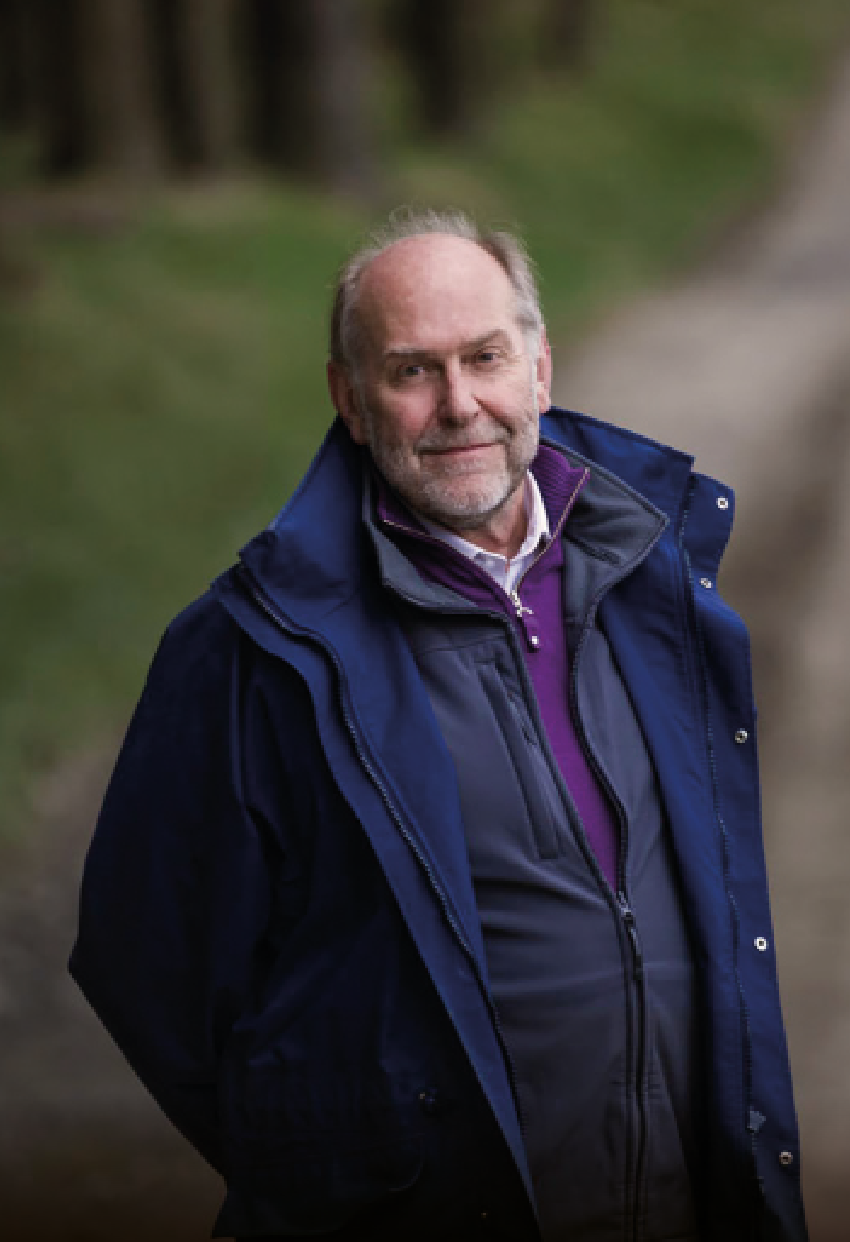
Alastair Moffatt
First published in edition 211 of The Northumbrian, April/May 2026
The North Sea has carried traders, raiders and fishermen for thousands of years – and it is still reshaping the land beside it. Pior to his appearance at Hexham Book Festival, this extract from Alistair Moffat’s new book tracing its coast explores one of our region’s most sacred sites
On a windless May morning the land lay still under an open sky, the sun brilliant and warming. I was driving down country roads made into glorious avenues of white blossom on hawthorn hedges, the colour of strawberries and cream from the occasional crab apple, egg-yolk yellow gorse, and everywhere the lustrous green of new leaves on birches and beeches. Where a night wind had blown, there were occasional drifts of blossom snow as the road swung around a corner.
I’d left very early to drive to the coast along a quiet B road that would take me up to the breast of a ridge, a vantage point where I had often stopped. To the east are revealed long views of the North Sea shore, where the patchwork of farmland – technicolour rapeseed and fields of pale-green barley – meets the blue vastness where the land undulates gently to its edges.
But a kilometre or so before I planned to stop and get out of the car to look at the sea and the coast, a haar loomed up. I disappeared into its grey shroud, visibility quickly shrinking to less than a hundred metres, the air suddenly cold. Known in Scotland by the Dutch word, haar, and called a sea-fret in England, it is a weather phenomenon characteristic of the North Sea. Haar occurs most frequently on its northern coasts in spring and early summer. When warm and moist air passes over the cold sea, it causes condensation to form, and easterlies blow the damp mist towards the land. It rarely penetrates far in daytime. In spring the land warms more quickly than the sea, and higher temperatures keep the haar at bay by dissolving it as the sun climbs, but at night, when the air is colder, the mist can move far inland.
~
As I drove into the heart of Gateshead the haar billowed above the tall buildings, sometimes hiding them, sometimes suddenly revealing them. But I could read the road signs for Jarrow and others told me that I was close to my destination: Bede Industrial Estate, Bede Metro station and the Bede Motor Company. They were surprising examples of the enduring memory of a very great man who lived on the shores of the North Sea and made an indelible mark on history and identity. I wanted to visit St Paul’s Church and the site of the early medieval monastery where Bede lived almost his whole life. There he wrote about sixty works of scholarship, much of it biblical commentary, some of it poetry, history and science. But immensely learned and prolific though he was, Bede rarely left Jarrow, except perhaps to go south to York and north to the Holy Island of Lindisfarne. His was the life of the mind and his world the library he constantly consulted. Bede’s achievements were towering, and his work dominated the intellectual life of Europe for four centuries. And he was fascinated by the nature of the North Sea.
Despite their immediate surroundings and wider context, certain locations can doggedly retain a powerful sense of place, a unique genius loci, places of spirits long fled. Almost perfectly preserved, the chancel of St Paul’s is the same little church where Bede prayed and sang every day. It was where, as a thirteen-year-old boy, he and his mentor Abbot Ceolfrith went together and kneeled to praise God, all of the other brothers having died in a devastating visitation of the plague by the end of 686. It was where divine office was observed every three hours and where at least one mass a day was said and sung.
The western end of St Paul’s is much younger, erected in 1866 on the site of the seventh century basilica and its successor churches. The Victorian building is bright, welcoming, with a gift shop in one corner and Fenwick Lawson’s stunning 1983 wooden sculpture, the Risen Ascended Christ, suspended from the roof of the nave. Perhaps not surprisingly, visitors seemed to prefer to spend their time there and not in the plain seventh-century chancel. I sat for a long time in the old church – not in prayer, for I am no Christian – but much moved that I could be exactly where Bede once was, look at the solid stone walls he saw every day of his life at the monastery. Such moments aren’t mysterious or even spiritual, at least not for me. They are miraculous.
~
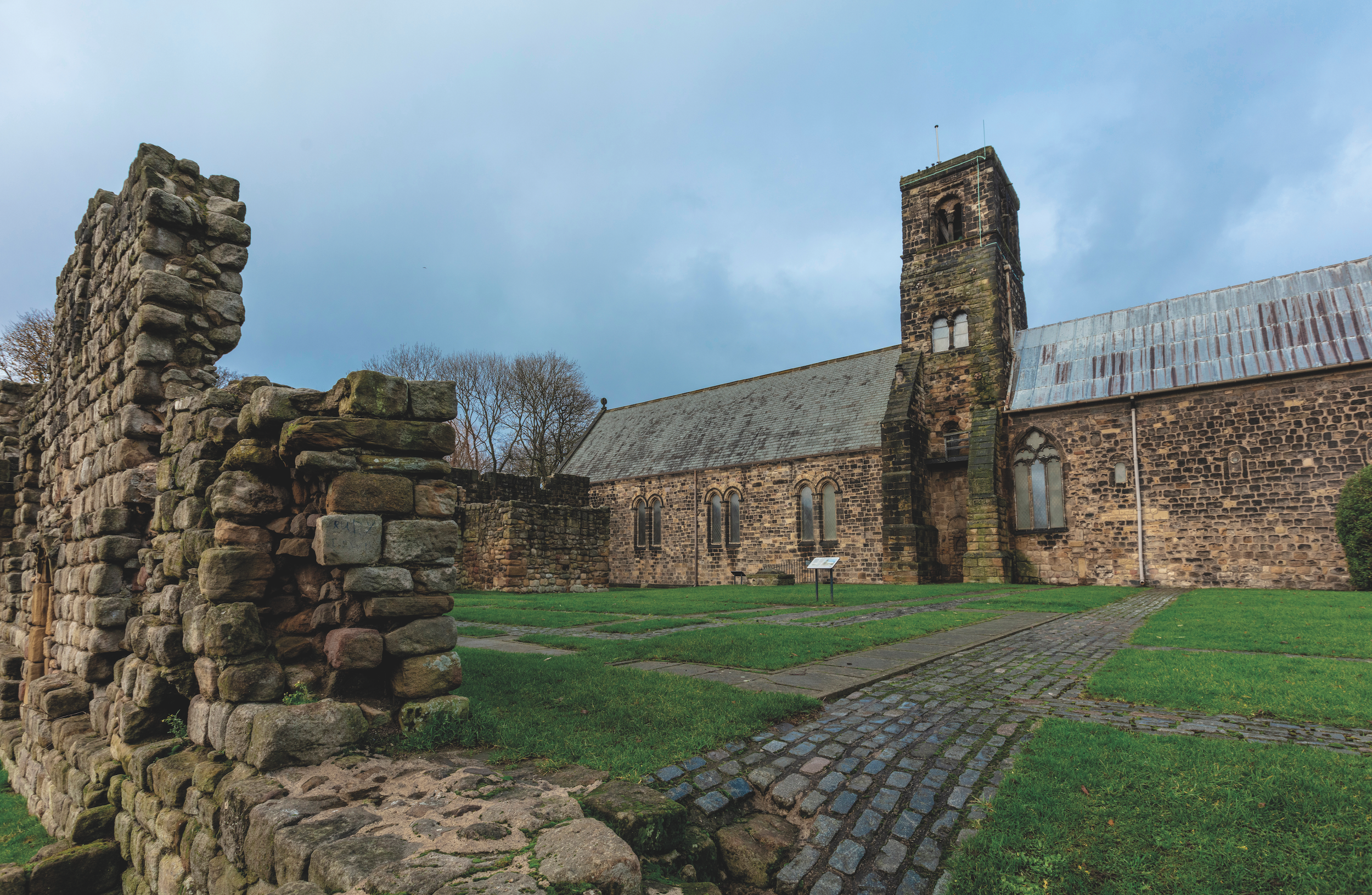
St Paul’s, Jarrow
Outside St Paul’s the twenty-first century is utterly dominant. Immensely tall pylons that carry power lines from across the River Tyne tower over the church. Traffic thrums along a very busy road only a few metres from its walls. Containers are piled up alongside rows of cars for export at the Port of Tyne only 200 metres away and factories and warehouses crowd around. In the midst of all this, the little church has miraculously survived for more than thirteen centuries. Perhaps there are spirits swirling around it. Perhaps the brilliance of Bede, the sanctity of Ceolfrith, Cuthbert and others have cast an invisible protective shield over St Paul’s, an island of peace and contemplation in the racket and hubbub of modern life.
Outside Bede’s church the haar had at last burned off. To the south of St Paul’s stand the substantial ruins of the later medieval monastery founded from Durham Cathedral in the eleventh century. Under its walls and archways lies the complex of buildings the great scholar knew so well. When Abbot Ceolfrith came to Jarrow with ten monks and twelve novices to found the monastery in 681, when Bede was only eight years old, they chose the site carefully, setting the church and the monastic buildings on the banks of the River Don, a tributary of the nearby Tyne. The landscape Ceolfrith and his followers saw in the late seventh century was very different. Now covered by the quays and warehouses of the Port of Tyne, Jarrow Slake was a wide, tidal expanse of mudflats close to the monastery, and the Don meandered along its southern fringes. The Anglian name for Jarrow was Gyrwe (pronounced ‘Jeer-way’) and it meant the ‘Place of the Marsh-Dwellers’.
It is clearly cognate to the Fenland kindreds of the North and South Gyrwa. When the port was built up after the Second World War the little river was canalised and the mudflats drained.
In 674 Ecgfrith, king of Northumbria and frustrated husband of Etheldreda, had gifted land near the mouth of the River Wear for the building of the monastery of St Peter. Its abbot was Benedict Biscop, a determined, energetic, innovative and apparently wealthy churchman. Born into a noble Northumbrian family, he decided that St Peter’s would be different from the humble timber-and-thatch buildings of other contemporary monasteries (which Bede later described as built in more Scottorum, in the manner of the Irish). Biscop’s church would be built in more Romanum, in the Roman fashion, meaning that it would be a stone structure. The abbot crossed to Europe to recruit masons who had the necessary skills, and also glaziers to make stained-glass windows, something not previously seen in Britain.
This was not only a well-organised extravagance, it was also a political statement. From his trips to Rome and from his Bible study, Biscop was making a series of conscious links. His king, Ecgfrith, claimed imperium, according to Bede’s later assessment – that is, authority over all the Anglo-Saxon kingdoms of England as their Bretwalda, their Britain-Ruler. And so his new church would make those links with the glories of the Roman Empire manifest and much stronger, Ecgfrith’s legitimacy was further underpinned by a biblical comparison.
The Angles, Saxons, Jutes and others had been Christian converts for a short time, fifty years or so, and it was only in the seventh century that their kings had finally overcome the native British, confining their power to the west, to Devon, Cornwall and Wales.
By building the new church with the help of foreign masons and glaziers, Biscop was inviting comparisons with Solomon. For the construction of the temple in Jerusalem the great king had imported the skills needed from beyond his realm, from gentiles. And more than that, the claims of the incoming Israelites to Judaea and the surrounding territories were justified because they were God’s chosen people – and to give praise and thanks to their God Solomon had built a temple. And so did Benedict Biscop with the help of King Ecgfrith. The Angles and Saxons had come to dominate England, incomers like the Israelites to the promised land, and they needed to give thanks to God for making them his chosen people.
Building in the Roman manner at Jarrow was also made much easier by the efforts of the Roman army. Nearby, in what is now South Shields, stood the large depot fort of Arbeia, and across the Tyne was the greatest Roman monument of all, Hadrian’s Wall, and its terminal fort at Segedunum in the middle of Wallsend. Already cut-and-dressed stone was almost certainly robbed out of these huge complexes to make the job of Biscop’s foreign masons much easier.
There is, of course, no direct written evidence to support this thesis of a link between the children of Israel and the Anglo-Saxon kings of the seventh and eighth centuries. Except for one defining document. When Bede sat down to write his great masterpiece, The Ecclesiastical History of the English People, he intended to produce an account of how the chosen people came to rule over England, and how their churchmen honoured God in several ways. The idea of the twin monasteries of St Peter and St Paul probably grew in Benedict Biscop’s mind. He had visited Rome six times and prayed at the tombs of the apostles Peter and Paul, the founders of the Christian Church. The twin monasteries, dedicated to the great saints, were perhaps an attempt to extend the frontiers of the Kingdom of God from Rome to faraway Northumbria.
Biscop’s energy and determination are striking. A journey from the shores of the North Sea to the Continent and then overland to Rome was long, arduous and potentially dangerous, especially when the abbot brought back objects like sacred paintings and jewelled reliquaries. But perhaps his most valuable baggage on the return journey would not have interested brigands or thieves. Benedict brought back many books. And when Abbot Ceolfrith later visited Rome, he did the same. The library of the twin monasteries grew vast for the times, with around 300 books on its shelves. It was without doubt the communities’ most enduringly valuable possession, and it was also a matter of great good fortune, or perhaps an act of divine providence, that a great scholar – Bede – emerged who could use the library to create an extraordinary cultural legacy.
Scholars believe that Bede consulted at least 200 of the 300 or so books in the libraries of the twin monasteries (St Paul’s was only eleven kilometres from St Peter’s) in his research for all that he wrote, and he knew intimately what knowledge each of them contained.
Compared to scrolls, codices were easy to rest on a table, either laid flat or at angle on a reading stand, and that made note taking (with a metal stylus and wax tablets) much more convenient. In St Paul’s Church I bought a postcard with an enlightening quote on it from the great scholar: ‘I am my own secretary; I dictate, I compose, I copy all myself.’ This is, I believe, revealing. We are nowadays surrounded by vast reservoirs of knowledge held in media of all sorts, whereas Bede had a library of only 300 books. The quote suggests that he owned what he read, knew his sources intimately, probably held a great deal of information in his head. Copying was the sole means of publication and it is also a reliable means of internalising information, and from that store a great stimulus to making connections and seeing relationships between different writers and their ideas.
Benedict Biscop’s ambition to build a Kingdom of God in Northumbria extended beyond the stone churches and walls of monasteries. The Word of God would be remade on the shores of the North Sea. Under Abbot Ceolfrith, three complete single-volume (or single-codex) Bibles were copied, the earliest surviving versions in Latin. It was an immense and enormously expensive labour. Each Bible needed 1,550 calfskins, a huge investment from an agrarian economy that measured its wealth in livestock, and especially cattle. Many skins must have been donated. Known as the Codex Amiatinus, only one of these Bibles has survived. It was taken to Italy in 716 as a gift to Pope Gregory II, and it eventually found its way to the Abbazia di San Salvatore at the foot of Monte Amiata in Tuscany. It can now be seen in all its vibrant glory in the Medici Library in Florence. There can be little doubt that, as the twin monasteries’ greatest scholar, Bede was heavily involved in the planning and perhaps part of the execution of this great project, perhaps the most impressive product made in the new northern Kingdom of God.
Beyond the library, Bede appears to have spent some of his time observing the natural world. From classical authors like Pliny and Isidore of Seville, he knew that the world was a globe in a cosmos of stars and planets (although he did also think that the solar system revolved around the earth). When he looked at the variations in the length of the shadow cast by a sundial and understood that the length of daylight varied according to latitude, that was further confirmation that the earth was round.
By the time I’d left St Paul’s the spring sunshine had returned, and I walked along a path that threaded through trees down to the banks of the canalised River Don. It was low tide, and on the steep-sided banks I could clearly see the high-water mark. The fall was substantial, perhaps five metres. When I later looked at the Port of Tyne Tide Tables for 2024 I saw that my guess was about right.
Thirteen centuries before Maritime House at Tyne Dock issued its annual tables, Bede completed the first set ever to be calculated.
Bede’s was a modern intellect, his thinking based on evidence, sources he could verify and also observation. Few dragons flew across his pages. He has often been hailed as the ‘Father of British History’, and the way in which he tidied up dating and got most things in the correct sequence is testament to that claim. But most striking is the fact that his achievements changed the world not by force but by the power of words, research and clear argument. Bede was the first in Britain to show that his quill pen was not only mightier than the sword but also that he could take a central role in the development of European culture from a monastery built on the windy shores of the North Sea, a long way from Rome, Greece or Constantinople and the great intellectual glories of early Islam. And more, he did this as his own secretary and copyist, often working alone. That was what drew me to Jarrow, to Bede’s story, an immense admiration for a mighty intellect, a dogged enquirer and a great writer. It was a privilege to sit in the place where he prayed and said mass and to be able to hear his voice echo across thirteen centuries in all that
he wrote.
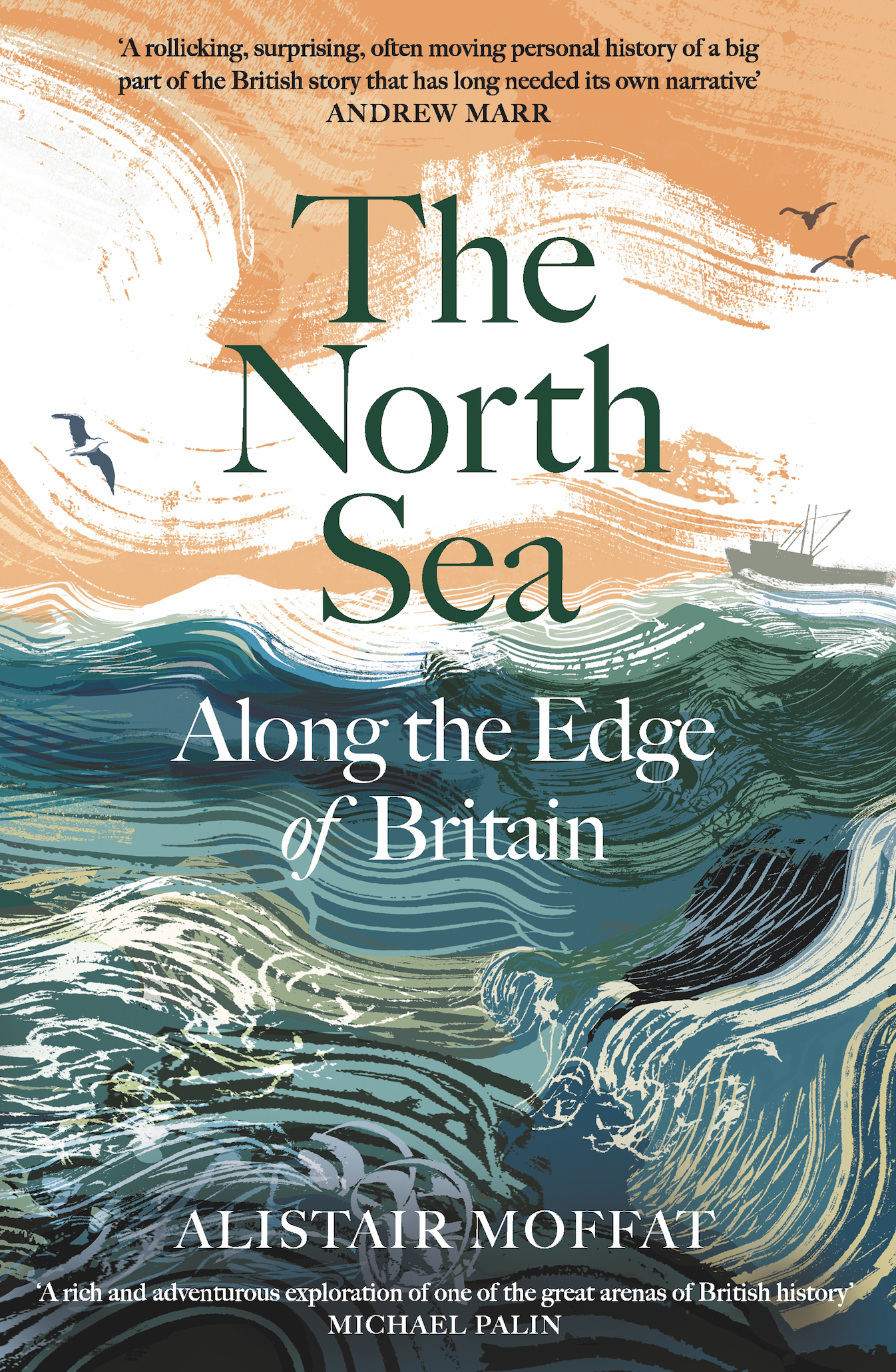
THE NORTH SEA by
Alistair Moffatt
For centuries the North Sea has shaped the story of Britain. It has been a highway for traders and invaders, a source of wealth and danger, and a restless force constantly remaking the coastline itself.
In his new book The North Sea, historian and award-winning writer Alistair Moffat journeys along more than 800 miles of Britain’s eastern edge, tracing the deep history of the sea that helped define these islands and the people who live beside it.
Along the way he explores a landscape where geology, migration and industry collide. The North Sea has seen Roman fleets, Saxon settlers and Viking raiders cross its waters, while along its shores stand traces of older worlds: Pictish strongholds, Orcadian stone circles and remote island monasteries battered by wind and salt. Over the centuries it has supported booming industries from fishing fleets and whaling ships to oil platforms and offshore wind farms while also bringing catastrophe, most famously in the devastating storm surge of 1953 that flooded vast areas of Britain’s east coast.
Yet the North Sea’s story is not only about conflict or commerce. It is also about culture: the seaside towns that have grown up along its shores, the sailors and fishermen who have learnt over centuries to read its moods, and the long scientific effort to understand and predict its weather. It is a story of communities shaped by the sea’s generosity and its dangers.
Today, as rising waters reshape the coastline once again, the North Sea remains a powerful reminder that change geological, cultural and political has always defined this place.
In The North Sea, published by Canongate, Alistair Moffat captures the drama, history and enduring pull of the sea that lies at the heart of Britain’s past and future, travelling its entire length, including the rugged stretch of coast that defines the North East of England and its rich maritime, Christian, and social heritage.