
First published in edition 212 of The Northumbrian, June/July 2026
Stephen Roberts profiles Tom Graveney, the gentlemanly Northumbrian-born cricketer whose dazzling talent and attacking instincts brought both acclaim and controversy in an age of defensive play
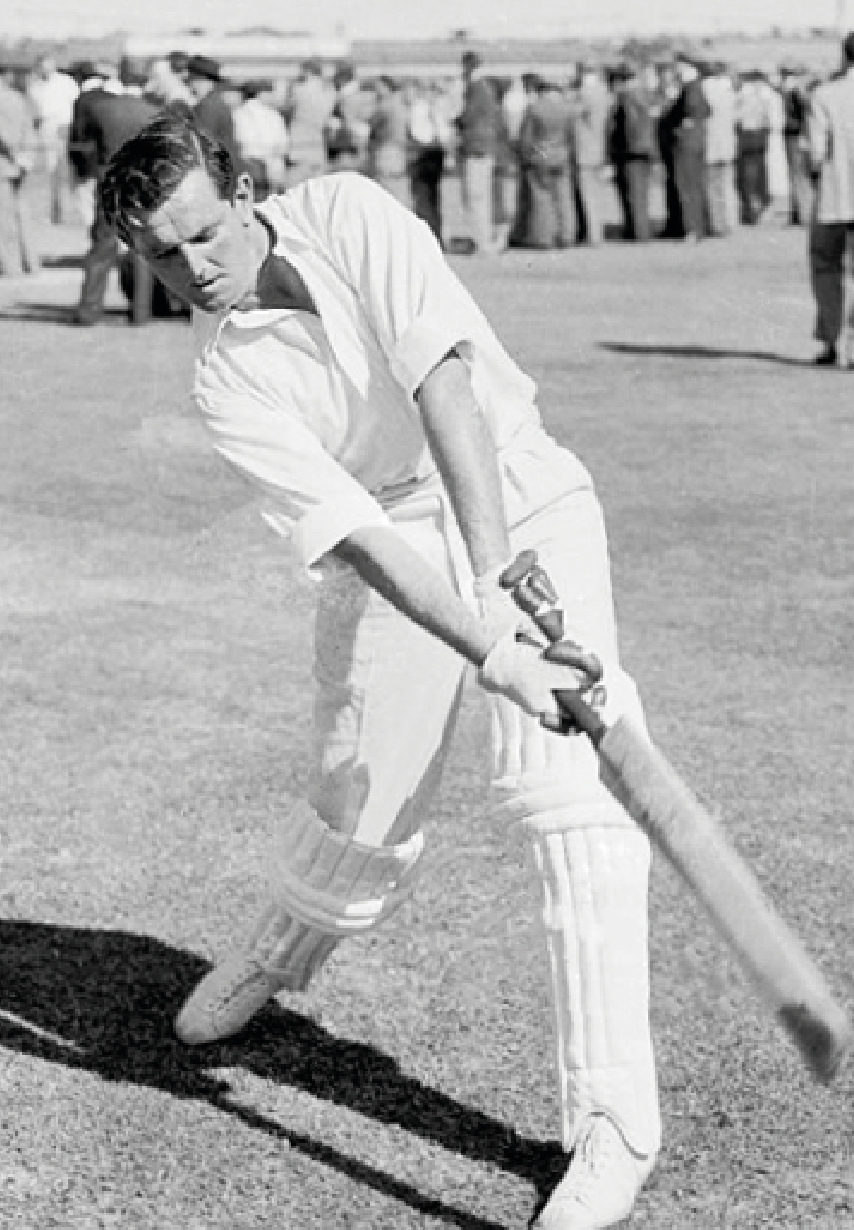
Nicknamed ‘Long Tom’, the straight-talking yet gentlemanly and self-deprecating Tom Graveney (1927-2015) would become one of England’s most elegant if at times controversial cricketers, and go on to enjoy a long career as a respected BBC TV commentator and analyst, and chair of the MCC.
In all, he played 79 Test matches for England between 1951 and 1969, scoring 4,882 runs at an average of 44.38. Yet despite these figures, he was often out of favour with selectors who preferred a rather different style of play some have since condemned as ‘dour’.
Graveney scored 47,793 first-class runs (a figure bettered by only eight others), making 122 centuries, and is the only player to have scored more than 10,000 runs for two counties. He was described by The Daily Telegraph as “the greatest, as well as the most elegant and graceful, professional batsman to emerge in Britain in the years after the Second World War”, yet, as mentioned, his England career was at times more out than in – some might say because his face didn’t quite fit.
Born in June 1927 in Riding Mill near Hexham, a quiet village of church, pub, railway station and, appropriately, local cricket club, Tom was one of five children born to Mary and Jack Graveney, who was an engineer at the Newcastle armaments manufacturer Vickers Armstrongs. Sadly, Jack died in 1933 when Tom was just six. Mary remarried, another engineer as it happens, and the family moved first to Lancashire and then to Bristol where Tom’s stepfather worked at Avonmouth Docks. Tom, meanwhile, attended Bristol Grammar School where he proved himself not just a very able cricketer, but excelled at hockey, rugby and golf.
Leaving school in 1946, he started work as an accountant but left after only a few days to follow his older brother Ken into the Army. Serving in Suez with the Gloucestershire Regiment, he attained the rank of captain in the sports depot, progressing from the schoolboy bowler he had been to soldier batsman. Tom enjoyed army life, it seems, but home on leave in August 1947, he turned out for Gloucestershire, where his brother Ken was already a bowler, and was offered a contract, which he accepted.
His first season, 1948, was mixed, but by 1949 he had found his stride, scoring 1,784 runs and beginning to be spoken of as a potential England player to back up the batting greats Len Hutton and Denis Compton. His break came when Compton was injured and Graveney was selected to bat at number four in the 1951 Old Trafford Test against South Africa. It was not a glorious debut, however, seeing him score a meagre 15 runs before being bowled. He didn’t bat in the second innings because England won by nine wickets before he had the chance.
He didn’t play again for England that season, but he did enjoy a successful 2,291-run season with Gloucestershire and was selected for England’s winter (1951-52) tour of India and Pakistan. He scored his first Test century on this tour – 175 runs against India at Bombay – and by the end of the campaign he was acknowledged as an established England player and, alongside Peter May, an outstanding young batsman.
Not everyone was in favour of his confident, attacking style, however, including the England captain Len Hutton, who made a habit of instructing the young pretender to curb his attacking instincts in favour of his own favoured approach, that being to grind out matches over long hours at the crease. It seems there was a mismatch that was never to be reconciled, which the cricket writer Scyld Berry later summed up as Graveney being “a glorious stroke-maker condemned to play in a dour age.”
Too attacking or not, Graveney was named Wisden Cricketer of the Year in 1953, this being the year that England regained the Ashes, which had been in the possession of Australia since 1934. Hutton continued to be on Graveney’s case, however, telling him to slow down and “grind this one out” in one match during the 1953-54 tour of the West Indies after the young pretender struck successive boundaries. His brilliant, attacking instinct had landed him in trouble again.
Thus, Graveney became familiar with the roller coaster that is being picked, being dropped, not being picked then being picked only to be dropped – a pattern that defined his England career. Yet he always played his cricket with a smile. Some say, however, that his cheerful persona may have worked against him. Perhaps he did not display sufficient gravitas for some in the game at that time – a concern that surfaced whenever he suffered an untimely dismissal.
Of 11 Test centuries, his biggest – a mighty 258 – was against the West Indies in 1957 at Trent Bridge, and while there were concerns that he was a bit ‘casual’, he belied these by practising assiduously. Principally a batsman and an occasional bowler of leg breaks Graveney played for Gloucestershire (1948-60) and Worcestershire (1961-70) as well as appearing for state side Queensland in Australia as player-coach (1969-70 and 1971-72).
As mentioned, his England career was up and down, but he was restored to the side in 1962 to hit two centuries and achieve an average score of 100 in a series against Pakistan. An object lesson in the vagaries of sport was played out that winter, however, when he bombed on the tour of Australia and was dropped again. There later followed a further international renaissance, though, earning him another 24 caps and four more centuries before he played his last for England aged 42.
He became only the fifteenth cricketer to amass 100 first-class centuries, and among his many domestic achievements was helping unfashionable Worcestershire to its first County Championship in 1964 and its second in 1965. Recalled by England yet again in 1966 aged 39, he shone against the West Indies, scoring 165 at the Oval in an innings one reporter described as his best ever. The man who had been dropped more times than a slippery bar of soap and made more comebacks than Lazarus finally captained the England side for one match in 1968, stepping in in the absence of regular skipper Colin Cowdrey.
In all, Graveney played for England 79 times (1951-69), accumulating more than 4,800 runs. He might have achieved a century of Tests had he been able to convince the selectors to pick him more consistently. He received the OBE in the New Year Honours List of 1968 while still playing the game, which was a rare distinction, and his final Test match was against the West Indies in 1969. Unfortunately, however, he committed the crime of playing in a benefit match on the Sunday rest day of that Test, for which he received a three-match ban and was never selected to play for his country again. He continued to captain Worcestershire until 1970.
Graveney wasn’t the only member of his family to make the grade. His brother, Hexham-born Ken (1924-2015), also played for Gloucestershire, while Ken’s son David Graveney (1953-), turned out for Gloucestershire, Somerset and Durham before becoming chairman of selectors for England. In later life Tom enjoyed a decade as a BBC commentator and analyst and became the 200th President of the MCC – the first former professional to be thus honoured, which must have seemed like retribution after the way his Test career had been unceremoniously ended.
In 2009 he was one of the first 55 cricketers to be inducted into the sport’s ICC Cricket Hall of Fame. He did some of the usual things retired sportsmen do, including playing golf exceptionally well (Graveney joked that beating the chairman of selectors, Gubby Allen at golf in 1956 led to him not being selected for the winter 1956 tour of South Africa) and being an affable pub landlord, which according to his wife Jackie, whom he married in 1952, was the first proper job he’d ever had. His last match was in 1995, when he turned out for the Lord’s Taverners against the MCC President’s XI with his 70th birthday not far distant. He scored one run before being caught by television host David Frost off the bowling of the actor Robert Powell.
The Independent said that although he never entirely won the trust of the England selectors, “the exquisiteness of his touch never faded” and his achievements for England after his recall in 1966 “were the stuff of legend.” The Times described him as “one of the finest English batsmen of the 1950s and 1960s, and arguably the most elegant of them all.”
In later life, his wife Jackie, to whom he was married for 60 years, producing two children, Tim and Becky, was diagnosed with Alzheimer’s Disease and Graveney moved into a care home to be with her until her death in 2013. He suffered from Parkinson’s Disease and died in November 2015 aged 88, just nine days after his brother Ken.
CHRONOLOGY
1927 Thomas William Graveney born in Riding Mill,
near Hexham on June 16.
1938 Thomas moves with his family to Bristol following the death of his father.
1946 Tom gives up a very short career in accountancy to join the Army and serve in Egypt.
1948 Tom makes his first-class debut for Gloucestershire County Cricket Club.
1951 Tom Graveney’s debut England appearance versus South Africa, scoring 15 runs.
1952 Graveney marries Jackie Brookman. Their marriage lasted more than 60 years.
1953 England retain the Ashes and Graveney is Wisden Cricketer of the Year.
1957 Graveney’s highest Test and first-class score of 258 achieved against the West Indies.
1964 Having moved to Worcestershire, Graveney inspires the team to its first County Championship.
1969 Graveney’s final Test match, aged 42, against the West Indies, the year after being made an OBE.
2015 Tom Graveney dies aged 88 on November 3.