
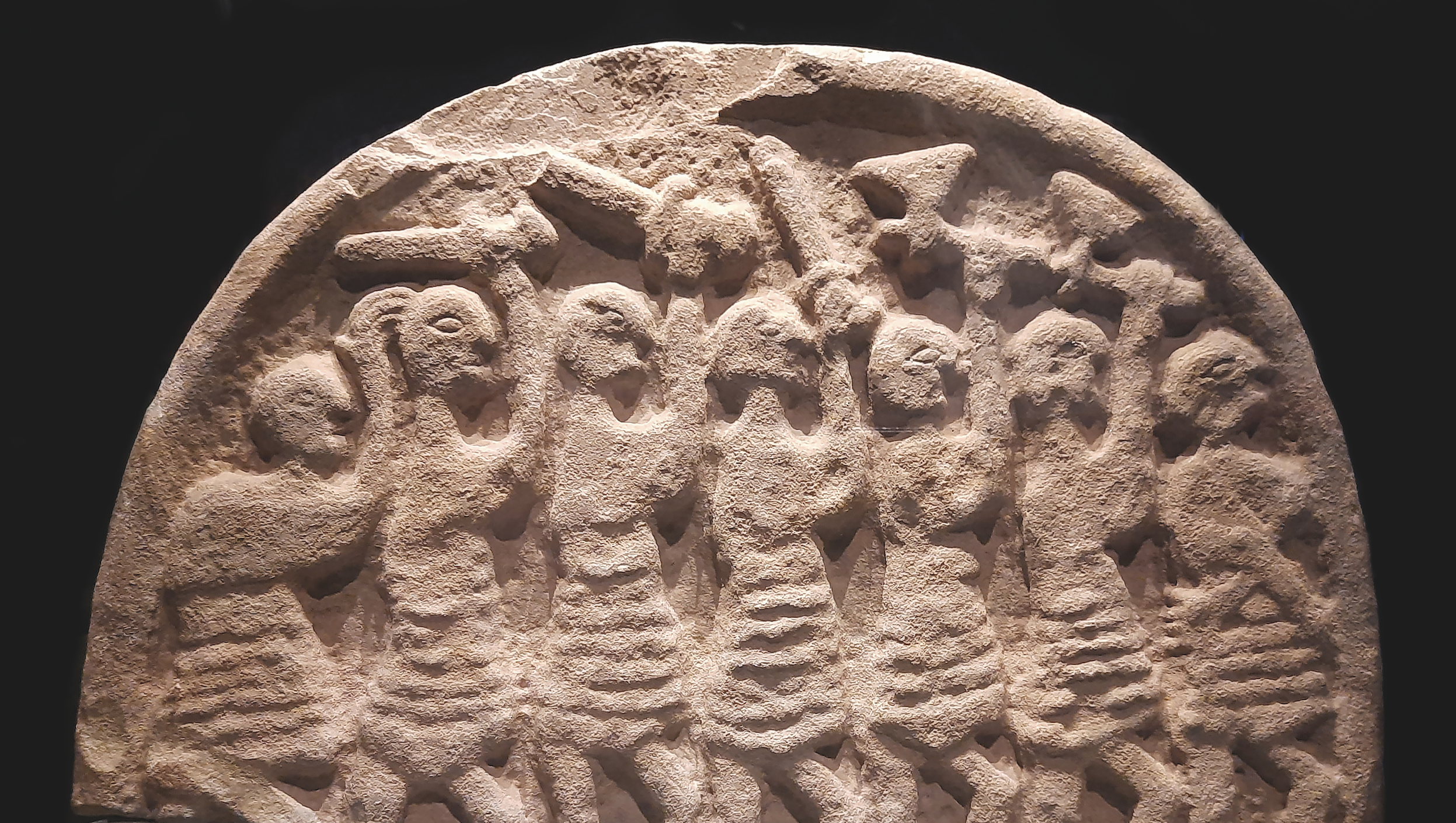
The Domesday Stone (c.900AD), found at Lindisfarne Priory, is a powerful Anglo-Saxon grave marker. One side shows armed warriors of the 793 Viking raid; the other depicts a Christian Day of Judgement scene reflecting the belief that the attack was God’s judgement on Lindisfarne. On display at Lindisfarne Priory Museum, it is one of the site’s most striking Anglo-Saxon treasures
First published in edition 213 of The Northumbrian, August/September 2026
It may often be overshadowed by more famous dates in history, but the Viking attack on Lindisfarne in 793 sent shock waves through Christendom and marked the dawn of the Viking Age. From bloodshed and blame to kings and conversion, its legacy still echoes
Our history is littered with dates of huge significance, but how many of us actually remember many of them? Just about everyone, I suppose, can recall from schooldays the really famous few – 1066 for the Battle of Hastings, 1492 for Columbus “discovering” the New World (though the Vikings likely beat him to it by centuries), or 1815 for the Battle of Waterloo.
Arguably less readily remembered might be 45AD (the Romans arriving in Britain), 1215 (Magna Carta), and 1346 (the start of the Black Death which halved the population of Britain and Europe).
Then there’s 793. I envisage many readers’ brain cells grinding, as that date is largely forgotten in British history, but it’s famed among our Scandinavian neighbours because it marks the start of one of the most significant periods of their history.
In that year, Vikings stormed ashore from longships to attack and pillage the early Christian community on Lindisfarne. This was their first substantial raid on English soil and is generally recognised as the start of the Viking Age, which was to change our history forever.
History does not record how many people were killed or taken for slaves, what was actually stolen, or indeed what the Vikings gained from the raid. We do know, however, that the Lindisfarne Gospels, that flowering of early medieval art and religious devotion, escaped intact, as did the body of St Cuthbert in whose memory the Gospels were written. The little information we have comes almost entirely from the quill of Alcuin of York (c735-804) who at the time was an adviser at the court of Charlemagne the Great, ruler of the Holy Roman Empire.
While light on detail, his writings record the shock waves which coursed through the whole of Christendom following the raid, which was a foretaste of things to come over the next couple of centuries.
Alcuin is regarded as one of the best sources of information about the 8th century because he corresponded widely with rulers, religious institutions and scholars across Europe and Anglo-Saxon Britain. His correspondents included the kings of Northumbria at their power base at Bamburgh, and the early Christian community on Holy Island. The shock the raid produced is clear from one of his letters: “Never before has such terror appeared in Britain as we have now suffered from a pagan race, nor was it thought that such an inroad from the sea could be made. Behold, the church of St Cuthbert splattered with the blood of the priests, despoiled of all its ornaments, a place more venerable that all in Britain is given as prey to pagan people.”
While pagans were responsible for the raid, Alcuin was quick to take part in an early medieval version of the blame game by suggesting that the outrage may have been divine retribution for what he saw as the wicked ways of the early Northumbrians and their rulers. There was also more than a hint of the wrath of God in the best-known and most-quoted account of the raid in the Anglo-Saxon Chronicle. Referring to 793, it stated: “In this year terrible portents appeared over Northumbria and miserably frightened the inhabitants: there were exceptional flashes of lightening and fiery dragons were seen flying in the air. A great famine soon followed these signs and a little after that on June 8 the harrying of the heathen miserably destroyed God’s church on Lindisfarne by rapine and slaughter.”
Much later, the monk Symeon of Durham claimed the raiders killed some of the brothers, drove others to drown in the sea, and dragged others away as slaves in fetters. They also dug up the altar and carried off the treasures of the church. Writing in the 12th century, Symeon may simply have been repeating the many stories which entered local folklore after the event. Popular history depicts the departure of the first Christian community from the island, for example, as including a bunch of tattered and terrified monks fleeing across the sands to the mainland.
Island historian Canon Kate Tristram, however, presents a different picture. She points out that the early monks had education and medical knowledge, were well-organised and maintained lines of communication with communities along the coasts of England and Scotland as well as old links with Ireland. Far from being a departure borne of panic, theirs was probably a disciplined strategic withdrawal from an island where life had become untenable under repeated threats from the Vikings. Apart from the body of Cuthbert, the monks took with them the bones of St Aidan, the founder of the community, and the Gospels, which had either been hidden, or were missed or ignored by the Vikings. Pagans, they probably also regarded the body of Cuthbert as worthless.
Many other raids followed and over the following decades Vikings began to settle in England, particularly in the north and east. They were soon controlling large areas and threatening further expansion into the lands then controlled by the Anglo-Saxon kings. By 865 English rulers were paying the Danegeld – huge bribes – in a bid to persuade the colonists to behave themselves. Needless to say, giving into blackmail is never a good policy. History records that the 11th century monarch Ethelred lived up to his nickname of “The Unready” by handing over more than £100,000 in silver to the Danes, yet still managed to lose his throne.
By 1016 a member of the Danish royal family, Cnut, or to give him his more familiar Anglicised name, Canute, was king of England, Denmark and Norway. In less than three centuries, the Vikings had gone from marauders to monarchs, and with their gradual conversion to Christianity the Viking Age faded out. All changed again a few years later with the arrival of the Normans in 1066, themselves descended from Viking settlers in France. Vikings and Normans alike left their stamp on Britain in hundreds of place names, our geographical counties, our language, even our bodies – many of us being possessed of a little Nordic DNA.
As mentioned, 793 is of great significance in Scandinavia, as shown when England played Norway at St James’ Park, Newcastle, many years ago. A Holy Islander in the crowd reported later that the visiting fans unfurled a banner bearing the legend: “793: Norway 1, England 0.” It is possible that he was the only England fan among the thousands there who understood the reference. But on Holy Island, memories are long, while a constant reminder is on display at the island’s parish church of St Mary the Virgin: a humble apology from Norway in the form of a plaque and letter presented to the island 1,200 years after the event.