
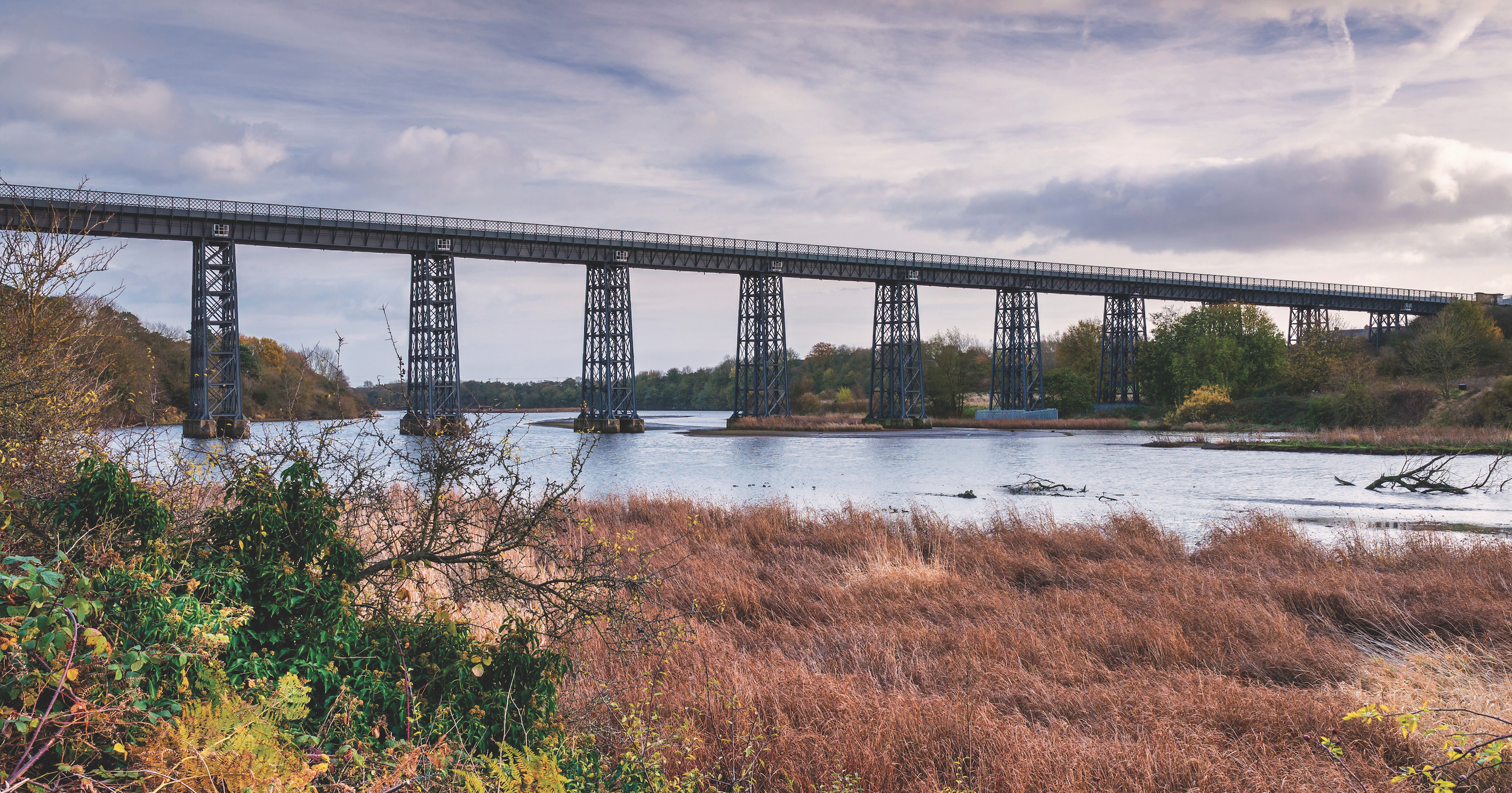
North Seaton Railway Viaduct
First published in edition 213 of The Northumbrian, August/September 2026
From childhood train trips to a journey on the restored Newcastle–Ashington route, John Grundy reflects on the reopening of a railway line that is reconnecting communities and reviving a piece of Northumberland’s past
I grew up in Carlisle with my mum and my sister Janet who was, and still is you’ll be pleased to hear, six years older than me. In the mid 1950s, when I was about 10 and she was about 16, the two of us took to having day trips across to Newcastle by train. Our motives were varied. We were excited to be visiting the big city of course, but more specifically she was irresistibly drawn by the cheap clothes in the bargain basement at C&A on Northumberland Street, while I was desperate to go to watch cartoons at what is now Tyneside Cinema but was the News Theatre in those days.
We always went to the Lyons tearoom on Market Street, which is empty today, sadly, but still has an attractive Art Deco façade, and we nearly always got lost finding our way back down Grainger Street in search of Central Station.
They were great adventures made even more special by the train rides in both directions. These journeys sparked my enduring passion for the railways as well as providing my first glimpses of the beauties of the Tyne Valley. Though even more memorable to me were the coalmines and factories that still existed then, and especially the extraordinary urban landscape of the west end of Tyneside, the great lines of terraced houses swooping up the steep hills of Scotswood on the north bank of the river and Blaydon on the south. It was my first introduction to industrial Tyneside and I was enthralled by it.
I continued to be fascinated by the excitement and variety of local train lines, but of course they were not to last. By the middle of the 1960s the dreaded Beecham Axe had fallen on the British railway system. As a sort of vapid response to the threat caused by the rise in car ownership and the growth of a new road system, 2,363 stations were closed at the drop of a hat, not to mention 5,000 miles of lines torn up and 67,700 railway workers losing their jobs. The Carlisle to Newcastle line survived of course, but so many didn’t, and even now, 60 years after the axe fell, the rural landscapes of places like Northumberland are still littered with aching reminders of railways past.
This makes it all the more exciting that one of these old lines has been brought back to life. The Newcastle to Ashington line and its six intermediate stations is now once again fully open. Isn’t that, as they say, a remarkable thing?
In the interests of full disclosure I must add that it has operated these last 60 years as a freight line, mainly serving the Port of Blyth and bringing fuel to the power station at Lynemouth, north of Ashington. But the stations and passengers were all gone and most people had got used to that, regretfully accepting that the days of small-scale local rural train journeys were forever over. Having said that, for some years there has been a swelling chorus of calls for the reopening of the line for passenger use. Now, following public consultations in 2019 and 2020 and a 2023 Department for Transport grant of £34m, it has come to pass.
Recently I had my first go on the line and I had a lovely time. I left from Newcastle Central Station, which was positively vibrant, awash with people coming and going, meeting up and saying goodbye. I bought a ticket from a machine for just £2 and boarded a little two-carriage train, which wasn’t vibrant but was modern and clean and nice, and there were enough people travelling with me to make it feel lively. Indeed, a couple of students sitting behind me laughed merrily the whole way.
As we left the station we headed east, passing within about 2 millimetres of Newcastle Castle keep. We crossed the remarkable bridge over Dean Street, which for a short time in the 1840s was the highest and widest single-arch bridge in the world, and we ventured off into the normally hidden landscape behind the streets of inner Newcastle. For a brief period, we glided through a world of graffiti and scrow with sneaky little glimpses into backyards; the sort of thing most trains pass through as they begin to leave the city. For a couple of miles after this it was more suburban, with well-kept council houses and tidy estates of new houses, and then in the blink of an eye we were in the countryside.
Most of this line was built in the 1840s as part of a network known as the Tyne and Blyth Railway. Back then, southeast Northumberland was an almost entirely industrial landscape of wall-to-wall coalmines and pit villages. Seaton Delaval, the location of one of the new stations, was a major centre of the glass industry, producing vast numbers of bottles each year. Of the other new stations, Newsham was a colliery village; Blyth was a hugely important coal exporting port; Bedlington was the centre of a ring of mines, early railways and iron works of international significance; and Ashington, our destination, had the reputation of being the world’s largest pit village.
You wouldn’t know any of that nowadays as the little train ambles through an unbroken pastoral landscape. We witnessed beautiful fields and hedgerows the whole way and animals all over the place. At one point I saw masses of dogs being walked and trained in a field divided up into separate lanes; it was like something from a TV programme called Nice Doggies. We passed a field filled with horses and at another point we passed over a level crossing with no cars, just three horses patiently waiting for our train to pass by. There was even – and I might have made this up because I only spotted it as I woke from a little doze, so I hope I’m right – but I think there was even a field entirely filled with Shetland ponies. Or might they have been llamas?
But the only cars I saw on the whole route were when we passed over the A1068, the dual carriageway that forms the main road north. It was motionless, frozen solid; not a car was moving in the late morning rush as we, the lucky ones, sped smoothly on towards Bedlington Station. Somehow it felt a significant sight.
And then, 37 pleasant minutes after we had set off from Newcastle, we arrived in Ashington and I had to pull my socks up and start to ask the question, what is the point of this line? Who does it benefit?
I ask that question because Ashington, to be a bit brutal, doesn’t have a reputation as a place to visit for fun and enjoyment. It is seen as a thoroughly workaday place, probably because it is a workaday place, and I suspect that on my little visit I was the only person who got off the train in a spirit of adventure. Most, if not all the others I suspect, were locals returning home from Newcastle. And yet it was a very nice arrival. The station was pretty and well designed. On the far side of the track there was a street of pleasant houses with small boys amusing themselves on their bikes. Beside the station was a large and largely full car park and beside that a pretty and well-maintained memorial park with quite a splendid war memorial statue in the centre.
Station Road, the main shopping street leading to the station, has clearly been redeveloped in recent times and looks agreeable with trees, broad pavements, seats and a sprinkling of well-known stores, though it is, to be honest, a bit mixed. There are some empty units and quite a lot of charity shops, but then which high street anywhere doesn’t have a similar mix?
And it is clearly trying. There are sweet noticeboards dotted about offering hope for future improvement and multi-screen cinemas and so on, and the shops I went to were nice. I had a naughty coffee and cake in a recently opened café and everybody I spoke to was noticeably kind and informative. But while all of this made it an agreeable place to live, it didn’t feel as if it was trying to establish itself as a place to visit. Rather, it felt like a nice place for locals to go shopping, so why the newly opened line?
The clues, I felt, were to be found in the car park, in the laughing students, in a couple of mothers with pushchairs returning from visits to Newcastle. They were to be found as I waited for the train back home, which was quite a bit busier than the morning train and people around me were making plans for what they were going to do in the Toon or talking on their phones with the people they were going to meet.
Then of course there was that car park. I should have counted how many cars were in it but failed to do so; it looked well over 100 though, parked for free on a weekday. Their owners had gone off with their £2 tickets into town to work, college or for a day out for a round trip of £3 to £4. My friend Normie who lives a few miles further up the coast has abandoned driving into Newcastle. No more scrabbling for a parking space and waiting for a Metro to get into the town centre; it’s a piece of pie nowadays and a little piece of pie for people like me who live by Gosforth High Street. It means a whole heap of cars that would formerly have added to the congestion on the way into town have been marginally reduced and parking is free instead of the elevated prices in town. For young people the train provides access to college, work and fun. Newcastle continues to do what it did for my sister and me in the 1950s, drawing people from outlying places to its shops and fleshpots (the Lyons Tearoom!)
And Ashington can benefit from the connection, too – not necessarily by bringing more people to the town but by making the town part of a broader community. That’s what branch lines did for me and my sister in 1955 and that’s what they can still do today.