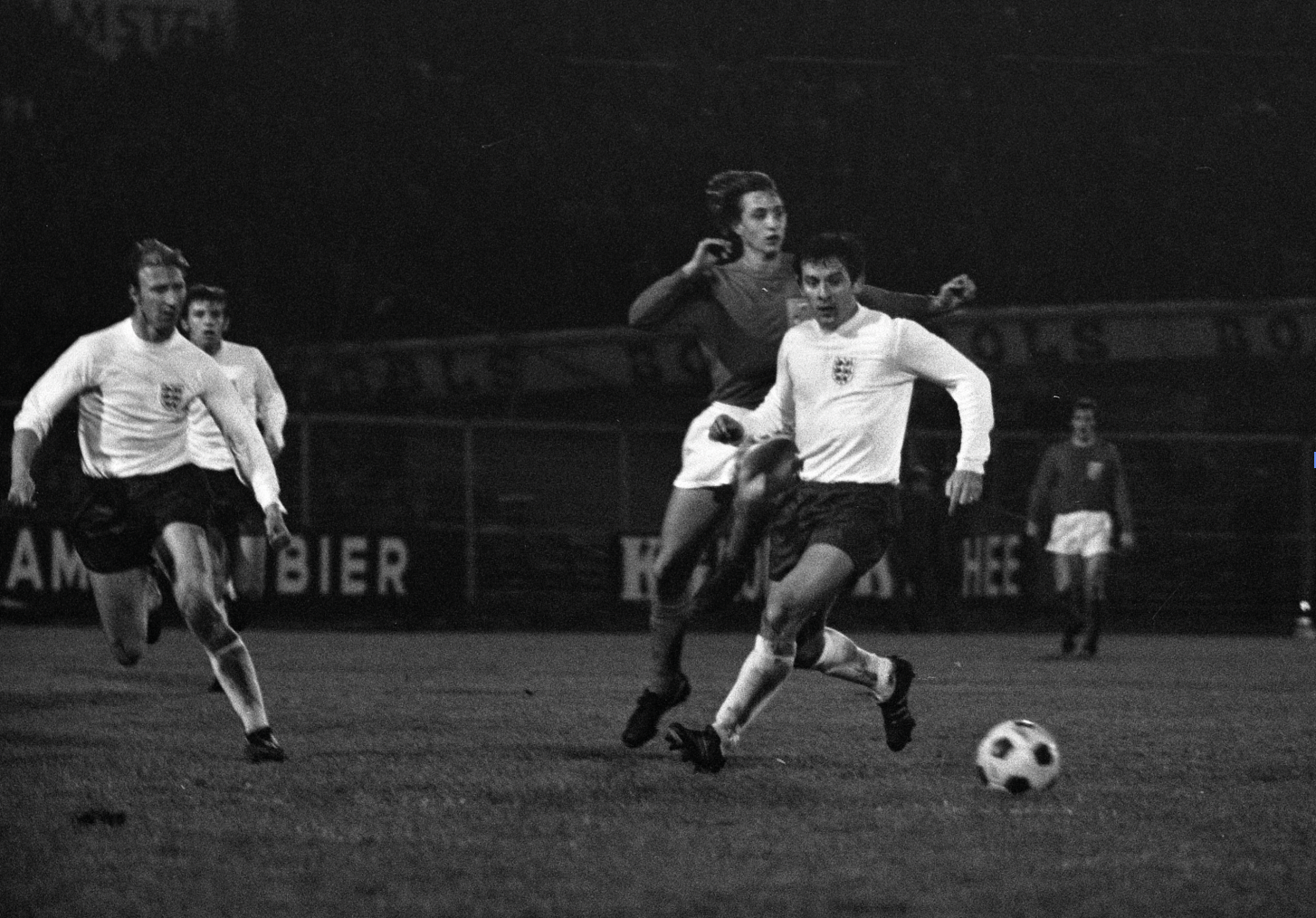
Charlton, left, playing for England against the Netherlands in Holland in 1969
(Dutch maestro Johan Cruyff is in the cente, and England midfielder Alan Mullery is in the foreground)
First published in edition 211 of The Northumbrian, April/May 2026
From the coalfields of Ashington to Wembley glory, Jack Charlton was a pillar of England’s 1966 World Cup team and later led the Republic of Ireland through its greatest era, as Stephen Roberts discovers in the latest in his series profiling great Northumbrians
Jack Charlton OBE was that rarity in football – finding success as both a player and a manager in a dual achievement that eludes many, including his famous brother Bobby.
He wasn’t the most elegant of players, but he was wholehearted, while as a manager he could be acerbic. He endeared himself to the multitude, however, as someone who was both straightforward and thoroughly rebellious.
His greatest claim to fame was of course as a member of the team which took to the field on July 30, 1966, to win England’s one and only World Cup. Later, as a manager, he’d take the Republic of Ireland to two World Cup tournaments and a European Championship, leading them through an unprecedented decade of success.
Born in May 1935 in the coal mining town of Ashington, John (‘Jack’) Charlton was one of several famous footballers to come into the world in this then-unprepossessing place. As well as the Charlton brothers, the town also produced the great Newcastle and England centre forward Jackie Milburn (1924-88), who was a cousin of Jack’s mother. Jack also had four uncles who played League football, three of them uncompromising defenders who represented Leeds United, the club Jack himself would serve with distinction in the same capacity.
This, then, was a footballing dynasty. The eldest of four brothers, above Bobby, Gordon and Tommy, the family was poor and all four boys shared the same bed. Their father Bob had no interest in football, but their mother Cissie played football with her children and later coached the local school team. She took them to watch Ashington and Newcastle United play, and Jack was a lifelong Newcastle supporter.
Jack would initially and perhaps permanently be overshadowed by the more exquisite skills of his brother Bobby, two years his junior, who’d join the glamorous Manchester United while Jack undertook national service. Jack had first joined Leeds in 1950, aged 15, and was a one club servant for his whole playing career, loyalty being more prevalent back then, before megabucks changed the beautiful game beyond recognition. A career in football wasn’t a given, though, and when he was offered a trial at Leeds Jack wasn’t sure. At first he declined and joined his father down the pit, but he soon changed his mind about that career choice after a short experience of life underground. He considered a career with the police, but in the end decided to take up the offer of that trial. His first professional contract followed when he was 17, and the rest, as they say, is history.
He made his first team debut on April 25 1953 against Doncaster Rovers, a match that ended in a 1-1 draw. It was the last match of the 1952-53 season in the old Second Division, and after it Jack had to go off and complete his national service with the Household Cavalry, relegating the rest of his early Leeds career to a two-year delayed kick-off. It was thus the 1955-56 season before he began to make his mark.
Having overcome a youthful disposition to party more than he should, Jack was also rewarded with his first representative honours during this season, with an appearance for the Football League against the League of Ireland in October 1957. Then, in January 1958, he married Pat Kemp, going on to have three children – John, Deborah and Peter. It was a strong marriage and in the 1960s Jack also ran a couple of clothing shops in Leeds, later going on to operate the club shop for Leeds.
A lanky 6ft 1ins tall, the beanpole of the Charlton brothers was a standout performer in Don Revie’s formidable Leeds of the 1960s and dawn of the 70s, departing in 1973 after 762 competitive appearances for the club, 629 of them in the League (statistics which remain club records).
He helped the club to take the First Division title, the FA Cup, the League Cup, and a couple of European trophies. The club would become known, however, for the number of occasions it finished runner-up, including five second place finishes in the League. Among it all, Charlton was named the Football Writers’ Association Footballer of the Year in 1967 – not bad for a man the England captain Bobby Moore once described as a ‘big giraffe’.
Aged 29 when he was called up to the national team in 1965, Charlton was a late arrival to the England World Cup squad. When he made his debut on April 10, 1965, against Scotland, Jack and Bobby were the first brothers to play for England in the 20th century. They were both possessed of a work ethic that endeared them to the England manager Alf Ramsey. Jack played in 35 internationals, scoring six goals, and played in the World Cups of 1966 and 1970, and the 1968 European Championship, in which England finished third.
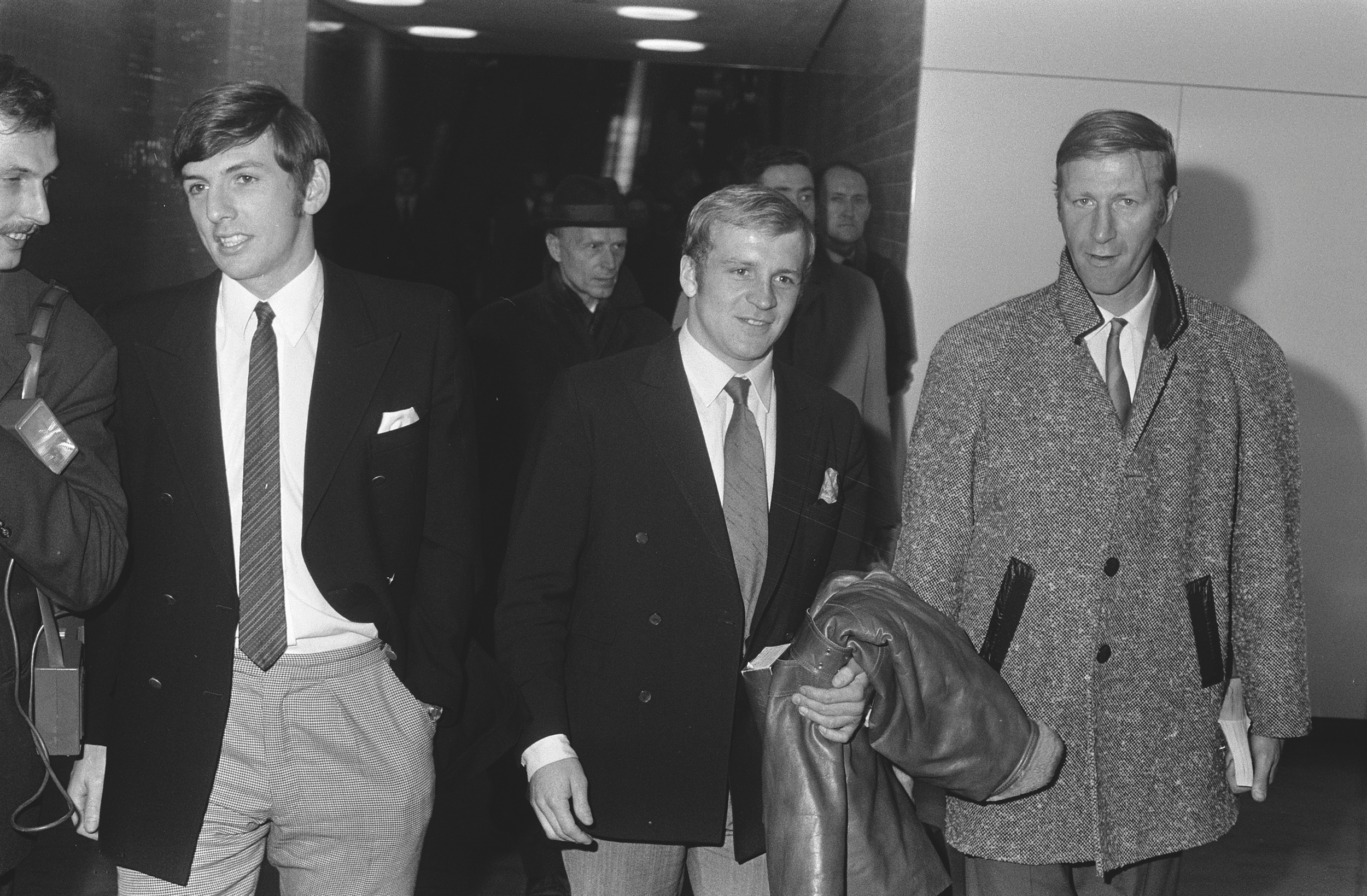
Jack Charlton, right, in the Netherlands in 1969 alongside England teammates, striker Francis Lee, centre, and midfielder Martin Peters, left
It is the 1966 World Cup win that will live forever in the memory, Jack falling to his knees in exhausted relief at the final whistle, his head lost in his hands. While his brother Bobby had done the creative, expansive stuff on the field, it was Jack’s place to be the rock at the heart of England’s defence – hard and uncompromising, like the coal mines of Ashington.
Following his retirement as a player, he transitioned into management. He led Middlesbrough to the Second Division title in 1973-74 and was named Manager of the Year in his first season as a manager. He kept ‘Boro as a stable top-flight club before he resigned in April 1977. He took charge of Sheffield Wednesday in October 1977 and led the club to promotion out of the Third Division in 1979-80. He returned to Middlesbrough briefly as caretaker manager and then managed Newcastle, the team he supported all his life, 1984-85. Then in February 1986, he took over as manager of the Republic of Ireland, which had traditionally underperformed on the international stage.
His first success was in leading the nation to its inaugural World Cup tournament, Italia ’90, when it reached the last eight before losing narrowly to the hosts. He’d already led the Republic to European qualification (1988) and followed up with a second World Cup appearance in 1994 in the United States; a tournament that England notoriously failed to qualify for. Charlton resigned in January 1996, the same year his autobiography was published, when he was also awarded honorary Irish citizenship (he’d already been granted the Freedom of the city of Dublin). He then tackled retirement.
Charlton’s love of sport extended to fishing and field sports. He was also a socialist and a committed supporter of the miners in their long-running strike of 1984-85. He was a guest on Desert Island Discs twice (1972 and 1996), showing a liking for the novels of Mark Twain, and was also a subject of TV’s This Is Your Life in 1973. He was appointed an OBE in the 1974 Birthday Honours and in 1997 was appointed a deputy lieutenant of Northumberland. He was inducted into the English Football Hall of Fame in 2005.
Sadly, relations with his brother Bobby were not always cordial, though Jack put their differences behind him to present Bobby with his BBC Sports Personality of the Year Lifetime Achievement Award in December 2008. A fair assessment would be that they were never that close as children and grew further apart as adults, their vastly different playing styles perhaps a metaphor for two very different men – Bobby the quiet one, Jack anything but.
And yet, despite those differences they achieved much in tandem – as young apprentices to the game; dedicated professionals; internationals who achieved the game’s highest honour; and as managers, though it was journeyman Jack who was to be the achiever here. They were also both lifelong ambassadors for the game they loved, commentators and pundits – and most of all, they were World Cup winners.
Jack Charlton, who’d been suffering from dementia, died on July 10, 2020, aged 85 in his native Northumberland. He lived his life true to his working-class roots, passionate and never one to give up. He was also happiest in the fields of Northumberland, his native county.
CHRONOLOGY
1935 John Charlton born in Ashington, Northumberland on May 8.
1950 Joins Leeds Utd, the only club side he would ever play for.
1953 Makes first team debut for Leeds Utd vs Doncaster Rovers.
1955 Jack becomes a first-team regular at Leeds after returning from national service.
1958 Marries Pat Kemp and goes on to have three children with her.
1965 Jack makes his full England debut
against Scotland.
1966 Jack is a World Cup winner with his brother Bobby as England defeat West Germany.
1967 Named Football Writers’ Association Footballer of the Year.
1973 Hangs up his boots at Leeds after well over 700 appearances.
1974 Now a manager, Jack takes Middlesbrough to the Second Division Championship.
1986 Becomes manager of the Republic of Ireland, embarking on a decade of success.
2020 Jack Charlton dies on July 10 aged 85, in Northumberland.