
Northumbrian Greats: Sir George Airy
First published in edition 206 of The Northumbrian, June/July 2025
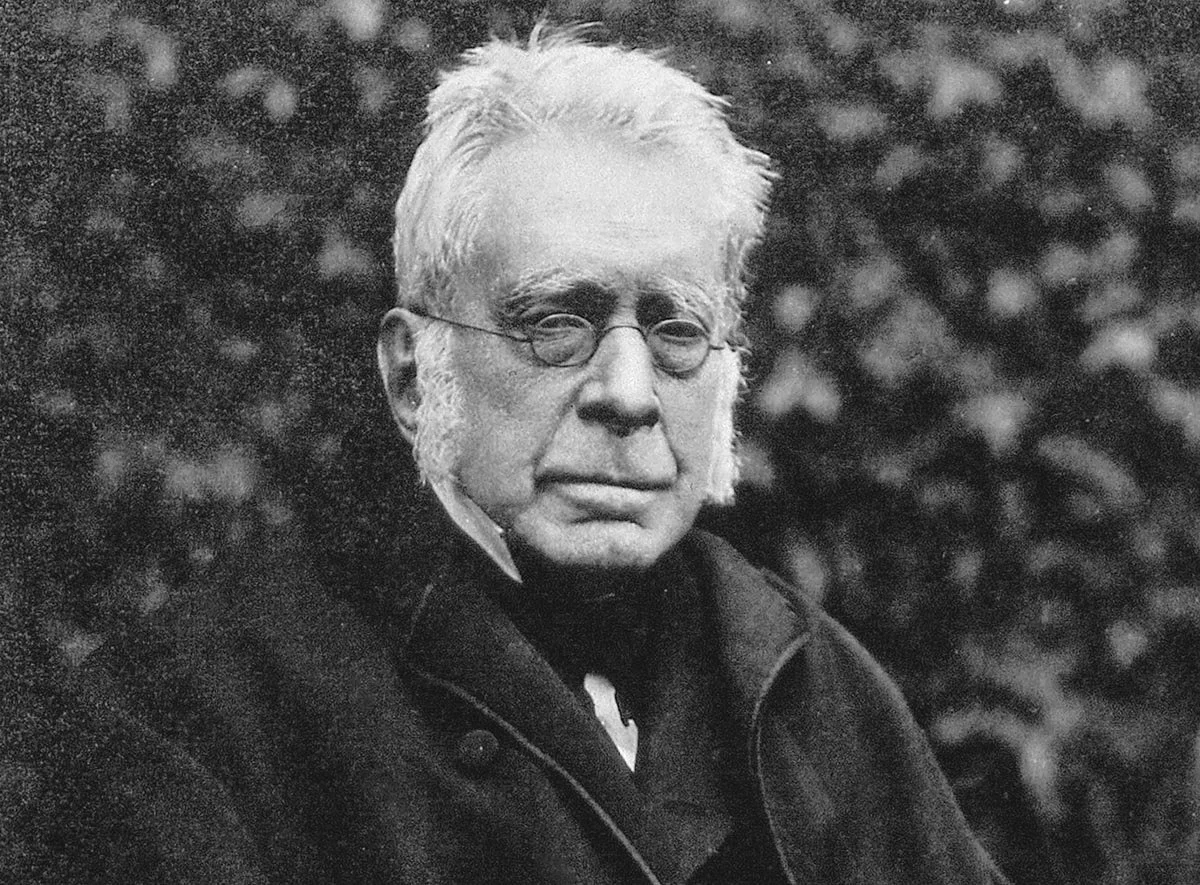
In the latest in his series celebrating great Northumbrians through history, Stephen Roberts profiles Sir George Airy (1801-1892), Astronomer Royal, writer, scientist, father of Greenwich Meantime, and son of Alnwick
Astronomer, scientist, writer, and Lucasian Professor of Mathematics at the University of Cambridge, Sir George Airy was also Astronomer Royal for more than 45 years and designed a legendary telescope that defined the Prime Meridian.
George Biddell Airy was born in Alnwick in July 1801, son of William and Ann (née Biddell). In 1805, the family moved to Hereford on account of William’s job as a tax inspector. Thus, Airy didn’t live in Alnwick long enough to appreciate its mighty castle, narrow streets and passageways, monuments and buildings of sturdy disposition, though his birthplace, 5 Grosvenor Terrace, is endowed with a blue plaque.
Having attended elementary schools in Hereford, in April 1810 the family moved to Colchester, Essex, where young George was enrolled at Colchester Royal Grammar School. There he courted popularity with his propensity for constructing peashooters, this an effective antidote to his introverted nature. He was said to be somewhat snooty and possessed of a prodigious memory. As a young teenager he began visiting an uncle, Arthur Biddell, in neighbouring Suffolk and it was through him that he was introduced to Thomas Clarkson (1760-1846), the Cambridgeshire-born abolitionist who held an MA in maths from Cambridge University. Clarkson arranged for Airy to be examined by a fellow from Trinity College, Cambridge, in mathematics and as a result, he entered Trinity in 1819 as a sizar (that is, he paid a reduced fee but essentially worked as a servant to make good the discount).
It was at Cambridge that his future career as an astronomer and mathematician was fostered. He graduated in 1823 and became a fellow of Trinity in 1824, having been ‘senior wrangler’ the previous year (that’s the top maths undergraduate at Cambridge, a position described with suitable hyperbole as ‘the greatest intellectual achievement attainable in Britain’).
Airy met his future wife, Richarda Smith (1804-75) in July 1824 while on a walking tour in Derbyshire. He described her as a great beauty, relating that: “Our eyes met . . . and my fate was sealed . . . I felt irresistibly that we must be united.” Airy made his proposal just two days later. They wouldn’t marry for six years, however, Richarda’s protective father, the Rev’d Richard Smith, insisting that George wait until he had the financial means to provide for her. Their surviving six of nine children included the engineer Wilfrid Airy (1836-1925), who designed Orwell Park Observatory; Hubert Airy (1838-1903), a doctor and pioneer in the study of migraines; Hilda Airy (1840-1916), wife of the mathematician Edward Routh, and the artist Christabel Airy (1842-1917).
Before the marriage in 1830, Airy achieved a great deal. In 1827, for instance, he became the first person to correct the blurred sight associated with astigmatism, working on his own eye using a cylindrical eyeglass lens.
He was Lucasian Professor of Mathematics at Cambridge 1826-28 and by 1828 was professor of astronomy and director of the newly established Cambridge Observatory. In the year of his marriage, 1830, Airy conducted calculations to determine the Earth’s diameter which showed to what extent the planet was non-spherical. If this all sounds a bit dry and dusty, well it’s actually rather vital if you want accurate maps, and his measurements from all those years ago are still taken noted by Ordnance Survey.
Three years later, in 1833, Airy designed a mounting for the splendid 12-inch Northumberland Telescope, presented by the duke of the same name to Cambridge, where it remains. Airy was twice the recipient of the Royal Astronomical Society’s Gold Medal, in 1833 and in 1846, and became a fellow of the Royal Society (FRS) in 1836. He was four times president of the Royal Astronomical Society, beginning in 1835.
Airy was Astronomer Royal, the seventh man to hold that august office, 1835-81 – his more than 45 years in the job a lengthy stint by anyone’s standards. He took up the post when the Greenwich Observatory was in what he called “a queer state,” having been neglected for many years. The first Astronomer Royal had been appointed in 1675, his brief to make observations for the improvement of navigation, cartography, instrument design and so forth, his true raison d’etre being to support Navy and Empire. The position was created with the ambition of discovering a means of determining longitude at sea when out of sight of land, and Airy followed in famed footsteps, the first two Astronomers Royal having been John Flamsteed and Edmond Halley, he of the comet.
As Astronomer Royal, Airy was also director of the Royal Greenwich Observatory. He was a powerful figure who argued against government interference, maintaining that original research was best left to private institutions and individuals. One area in which he may have slipped up was his failure to kick-start a search for a new planet, Neptune, whose likely presence had been predicted on a mathematical basis in 1845 by the Cornish mathematician/astronomer John Couch Adams (1819-92) whose theory was based on discrepancies observed in Uranus’ orbit. It would be left to the Europeans to find the new planet – much to the chagrin of the British.
But Airy’s achievements were numerous, including his energetic sorting out of the observatory, where he installed new equipment and formalised observations. He also produced significant work on planetary orbits including discovering an inequality in the motions of Earth and Venus; measured the mean density of the Earth; and established Greenwich as the location of the prime meridian. This was achieved courtesy of Airy’s Transit Circle, a telescope he installed in 1851.
Airy was not desk-bound at Greenwich. In 1854 he was to be found at Harton Colliery, South Shields, where his measurements of the Earth’s average density enabled its mass to be calculated. This was achieved using pendulum readings taken at the top and bottom of a deep mineshaft. Airy also travelled to Italy, Sweden and Spain to observe eclipses.
He was knighted in 1872, appeared as an expert witness at the inquiry into the Tay Bridge disaster (1879), and in 1884 the International Meridian Conference in Washington DC confirmed Greenwich meridian and therefore Airy’s Transit Circle as the prime meridian for the world, despite vigorous opposition from the French, who wanted Paris designated instead. He also found time to publish more than 500 papers, which included such eclectic subjects as astronomy (naturally); lunar and planetary theory; the theory of light; gravitation; iron-built ship experiments; correction to compass deviation; trigonometry; algebra; partial differential equations; the mathematical elements of music; and magnetism.
He retired in 1881 and died on January 2, 1892, in Greenwich following surgery for an internal injury after a fall. He has a crater on the Moon named after him, and two craters on Mars, one inside the other, are named in his honour. The inner of the two, Airy-0, defines Mars’ prime meridian – the Martian equivalent of Greenwich. The Airy Stress Function remains in use by engineers to determine the stress in structures, the necessity of which was shown by the Tay Bridge disaster. Airy’s estate was valued at approaching £28,000, which equates to around £3¼ million today, and his autobiography was published posthumously in 1896. It has been asserted that his ghost haunts the Royal Greenwich Observatory during nighttime hours.