
Our lady of letters
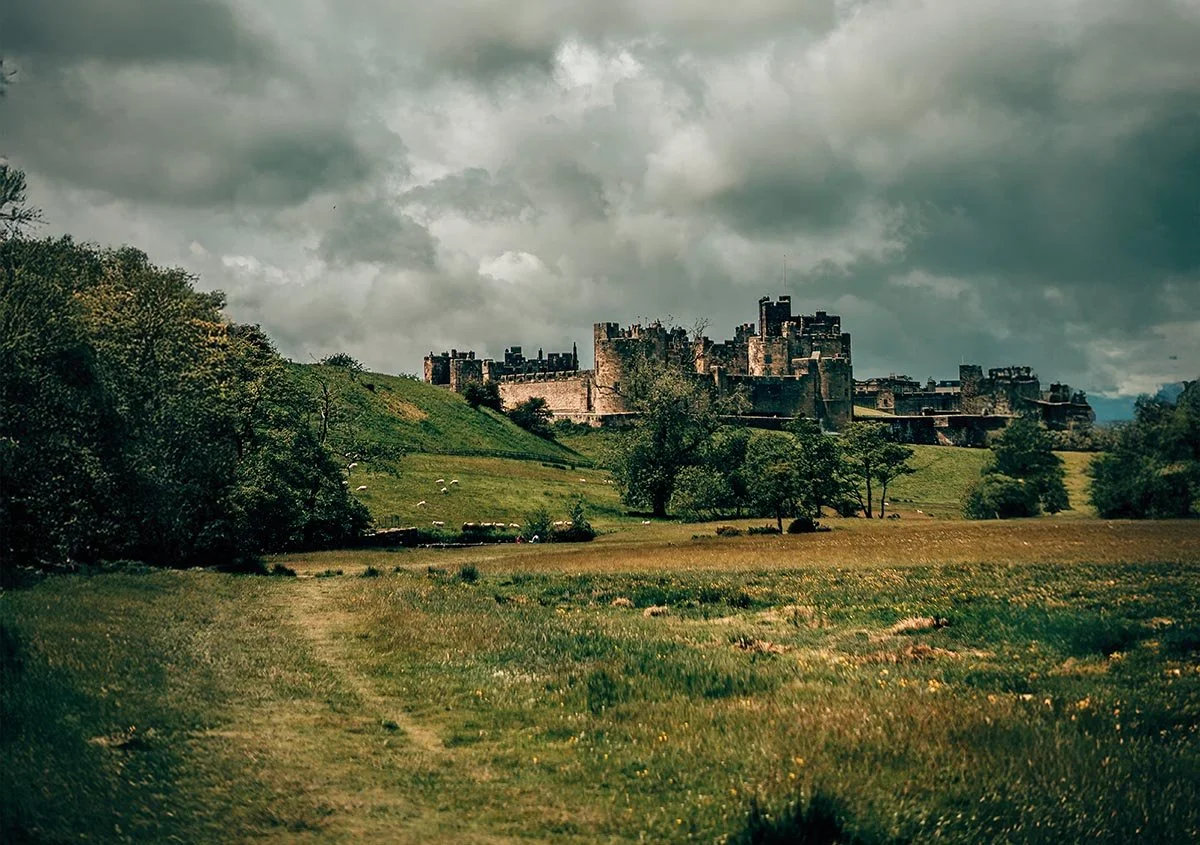
Alnwick Castle perhaps as Elizabeth saw it when she first arrived
First published in edition 207 of The Northumbrian, Aug/Sept 2025
John Grundy recalls the diarist and traveller Elizabeth Percy, 1st Duchess of Northumberland, who was rich, well-travelled, and did things her own way
Many years ago there was a notorious episode of BBC Radio 4’s Desert Island Discs in which a famous American opera singer called Victoria de Los Angeles selected only recordings made by herself. I mention this because I’m slightly worried that I am turning into her. Not that I can sing, of course, nor that I am in danger of changing sex, but I have for various reasons been a touch restricted recently in what we Grundys call “getties outies.” So, instead of leaping off around the county in search of new stories like everyone else on The Northumbrian writing team, I have been rather stuck at home, mining my own memories and dredging up stories from things I have written about in the past. This is my justification for bringing to your attention Elizabeth Percy, 1st Duchess of Northumberland, who was born in Sussex in 1716, died in London in 1776, in between had a major impact on Northumberland, and happens to be a favourite of mine.
She was brought up at Petworth in the family of her father, the 7th Duke of Somerset, for rather complicated reasons to do with her grandmother – another Elizabeth Percy who is also a bit of a weakness of mine, and about whom I have written fairly extensively in the past and might well do again in the future. She (Elizabeth Percy #1) had quite a start in life and by the time she was 15 had already been married three times. At 12 she was married off to a sickly and pathetic young earl who died six months after the wedding. When she was 14, she was provided with a second husband – a grotesque, corrupt, middle-aged man called Thomas Thynne from whom she fled almost immediately. He was subsequently murdered on Pall Mall by two assassins hired by a Swedish count who fancied marrying
Elizabeth. However, her actual third husband, who got her when she was still 15, was a Duke of Somerset with whom she spent the rest of her life (though to be honest he was almost as ghastly as the first two).
All these suitors were after her because, as well as being young, pretty and female (it always helps), she was also the sole surviving heir of the great Percy family, the historic earls of Northumberland, and (surprise, surprise) was fabulously wealthy. “What first attracted you to the fabulously wealthy Elizabeth Percy?” You might have asked any of them.
Our Elizabeth, Elizabeth Percy #2, the subject of this article, in case you had dropped off and stopped paying attention, was also fabulously wealthy, having been left, like her granny, sole heir to the immense Percy wealth following the death of her elder brother, but that sad loss (if that’s what it was) seems to have been the only sorry thing that happened to her because in 1740, when she was 24, she married a man called Hugh Smithson.
Nowadays, if you read the papers or watch the news or Eastenders, almost anywhere you look hammers home the
message that marriage, even to a bloke called Hugh, is no guarantee of a woman’s happiness, and sadly ’twas ever thus. Indeed, ’twas definitely thus among posh women in the 18th century, whose money became their husband’s the moment they were married, and whose life and dreams often shrank into a narrow domestic world usually miles away from any sort of social interaction except with a husband they may or may not like, but who had been chosen for them and was free to travel off into the wider world, leaving them alone with the servants and their dreams.
But our Elizabeth, I’m going to call her my Elizabeth, took a different route. Her marriage to Hugh wasn’t just a financial arrangement, it was a love match. One historian ironically called it a “scandalously unfashionable love match,” which not only survived until her death but also allowed her room to be herself. It didn’t do him any harm either, because not only did he have her wealth (fabulous!) but she also brought him a title (a fabulous one, too). Being a woman, she could inherit the estate but not the family titles. Only a chap could do that in those days, so on their marriage he became first the Earl of Northumberland, and later, in recognition of some sterling political work he’d done for George III, the 1st Duke of Northumberland. Which is why, as his wife, she became the 1st Duchess.
So, apart from marrying a bloke she liked, what do I admire her for? Well, first of all I like that she could be pushy and independent. As a duchess she was one of Queen Charlotte’s ladies-in-waiting, but she fell out with the Queen and resigned. Charlotte seems to have been quite nice as far as queens go, but her court circle had the reputation of being boring, and her women had nothing to do but sit around looking decorative, which wasn’t Elizabeth’s way at all. She seems also to have offended the Queen by having a train of servants wherever she went which was larger than her majesty’s.
So she left the court and moved off in other directions. First of all, and I love this about her, she took to travelling. All over. She became one of the first generation of Lady Grand Tourists, women who were determined not to be tied down by English restrictions and social expectations. Sometimes she went off into Europe with old Hugh, but more often she popped off on her own (with a train of servants, of course). She kept a diary wherever she went, some of which was published during her lifetime while the rest had to wait until 1913 when the complete diaries were published along with a biographical account of her life by the then Duke of Northumberland. I first ran across this volume in Newcastle Central Library 20 or 30 years ago, but nowadays it is readily available on the internet, and a spiffing read it makes.
It clearly helped that Elizabeth was a duchess because her status got her access to people and places that less exalted travellers would never reach. She visited the great French Enlightenment philosopher, satirist and historian Voltaire, for example, who gave her a pineapple. She met Frederick the Great in Prussia and was a bit shocked by the adventurous sexual habits of his court, noting that a virtuous woman in the palace was as rare as a black swan. In 1770 she was present at the marriage of the future Louis XVI to Marie Antoinette, who was 15 at the time but looked younger. She described how the bridegroom (who was also 15) “blushed to his eyebrows” when he put the ring on his wife’s finger. A couple of days later she was present during a catastrophic celebratory firework display in the Place de la Concorde which led to mass panic, hundreds of injuries, and at least 150 deaths. She describes it graphically yet with great sensitivity.
In fact she was, in my opinion at least, a good writer. She had a good eye and a passionate appreciation of landscape and place. That leads me to the third thing I like about her – among all her travels and posh southern houses, of which she had several, she fell in love with our landscape. At that time, in the middle of the 1700s, no Percy had lived in their Northumbrian castle for a couple of centuries, but Elizabeth re-discovered the romance and history of Alnwick and the countryside around it. She is said to have identified 93 rides in the area that she fell in love with. She was clearly drawn to the wildness of our county and her family’s medieval past, so she and Hugh brought the headquarters of the Percy family back north to the land of what she called her “braw, rough” ancestors.
She appointed a Northumbrian piper to her household and enhanced the Gothic glories of the house while stuffing it with art and the myriad objets d’art she had acquired on her travels. She converted the remarkable Hulne Priory in her deer park into a romantic Gothic summer house (complete with a little Gothic toilet with arrow slits so she could repel raiders if need be).
The Gothic alterations to the castle itself haven’t survived because they were re-done in Victorian times by her great grandson, the 4th Duke, but the Percy presence was firmly established and has remained. When Elizabeth died in 1776 at the age of 60, her principal memorial, erected by her husband, was, and remains, the splendid Brizlee Tower, high on a shelf in Hulne Park. It has glorious views of the Cheviot Hills across to the sea, and it has a charming terracotta medallion with her portrait. I imagine that it’s a good likeness.
In her diaries she records with refreshing openness that her husband weighed 12st 9lbs while she was a fairly hefty 12st 1lb, and it is true that she appears a little chubby in her portrait, with a slightly hooked nose and a double chin, but I think she looks nice. Writing about her in the past I found myself quoting a Geordie music hall song in describing her as “a big lass, but a bonny lass.” I don’t know whether she “liked hor beer,” as the song continues, but she certainly seemed to like life, and that’s good enough for me.