
The music hall maestro
First published in edition 207 of The Northumbrian, Aug/Sept 2025
We know the music hall classic I Do Like to Be Beside the Seaside, but who remembers the star who made it a hit, Mark Sheridan? Nicholas McDonald Lyons looks at the ultimately tragic life of the Northumbrian-born stage hero
Mark Sheridan was born Frederick Shaw in the shipbuilding area of Hendon, Sunderland, in 1864, and raised there with his six siblings. Leaving school in the mid-1870s, he found work in the dockyards where his father William was a skilled sailmaker. The industry then was poorly regulated and beset with low pay, industrial accidents, and strikes. But Sheridan was one for seizing the initiative and by the age of 16 was a telegraph messenger – perhaps the first evidence of him inhabiting a role in direct contact with the highest to the lowest echelons of society.
Later, selling programmes at Sunderland’s Theatre Royal, he developed a keen interest in the stage, going on to work behind the scenes in Newcastle theatres, learning production and taking his first steps into acting. A prodigious worker, he spent the 1880s honing his comedic performance and the singing skills which became essential to his act. A stage name was created. Sheridan was his mother Isabella’s maiden name, Mark is recognised as possibly an homage to Mark Twain, the American writer and humourist.
Every music hall performer’s goal was to succeed in London, but first Sheridan had to establish himself in the provinces, and he toured widely, winning plaudits. Buoyed by his progression, he took out a recurring advertisement in The Stage, the newspaper bible of the theatrical world. He described himself as a “Principal Comedian, Burlesque Actor, Vocalist and Dancer.”
In 1889 he married Ethel Maud Davenport, granddaughter of Sir Allan Napier Macnab, 1st Baronet (1798-1862) – a successful Canadian political leader, lawyer and property investor. The marriage struck a blow to class distinction, Sheridan’s working class a sharp contrast to Ethel’s lineage. Ethel’s Aunt Sophia married William Keppel, 7th Earl of Albermarle, and one of their children was Lt Colonel George Keppel, husband of Alice Edmonstone, future mistress of King Edward VII and great grandmother of the current Queen Camilla.
That year Sheridan appeared in a pantomime at The Standard Theatre, Shoreditch. Among the cast was the comic Frank Pierce. Sheridan invited him to form a partnership – The Sheridans. They went overseas with The Harry Rickards tour of South Africa and its gruelling schedule. The impresario Rickards was a larger-than-life character. He had risen to fame as a lion comique – a comedian who affected a dilettante man-about-town style with cane, moustache and champagne. While he is now most associated with his Tivoli theatrical tours in Australia, he enjoyed considerable success in South Africa.
By the latter half of 1891, The Sheridans were topping bills in Pretoria and Johannesburg. But the duo’s new home did not come without problems. Johannesburg had developed from a ramshackle tent town of a few hundred people to a sprawling metropolis of 100,000 in a little over 10 years, facilitated by the discovery of gold and the advent of the railroad. With such a large population there was a growing need for the mass entertainment the music hall offered.
Here, The Sheridans performed to a far more diverse audience than at home. Class was indistinct, and economic opportunity allowed for upward mobility. Equally, the town had a frontier style about it akin to the American West. As a well-known music hall performer, Sheridan began to carry a gun for personal protection. But Johannesburg was unstable and the boom and bust of the local economy was reflected in box office returns, hence the well-negotiated contracts of The Sheridans was key.
By the time Sheridan returned to Blighty in 1892 he had completed a well-received overseas tour and endured a prolonged bout of epidemic typhus. Rather than recuperating, however, Sheridan embarked on a tour of the North East of England. But then he joined another South African tour, Frank Pierce replaced by Joe Halliwell. Sheridan’s new comedy partner was not attuned to his British music hall style and the transition was a learning curve. By 1894 Sheridan returned to the British stage as a solo performer. His career was briefly sidelined by the threat of bankruptcy stemming from agents’ fees, medical expenses, and debts accrued by his comedy partners. Between the instigation of proceedings in April and their conclusion in July 1894, when Sheridan was cleared, he relocated to London. By September he was performing on the undercard at The Eastern Empire, East London, and six months later he was engaged at The Royal Standard Theatre, Pimlico, where he wowed audiences.
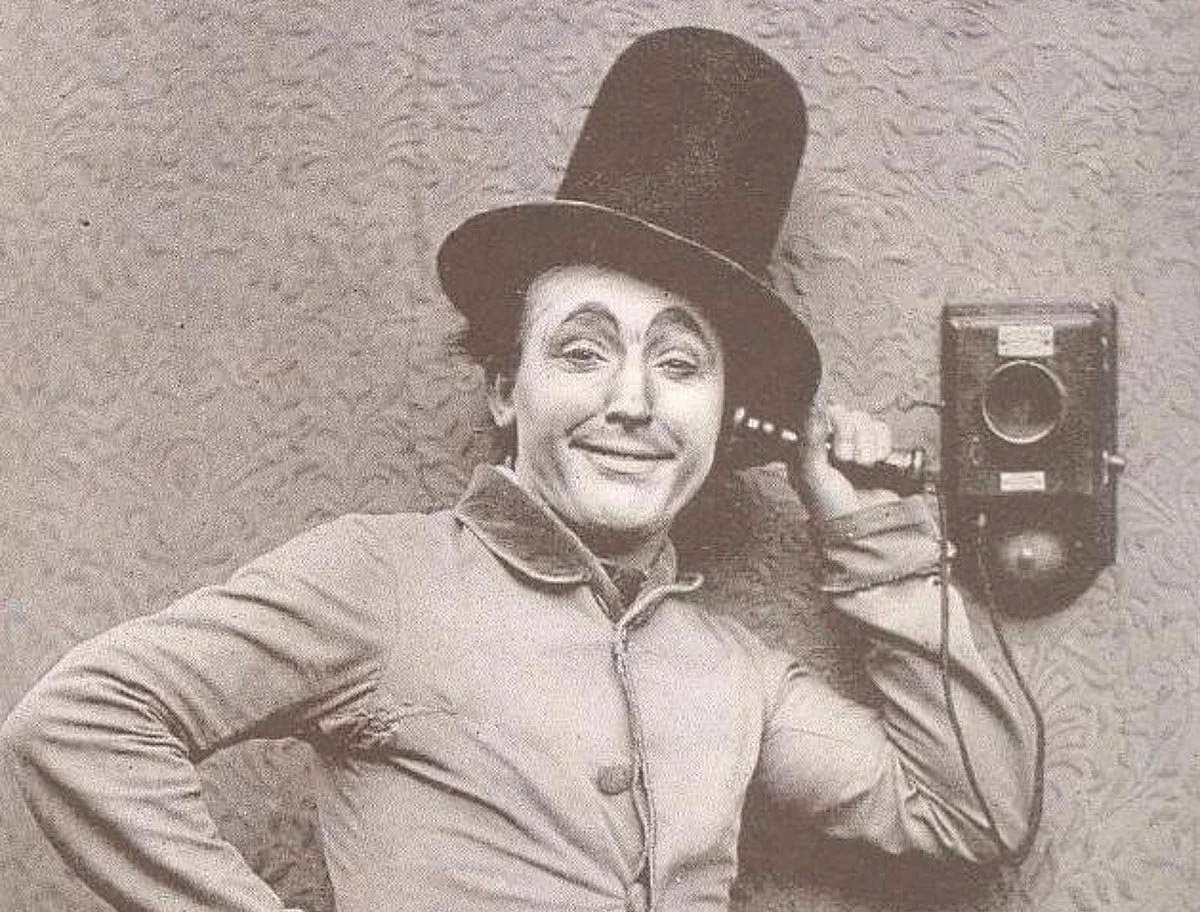
After more than 15 years in the business, Sheridan had become an overnight star. In the years that followed he headlined bills, drawing comparisons with music hall royalty Dan Leno and Marie Lloyd. Dressed in bell-bottomed trousers, shabby jacket, tall-crowned bowler hat and cane, he portrayed a nostalgic music hall image, yet his comedy act could be bitingly satirical. There were long runs in London, regional tours, pantomime and charitable endeavours.
By the turn of the 20th century the music hall was in flux, new regulations affecting relationships between performers, managers and agents. By 1907 contract stipulations could ban an artist from working within a 10-mile radius of any music hall for six months after an appearance. The Music Hall Strike which followed was supported by headline performers and picket lines emerged outside theatres throughout the country. A settlement was reached.
Conscious of all of this, Sheridan lived by the maxim that you are only as good as your last performance. He developed a talent for recognising classics, striking gold in 1909 with I Do Like to Be Beside the Seaside. Performing with a sauntering swagger, he breathed life into the John H Glover-Kind classic, tapping into the Edwardian boom in seaside holidays and making the song a classic. The following year he released One of the Bhoys – a song which further cemented his reputation as a leading light.
By 1910 he and his family were living in Teddington, and with a reduced working schedule Sheridan enjoyed time with his younger children William, Winifrieda and Fred junior. He also took an active interest in his adult children Jack and Juantia, who themselves had embarked on theatrical careers. He spent long holidays in Upper Coquetdale, Northumberland, and was a familiar face in Harbottle and Alwinton. In 1911 he appeared in the pantomime Humpty Dumpty at the Theatre Royal, Newcastle, and such was its success that he called time on his acting career.
As the spectre of World War I loomed, Sheridan’s were patriotic battle anthems. Put the Kibosh on the Kaiser in October 1914 referenced the small British Expeditionary Force that worked with the fierce Belgian defence to delay the superior German forces. Other classics include Here We Are Again (1914) and I’d Like to Shake Shakespeare (1915). With the slow demise of the music hall exacerbated by war, Sheridan began to concentrate on revue. In 1915 he starred in the comic revue Winkles, which later toured northern England and proved a minor success.
In January 1918 he brought his production of Gay Paree to the Glasgow Coliseum Theatre. This entertaining pastiche of the West End favourite A Royal Divorce portrayed the romance between Napoleon and Josephine. The show had been months in the planning and Sheridan had financed it to the tune of £2,000, forming a London company of 40 which included three of his children. After a first night, music hall tradition dictates a show is met with apathy by audience and critic alike, but there is no evidence of that here. The first reviews were enthusiastic, Sheridan singled out by the Daily Record for playing Napoleon in “scenes and situations which he makes so irresistibly humorous.”
The following morning began as it normally did on tour. Sheridan left his hotel mid-morning to take a walk with the proviso that he would be at the theatre by lunchtime for rehearsal. Just before 2.30pm, two boys passing through Kelvingrove Park found the corpse of a middle-aged man. The boys, Edward Moore and John McAllister, reported this to the park warden who informed the police. The body was identified at the Western Police Mortuary by its clothes, and Sheridan’s wife and the cast were informed. It emerged that Sheridan had died from a bullet fired from his own Browning automatic pistol. With his death designated a suicide, the funeral took place on January 18, 1918, the internment at Cathcart Cemetery, Glasgow.
The production of Gay Paree continued under the stewardship of Ethel Sheridan – a necessity as there were significant financial outlays, future engagements and a large cast and crew under contract. Thanks to concerted advertising, the show survived and by the summer of 1918 Mrs Sheridan sold the production as a profitable going concern.
It was not until November 1918 that a clearer picture of Sheridan’s death emerged, after a court case brought by his executors against The Equitable Assurance Society. With the celebrated lawyer Sir Edward Marshall Hall KC, the plaintiffs sought to claim £5,000 under two life insurance policies. Counsel for the plaintiffs suggested that Sheridan had accidentally shot himself while rehearsing for the play. The defence relied on a clause in the policies which stipulated that if the insured committed suicide within a year from the beginning of the policy the insurer was only liable for premiums paid to date. The defence was given credence when the forensic scientist Prof Harvey Littlejohn stated that medical evidence pointed to the death being suicide.
In evidence, Det Insp Piper said Mrs Sheridan had told police her husband had been in poor health for two years, preoccupied by their daughter leaving home and two sons joining the military – claims countered in court by Mrs Sheridan. However, the manager of the Coliseum Theatre, LJ Baxter, stated there had been some hostility to Gay Paree and Sheridan’s performance. The comedian and friend of the deceased Sir George Robey gave evidence, stating under questioning that Sheridan was not the sort of man to kill himself.
The jury did not have to leave the box, returning an almost immediate verdict in favour of The Equitable Assurance Society. While there is evidence that Sheridan had been in poor health, there is none that he was depressed. Indeed, he was set to entertain the war wounded in a Glasgow hospital later that week, he loved his wife and family and was entering a new phase in his career.
As a possible suicide, his death should have been subject to a Fatal Accident Inquiry (FAI) under Scottish law. There are reasons why this did not happen – protecting the family from intrusion and a lack of resources in times of war are two. But the purpose of such an inquiry is to provide a timeline in the final hours of a life, discovering where they went, what they did, and who they saw. Unfortunately, these answers elude us. In conclusion, perhaps we are best served by remembering Mark Sheridan as a music hall great who provided laughter to many, loved his family, and found happiness on the moorlands of Northumberland.