
This warlike coast
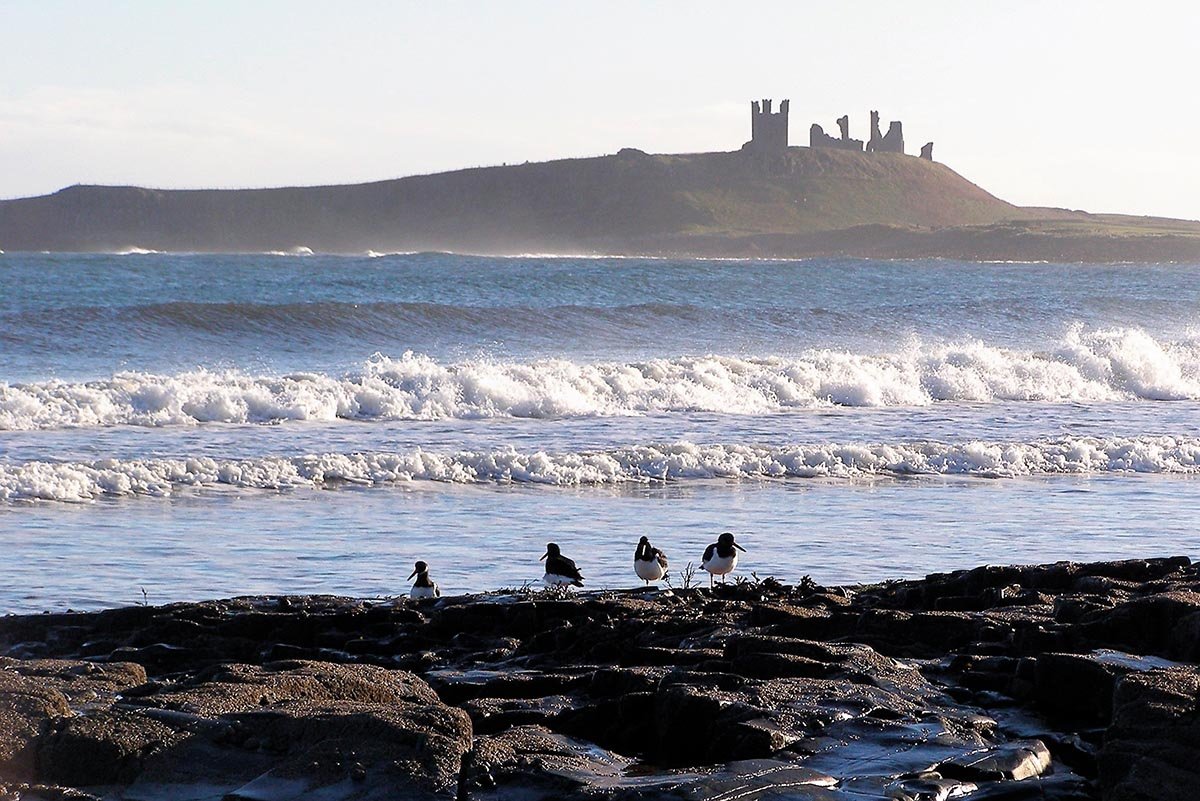
This tranquil view of Dunstanburgh belies the coast’s often violent past
First published in edition 208 of The Northumbrian, Oct/Nov 2025
As we enter remembrance season, John Grundy considers the centuries of coastal invasion and battle our region has endured, beginning way back when
The pretty picture that I hope you can see above almost sums up for me what I feel about the Northumbrian coast – largely calm and sublime, a beautiful sea, a few watery birds, tranquil sands. If you could glance off just to the right of the picture, you would also see tall, unspoilt sand dunes covered in rough seaside grasses.
It’s an unbroken, natural world, utterly peaceful, except that lurking on the far horizon, as there is so often on our coast, there’s a stonking great castle on top of a stonking great cliff. On this occasion the castle is Dunstanburgh, but it could just as well be Bamburgh, Lindisfarne, or even, just beyond the coast but visible from it, the splendours of Warkworth. These are all perfect illustrations of the Northumberland coast’s warlike past, and I’ll probably come back and try to say something meaningful about them in a moment or two. But first of all, to return to the original picture, if you could imagine yourself glancing right towards the sand dunes lining the beach (and to the top of the page opposite) you would see a small memento of a very different war from a very different time. It’s a little pillbox almost buried in the sand and among the grasses. It dates from the early years of World War II, when it suddenly seemed frighteningly possible that our lovely coast might suffer a seaborne invasion.
Actually, it scares me, this little warlike building, in a way that our great castles don’t. It brings home to me the possible realities of what it would have been like to be a defender confronted by the enemy, face to face on a familiar shore. As you may know, I’m quite a nervous little man, so I find it too easy to imagine a superior officer ordering me to take up position there in an emergency.
“Okay, Grundy, this is it. An invasion fleet of tanks and troops has been spotted. There are thousands of them on their way and it’s our job – actually, it’s your job, Grundy – to stop them. So, I want you to go and sit in that tiny little place at the foot of the dunes, and when they land and are advancing up the beach, I want you to shoot them all. Is that clear?”
In the last couple of years, as significant anniversaries of the 1944 Normandy Landings have been marked, veterans have shared terrifying accounts of being on a beach during an invasion. The focus has tended to be on our side, to see the attack through the eyes of the brave British and American invaders leaping unprotected from their landing craft onto an exposed and heavily defended beach. Funnily enough, I have never really considered the possibility of that happening here on our coast. Yet my interest in Northumbrian history should have made it clear, since it’s probably happened lots of times over the last few thousand years.
Take, for example, the “stonking cliff”. The one under Bamburgh Castle was the scene of a hill fort in the Iron Age and I don’t suppose its builders isolated themselves on top of a rock like that unless they were concerned with the need to protect themselves against attack from other tribes and, eventually, the Romans. Indeed, the Romans did attack them and built a signal station on top of their settlement. Years later, when the Romans pulled out of Britain in the 5th century, it was Anglo-Saxon invaders who moved in and made the place their own.
To be honest, in none of those changes of ownership is there any evidence of full- frontal attacks from the sea. There might have been, but I don’t think there’s any way of knowing for sure, except for the attack on the Saxon monastery on Holy Island on June 6, 793, which was by all accounts as full-on as they come. The Vikings had arrived, and it made headline news all over Europe. This is how I described the attack in a book recently: “The weather had been really awful recently and ‘terrible portents had come about over the land of Northumbria and miserably frightened the people’. Not only that, there were immense flashes of lightning and, even worse and even more unexpected, fiery dragons were seen flying through the air. I think you always know, when you see fiery dragons flying through the air, that something unpleasant is about to happen, and of course it did. The Vikings appeared out of the sea and wrought terror. In fact, one correspondent wrote that ‘never before had such terror appeared in Britain’. The attackers had left the church of St Cuthbert ‘spattered with the blood of the priests of God, despoiled of all its ornaments’.”
The event is commemorated in the Lindisfarne Priory Stone, a 9th century grave marker which on one side depicts seven warriors with bulging tummies waving their arms in the air and bearing mighty swords. I suspect you needed to see it when it was new to get the full effect, but you can see it in the priory museum and on the right of this page. There is a Victorian depiction, one of a magnificent sequence of paintings at Wallington Hall by William Bell Scott and also on this page to the right, which definitely conveys some of the shock and awe of the incident.
The other seaborne invasions of Britain – the permanent settlement by the Vikings and the arrival of the Normans after 1066 – occurred elsewhere in the country and don’t seem to have impinged directly on our coastline. That is except once, oddly, in 1690, with the last invasion of our island when a French force landed at Druridge Bay and sacked the village of Widdrington for reasons I have never ascertained, but which I suspect are to do with the exile in France of James Stuart, Roman Catholic son of Charles II who had dreams of returning to England as king, and the English determination to stop him doing so.
Interestingly enough, Druridge Bay and Widdrington is a useful place to return to the World War II theme of pillboxes and coastal defences. The coast here is beautiful, a splendid sweep of sea and shore flanked by unspoilt dunes. Standing on top of the highest of the dunes provides one of the great unsung views of the coast, but being at the bottom of the dune with the tide in is to be transported back to the early 1940s, when fear of invasion stalked the land and furious attempts to make our coastline a fortress left reminders all the way from the mouth of the Tyne to Berwick.
The shore at Druridge is entirely lined with tank traps, 3ft-4ft cubes of concrete. In my picture of the scene overleaf, a Grundy is celebrating the sturdiness of these concrete blocks and the closeness of the encroaching tide. When we were there, one of the blocks was enriched by a collection of neatly laid out geology and some weathered and eroded glass.
There are examples of similar tank traps on Bamburgh Beach and they have been more permanently decorated with artistic graffiti that has always tickled my fancy. It is interesting that on the whole, these many hundreds (possibly thousands) of lumps of alien concrete not only remain all along the coast, but are accepted, sometimes taken for granted, and quite often used in the way that natural rocks are as part of the beach – things to lean on, shelter behind or leap from. What I have never found out, though I’m sure somebody will know and tell me, is where they were made in such numbers in the early years of the war, and how they were manoeuvred into place.
And they weren’t alone. When you start to look into it, as early as 1940, when the war was barely underway, there were hundreds, possibly thousands, of defensive structures strung along the coast, many of which have left vestiges of themselves if you know here to look. There were great barriers of barbed wire and pillboxes almost everywhere, especially in places which offered broad views of the sea. Many places had roadblocks and sometimes there were trenches and even minefields. There were special ditches dug to deter the possibility of glider-borne attacks, while in other places there were new emergency airfields just behind the coast. People still describe the wartime beaches of Normandy as Fortress Europe. Well, we clearly had a Fortress Northumberland.
The defences were never needed, but they were there and, to a surprising extent, they still are. In fact, the coastal defences started before the war. For some reason there were a number of gun batteries built facing the sea in the late 19th century. I’m not sure where the perceived threat was coming from then, but in World War I, after Hartlepool had been bombarded by German warships in 1916, defences against seaborne attack began to be strengthened along the whole North East coast, and they were strengthened again after 1939.
Tynemouth Priory is one of the great examples. It is like a concentrated version of the castles and 20th century defences further north, with the extraordinary brutal efficiency of the gun battery and all its associated underground corridors and shell stores and so on nestled in the lea of the beautiful 13th century priory. It had, and has, a searchlight station too, and towering above Percy Gardens, just inland from the priory, is a remarkable seven-storey concrete building which was a watchtower from which the activities and accuracy of the gunners in the battery could be controlled. It’s a house now, seven storeys high, one room on each floor and, as far as I recall, no lift. Tough folk in Tynemouth!
One other site to mention is a real rarity, recently restored and eminently visitable, and that’s Blyth Battery. It too was started in the 19th century, remodelled between 1914-18 and again after 1939. Like Tynemouth, it had two 6 inch guns facing out to sea, searchlights, and a mass of ancillary buildings all built in concrete. It’s just south of the entrance to Blyth Harbour, which was one of the country’s key coal-exporting ports in those days and an important submarine base. The fort’s job was initially to protect the port, and it had a small garrison of ten men to do the job, but as the war progressed and more batteries were added up and down the coast at places like Amble, the garrison expanded to 110 men and five officers.
I blush prettily when I think how little I knew about this rapid and formidable fortification of the coast, and how little I know about how much it affected the people who lived on the coast in those days. I know more about the subsequent airborne attacks on Tyneside, but absolutely nothing about the coast further north. My dream is that somebody will let me know.