
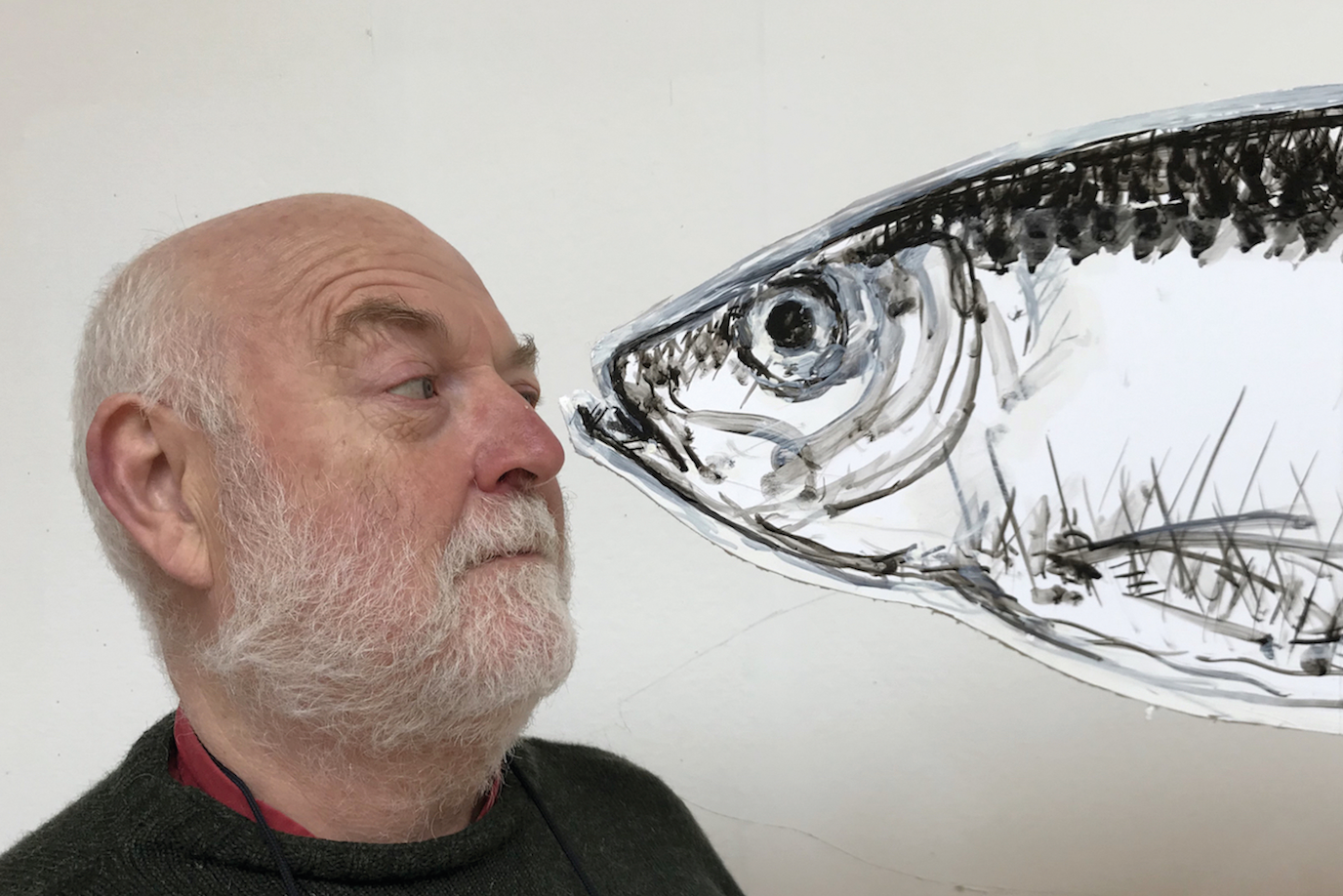
Graeme Rigby meets a herring courtesy of the artist Keith McIntyre
First published in edition 212 of The Northumbrian, June/July 2026
Rosie McGlade meets the man behind a remarkable 462-page herring history and learns what happens when curiosity, maritime heritage and one very underrated fish collide
It is 27 years since Graeme Rigby took up his obsession with herring. In the years since he has followed various other passions, working for 20 years with the influential Amber Film & Photography Collective to document the North East’s working heritage, and turning his hand to poetry, comedy and jazz. But, he says, “the herring has just taken over.”
The result, his life’s chief work, the recently published Rigby’s Encyclopaedia of the Herring, is a substantial tome of 462 pages. In Rigby’s hands, the herring is the lens through which our own quirky story unfolds. While the humble fish may have slipped from discourse, it has, it seems, stirred up wars, sustained armies, and shaped our country’s very history and culture. With all the curious facts he came upon, the tangents and the ‘wild cards’, as he calls them, Graeme felt the only way to do the herring justice was through an encyclopaedia.
C, for example, is for Caribbean and West African Food. F is for Farting, I kid you not, which is an unfortunate habit of herring when caught. H for Herring Lasses, K for King of Fishes, the book’s subtitle, and O for Olivier, Laurence, far from the only figure of note to grace its pages. Under S we have Smith, Adam: The Wealth of Nations, though it could easily be Shakespeare as he too makes an interesting contribution. Y, which comes for obvious reasons at the very start, is for Why, which is the question he’s been asked for 27 years.
We meet at the Fish Quay in North Shields, and Graeme opens with the first of many facts: you can see herring shoals from space. They can be as massive as 5 miles wide and 12 miles long, and when they’re spawning they turn the water pure white, though this being a family magazine we won’t go into why, precisely.
In 1997 Graeme was commissioned to make a series of radio documentaries about dried fish for Radio 4, which became known as Rigby’s Red Herrings. Red herring, we should clarify, is a fish that has been heavily salted and then smoked until it takes on a deep reddish-brown colour. Historically, it was a cheap and abundant preserved food. The curing process made it tougher, saltier and more durable than lightly cured herring like kippers (which come later). In the great fishing centuries, enormous quantities were exported to armies, navies and industrial workers at home and further afield.
“Red herring is very strong smelling, which is why it became used as a term for a distraction,” Graeme explains. “It was once used to steer pursuing hounds from a scent.” Interestingly, you can still get hold of it to this day. Graeme says it’s like a fish equivalent of beef jerky.
Back to Rigby’s Red Herrings, and Graeme recorded several programmes focusing each on Arbroath Smokies, lamprey pie, and dried cod from the Lofoten Islands in the Norwegian Arctic Circle. The only one he struggled with was red herring itself, because unlike cod, haddock or whatever, the span of the herring’s story seemed endless. Hence the encyclopaedia. “It’s organised by letter so every story can find its own space,” Graeme explains. “People have forgotten how significant herring is and people here don’t eat it much, which is ridiculous because it’s really tasty. People want fish they don’t think is fiddly, but you just lift the bones out – it’s easy.
“Just the zoology of the herring alone is incredible, like the way the spawning can be seen from space. There is so much white herring sperm in the sea it’s incredible.”
Ahh, he said it . . .
The reason herrings do well, and bounced back from near decimation in the 1970s, is because of this vast shoaling habit. Dolphins and killer whales take their fill and there will still be millions left. Only humans use nets, which the Dutch began to do in earnest in the late Middle Ages, sending what became known as ‘herring busses’ to English and Scottish waters to work the sea heavily. “But oily fish will go off quickly,” Graeme explains. “You have to learn to cure them.” On their herring busses, an early form of factory ship, the Dutch did all the gutting and salting on board. “And once you cure them at scale you have to start selling them beyond your community because you will never eat them all.”
Thus trade took off, and herring, in its unending preserved supply, began to make the Dutch very rich, a fact that didn’t go unnoticed by the Scots. “The Stuarts got upset, and King James declared war. The first three Anglo Dutch wars were substantially about herring and through it an attempt to break Dutch supremacy.”
For a passion to endure for 27 years – especially one about herring you might add, though hopefully you’re now beginning to see the light – there must have been many moments that made Graeme’s eyes light up during the course of research. One such discovery was the link between these wars and his home village, Chopwell, near Gateshead: the flagship commissioned by King James’s son Charles I to humiliate the Dutch was built with oak from Chopwell Woods. “And it has never been the same since all those healthy oaks were cut down. I live next door to it,” Graeme asserts.
That ship, the Sovereign of the Seas, was magnificent. “Van Dyck [the great Flemish artist] did the colour scheme – it was all decked out in black and gold. Thomas Heywood, a playwright and set designer, was in charge of the carvings. £6,000 was spent on gold leaf, which was a colossal amount of money in those days. The Dutch called it the Golden Devil.”
Gradually, the British came to dominate the trade. By the 19th century, communities from Shetland to Yarmouth were making herring fortunes as vast seasonal industries developed in fishing, curing and packing; boat-building, barrel, rope and net making; and export. Seahouses, Newbiggin and North Shields prospered and for ordinary people, especially the working poor, herring became a staple food. It was cheap, nutritious and available in huge quantities. Salted, smoked or packed in barrels, in the days before refrigeration herring was one of the few affordable proteins that could be preserved and transported at scale. Hence the ‘C for Caribbean’ entry: huge quantities of red herring, cured so heavily it could last a year, were shipped to island plantations as food for the enslaved workforce. The enduring popularity of salt fish there today is in part a legacy of that dark history.
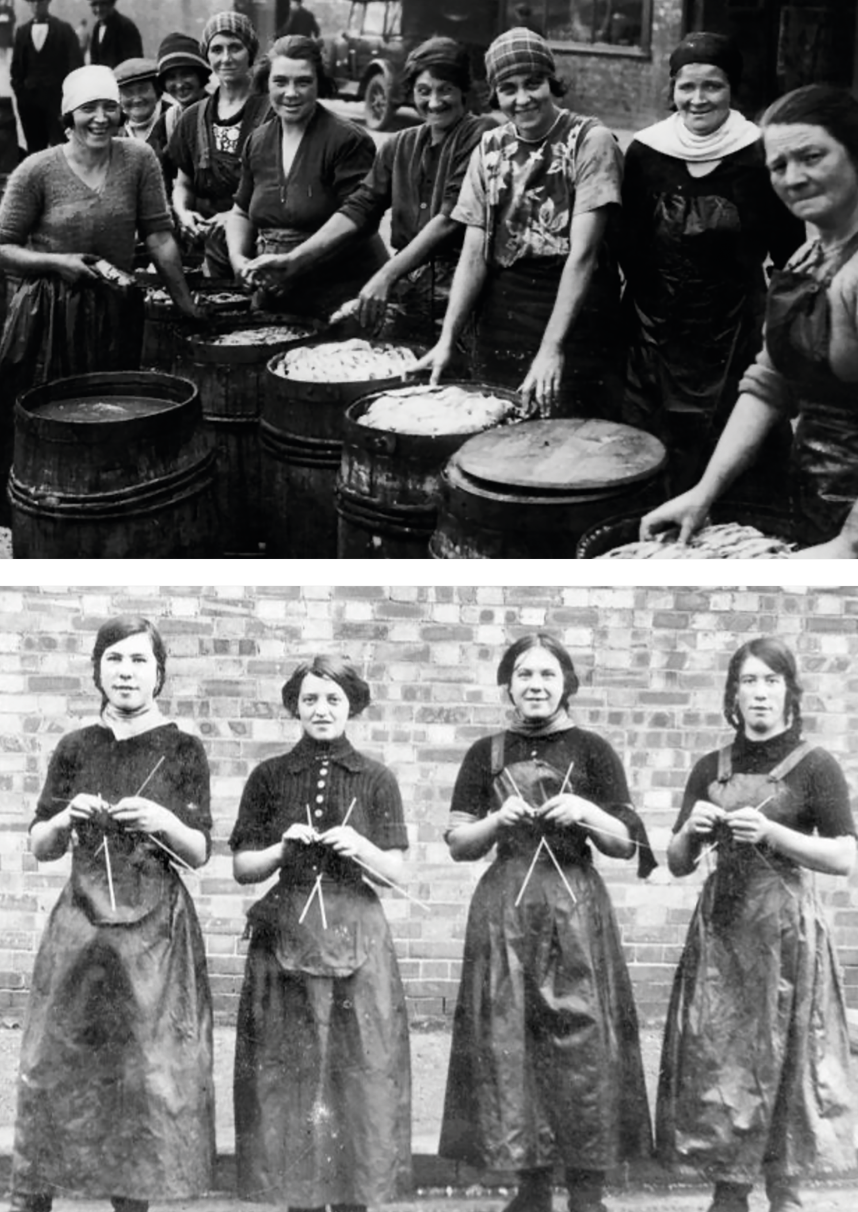
Scottish (top) and North Shields (bottom) herring lasses
F is for fasting, relevant in Catholic Europe because on Friday and throughout Lent meat was forbidden and fish encouraged, and it was red or salt herring to which people turned. “One of the key selling points of the Reformation was that people didn’t have to do that fish thing any more,” Graeme says, with the wry humour that runs through the book. “In England there was a deep resentment of having to eat it all the time. People got bored of it.”
H is for Herring Lasses, the iconic coastal heroines who did all the gutting and the barrel packing and travelled in droves from one port to the next, following the herring season south. “It used to be thought that there was just one huge herring migration shoal going all the way down the coast, but now we know there are different populations that spawn at different times, and the herring lasses would follow them, starting in Shetland in June and working their way down the coast through Seahouses, Shields and so on, and reaching Yarmouth for the spawn in September into November, and even into the Channel in January.”
Mostly they were Scottish, but not all. “The Scots began to crack quality control before the English in the 18th century. They sought to up their game in order to sell to the top end of the market, and as curers they became very dominant. “Britain would sell vast amounts to Germany and Russia – they were by far Britain’s biggest market. They were keen on salt herring in particular.”
As they followed the herring south, the Scots needed thousands of women they could rely on to process the fish, so they would bring their daughters and grandmothers to work on the quaysides. It was an incredibly skilled job, very repetitive, and fairly common for a woman to process 40 herrings a minute. Some could do up to 60. They might hire local herring lasses, but it was the Scots who set the quality of work expectations, working in teams of three with the tallest packing because they had to reach down to the bottom of the barrel to lay the herrings properly.
“It was an early industrial process. They would perhaps start at 9am and they would work through sometimes to 1am or 2am. They were known for their singing, too, and when they weren’t working they would be knitting. I have photographs of them walking to work, knitting as they walked.”
The practice died out as the herring fisheries collapsed between 1940s and 1960s, but the lasses endure in living memory.
So what happened to herring? “It was a very prosperous industry until World War I when Germany and Russia were short of hard currency. They had to find people who could sell it to them cheaper, and they also started developing their own industry. Then people got wealthier and wanted fancier things. Herring was thought of as cheap. We also had the herring crash of the 1970s and people got out of the habit of eating it.”
Kippers, under K, were invented in Newcastle in 1843, give or take a year or two Graeme says, when the arrival of the railways and speedier transport meant that the lighter, two-week cure would allow for more timely distribution to market. John Woodger moved here from his native Hampshire to run a Newcastle pub and diversified. As the kipper took off, he sent members of his large family to run smokehouses in Seahouses, Newbiggin and North Shields, up to Eyemouth and over to the North West. He also went down to start producing it in Great Yarmouth.
With work on his encyclopaedia now finished and the book on the shelves, Graeme is busy giving talks and preparing for a visit to Ullapool and the Shetlands, so herring is still in his life. And as for the future? “I’m not abandoning the herring. I’m still finding out new stuff. There’s so much going on today with the development of genetics in archaeology which is transforming what we know about where and when people were eating herring in the past.”
Another book? He’s not saying no. “It’s a bit niche, I know, but I’ve never been bored since the day I started. Mackerel, cod; there just aren’t the stories. It’s a very, very interesting fish!”
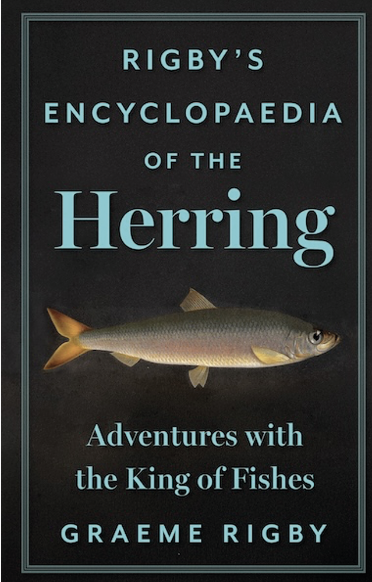
Graeme’s book