
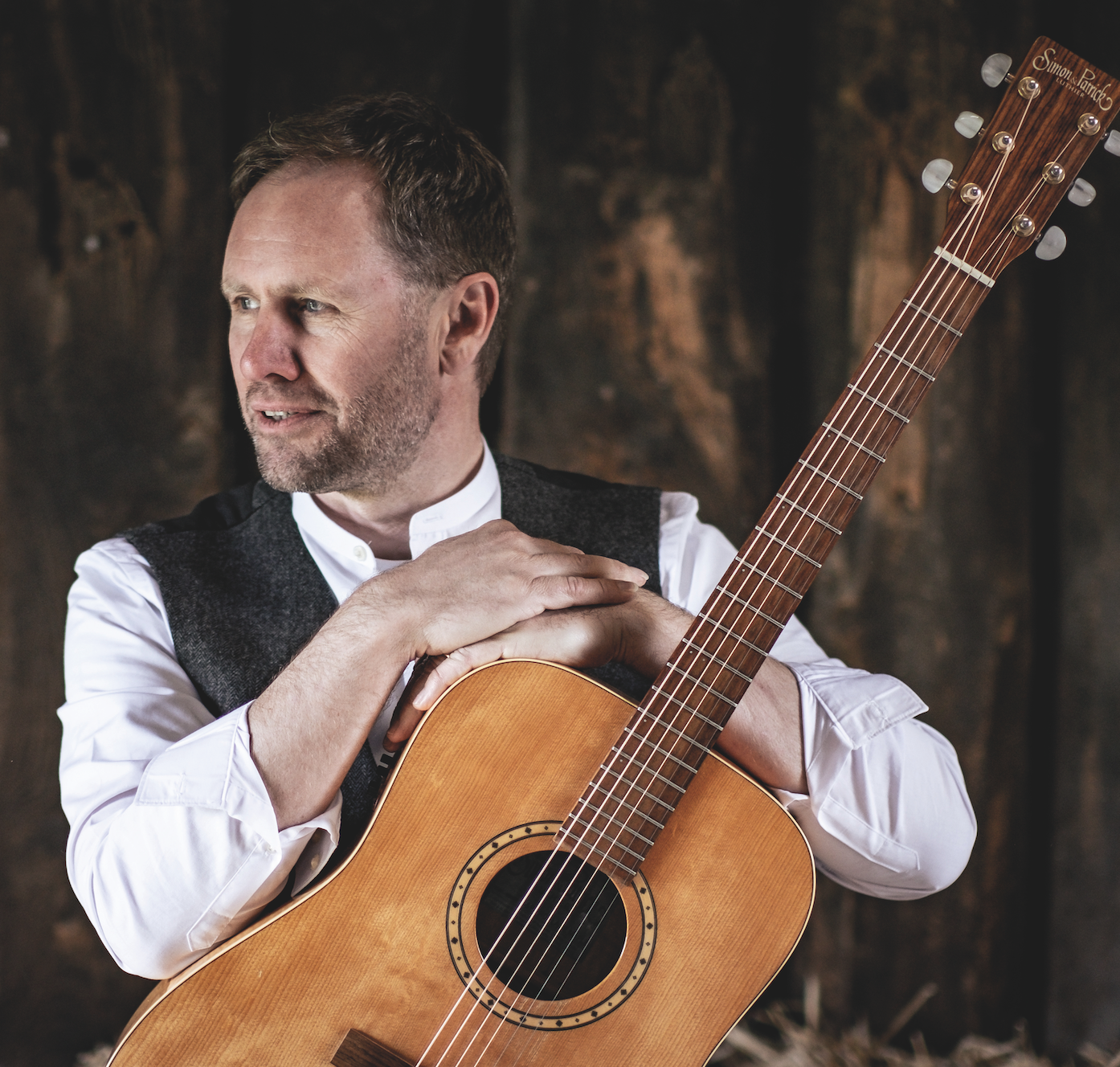
Gareth Davies-Jones
First published in edition 211 of The Northumbrian, April/May 2026
Jane Pikett meets Gareth Davies-Jones, who walked 140 miles from Lindisfarne to Durham Cathedral, turning pilgrimage paths, landscapes and chance encounters into music rooted in place
It is 7am on a June morning and mist lies low over the vast expanse of Holy Island’s exposed Pilgrim Sands. Gareth Davies-Jones surveys the scene with a mixture of anticipation and apprehension. For he is about to embark on a long, solitary walk, a small guitar on his back, a portable recording device in his bag, and – for this stretch across the sands at least – only his bare feet on the ground.
“It was one of those silvery-grey mornings, the sun just pitching in in places, and sound of seal song on the air,” he remembers. “I don’t think I was quite prepared for how profound it would be. When I got to the other side, I had to sit for half an hour, just to take it all in.”
His destination was Durham Cathedral, around 140 miles to the south. His route followed St Oswald’s Way and the Way of Light, tracing ancient paths through landscapes shaped by early Christian history. The wandering minstrel hoped the journey would inspire new music that would “well up out of the trail”. And so it did, over nearly two gloriously sunny weeks – an experience etched into his memory and into a new album, A Troubadour Journey.
Gareth traced coastal path, farmland and valley, stopping on the way to perform intimate concerts in churches, village halls, and community venues. He stayed with friends and friends of friends who had volunteered their spare rooms, intrigued by the idea of a modern-day minstrel carrying story and song from place to place.
As he walked, the guitar slung across his back often sparked curiosity. Some encounters were brief and cheerful; others unfolded into deeper conversations. One, beneath a bridge near a coastal tern colony, began when a National Trust ranger noticed him recording birdsong. Their chat moved from wildlife to pilgrimage.
“Her mum had been ill and afterwards they walked a stretch of the Camino de Santiago to spend some time together after a difficult period in their lives,” Gareth recalls. “There they experienced the profound nature of walking; how it brings things to the surface you don’t often get the chance to think about.”
Gareth hoped new music would emerge from his experience of walking; from the places he passed through and the people he met along the way. As he travelled, he recorded fragments of sound: birdsong at dawn, the crunch of boots on gravel, the breeze across open fields, distant church bells. When he later replayed these soundscapes while writing, they carried him back to the journey and helped to shape the music and words that followed.
The idea for the trip had been quietly forming for years, sparked by a conversation with David Pott, pilgrimage consultant for the Diocese of Durham and the driving force behind the six Northern Saints Trails, including the Way of Light. David had suggested the possibility of interpreting the region’s pilgrimage routes through song. The pandemic brought the idea to a halt, but when Gareth began thinking about a new album last year, the notion resurfaced.
He decided to follow two great pilgrimage paths. St Oswald’s Way winds south through Northumberland’s coast and countryside to Heavenfield near Hadrian’s Wall, where it joins the Way of Light to Durham Cathedral. Together, the paths link Lindisfarne to the shrine of St Cuthbert, charting a thread of history that stretches from early Northumbrian Christianity to
St Cuthbert’s shrine at Durham.
To walk these paths is to move through layers of history. To walk them with a guitar and a series of concerts to perform is to add another layer still. On a practical level the journey was physically demanding. There were blisters, and some days pushed Gareth’s endurance. The toughest stretch was the 23 miles from Hexham to Edmundbyers. At its end, Gareth had little energy left, yet that evening he was due to perform for people at the village church. Arriving in Edmundbyers, Gareth stopped to say hello to the locals organising the concert. Only then did he realise the youth hostel where he was staying was still about 1,000 yards away. Not far, but after 23 miles on the trail it was 1,000 yards too many, and he had to ask for a lift.
“When your body knows you’re done, you’re done,” he says. A couple of hours later he was hobbling back to the village church for the concert, unsure whether he would manage it, but the show went on.
The album inspired by the trek is released in April. Recorded with producer Graeme Duffin, the collection draws on melodies, lyrics and ambient sounds born of those June days, shifting between specific moments and broader impressions of place. The opening track, Beginnings, reflects the start of the journey at Lindisfarne, capturing the vastness of the Pilgrim Sands, the silence but for seal song, the shifting light, and the feeling of setting out on a journey whose meaning was not yet clear. The song, which features a string arrangement by Scottish fiddler Seonaid Aitken, conveys, Gareth says, “the sense of journeying into something, or beginning something, that you don’t quite understand.”
Another song on the album, The White Blade Prince, draws on the story of St Oswald. Discovering that Oswald’s name was rendered in Irish as the “White Blade Prince”, Gareth built the song around the mythic sense of the king’s return from exile on Iona and his invitation to the monk Aidan to come to Northumbria and found the monastery on Lindisfarne. The album closes with a reflection on Gareth’s arrival at Durham Cathedral, exhausted but ecstatic, and just in time for evensong, as he had planned, on the eve of midsummer. After the service, he was given the small pewter pilgrim’s token traditionally presented to those who arrive at Durham; a quiet but powerful marker of the journey’s completion.
The album is deeply rooted in all its places, and its visual identity grew out of that sense thanks to the work of Northumberland-based artist Rebecca Vincent, whose artwork for the album cover is called Echoes of the Past, Lindisfarne.
Place matters deeply to Gareth, a softly spoken Ulsterman who grew up in Bangor, County Down, and has been rooted in Northumberland since moving to Newcastle for university three decades ago. Describing himself as “part Ulsterman, part Northumbrian”, he has long been drawn to locations on the edge of things, from remote coastlines to solitary lighthouses. Such places, he says, carry layers of meaning; practical structures but also symbols, surrounded by stories and shaped by the landscapes they inhabit. “When you walk through a landscape,” he says, “it all collides; the aesthetic, the history, the nature of community, who the people are, what’s gone before.”
Those elements – landscape, faith, history and collaboration – have come to define the album that emerged from the walk. “When I did it in June 2025 we had the most extraordinary weather,” Gareth says. “It made the whole experience even more uplifting, because the expanse of these two fantastic counties literally opened up in front of me. There was an incredible sense of space as I walked, and I hope that comes through in the music.”
Gareth sometimes collaborates with other artists, often via his publisher Phil Simpson of First Original Music. Usually that means sitting in a room together to see what might emerge, but the pilgrimage project suggests a different approach. “What if,” he says, “instead of sitting in a room trying to write, you walked together and saw what happened?”
The idea fits naturally with another strand of his work. Over the years Gareth has led community music projects with organisations including the NHS, Traidcraft and The Common Room in Newcastle (formerly the Mining Institute). Working with communities and collaborating on some projects with his singer-songwriter daughter Bronwen Davies-Jones has reinforced his belief that songs often grow from shared stories rather than individual inspiration. “The deeper you get into it,” he says, “the more you realise that songwriting is almost like telling people’s story back to them.”
The walking project reflected that philosophy too. The concerts along the trail became opportunities not just to perform but to listen; to hear local memories, experiences and reflections that gradually fed into the music. This June, marking the anniversary of the walk, he will return to several of the communities that hosted him with a series of concerts in the places that inspired them, bringing the project full circle.
There is something compelling about the image of a lone musician setting out across Northumberland, trusting that songs will emerge from encounter and effort. In an age of speed and digital immediacy, the deliberate slowness of the project feels radical. For Gareth, the songwriter simply captures moments that are already in the air. He recalls the philosophy of Welsh singer-songwriter Martyn Joseph: the idea that songs are not so much written as caught in passing. “I love that thought,” Gareth says. “That something passes in the breeze and you just happen to catch hold of it.”
There is a long tradition of pilgrimage and of song in the North East. A Troubadour Journey suggests that the two still have much to say to one other. The old routes are not relics but living paths that pass through modern communities. And the travelling musician – attentive, open and unhurried – may still find that the landscape has music to offer.
THE MUSIC
You can purchase the album inspired
by the walk at:
www.garethdavies-jones.com/music