
First published in edition 211 of The Northumbrian, February/March 2026
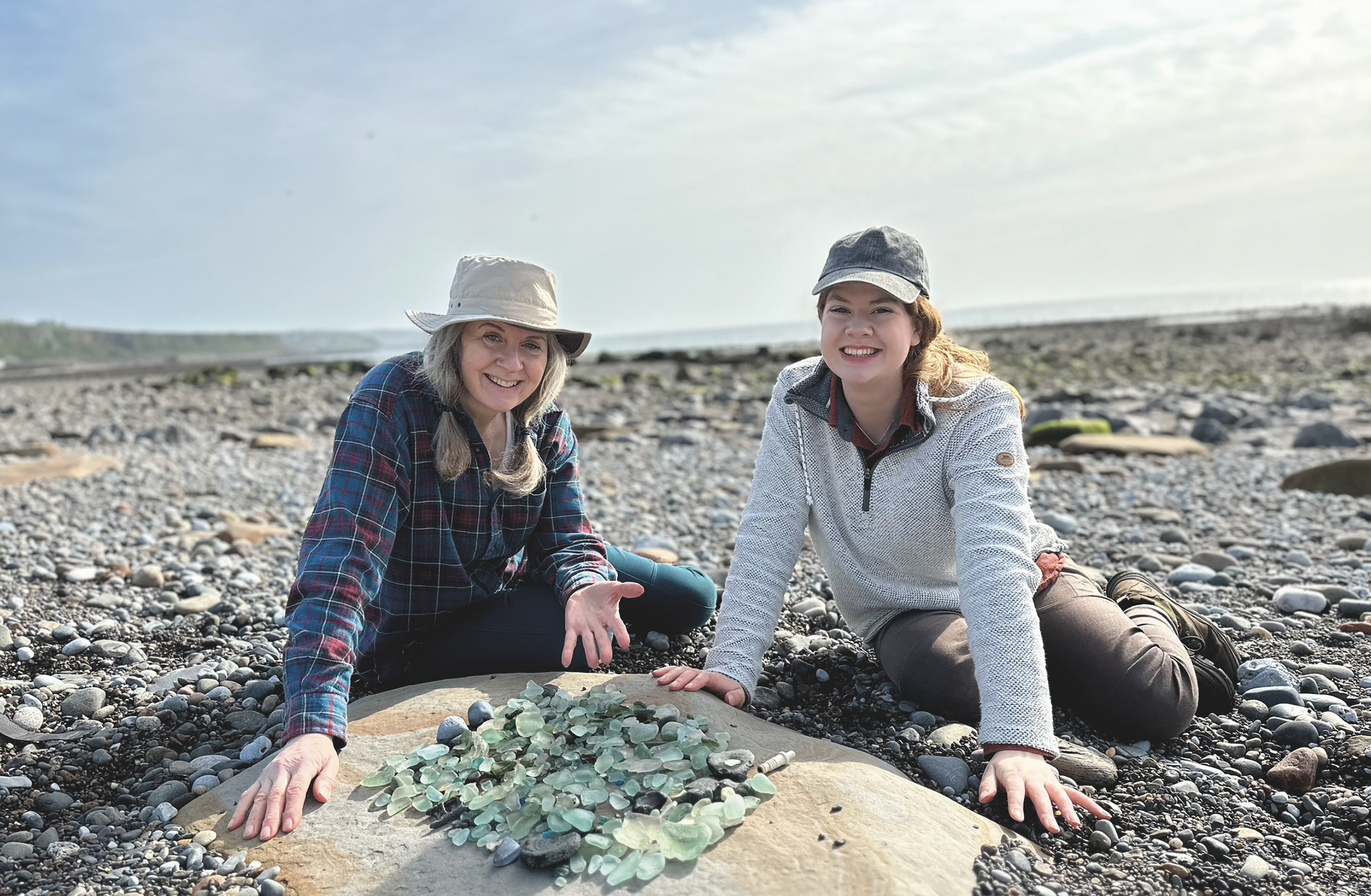
Some people never look down. Others spend their lives and make their livelihoods from doing just that. Rosie McGlade meets mother and daughter mudlarkers Gail and Alex Hildreth
It’s 9am below the road bridge in Berwick; it’s grey and freezing and there’s a brutal wind. Mother and daughter mudlarkers Gail and Alex Hildreth, regular visitors to the tidal gloop of the Tweed’s riverbanks, are nowhere to be seen. The ‘tiny treasures’ they unearth from decades, often centuries, of hiding, can guard their secrets for another day.
I’m gutted, but they were forced to call off our rendezvous as the gales would have wrecked the audio on their weekly YouTube broadcast. They had promised me fairy pipes, maybe gemstones, maybe more; this is partly a game of luck, as well as patience, once your ‘eye is in’. Their memory of sheltering behind rocks on Holy Island almost in tears from the cold doesn’t stop them, but wind is a deal breaker.
Gail and Alex are the real mudlarking deal. How impressive they are! Their relationship for a start – they appear to spend every moment together and share the same passions. The stuff and the stories they unearth paint a social history otherwise in danger of being lost. And their passion is now their living. Their YouTube channel has 110,000 global followers, and one of their broadcasts has had more than 1m views.
The term mudlarking derives from the late 18th century when it described impoverished, mostly young people who scavenged in the dangerous slop of the River Thames at low tide for debris to sell – bits of coal, rope and copper nails from ships. Today it describes amateur archaeologists who explore tidal rivers, ancient middens, old tips and such like.
Gail is the sort of person who can’t leave a mole hill unkicked. Born in Wallsend, she was making little museums from her finds by the age of five. Her mother was an amateur archaeologist, and by the age of 18, Gail was digging at Segadunum in Wallsend alongside respected archaeologist Charles Daniels of Newcastle University. In her twenties, she volunteered on digs along Hadrian’s Wall.
Alex, like her mother, grew up beachcombing and searching for treasures in rabbit holes under hedges at the Roman sites where Gail worked, literally leaving no stone unturned.
Near Alston, Cumbria, they volunteered to help landscape archaeologist Stewart Ainsworth locate a Roman parade ground. “It was only the third found in England,” Gail says. “Stewart told us to dig a test pit about a metre square, and as soon as we took the clods off the top we saw slabs underneath, typically Roman. Stewart said he was more excited by that than anything he’d done on Time Team on TV, which he appeared on many times.” Whitley Castle – Epiacum – is the highest stone-built Roman fort in Britain, and the best preserved, Gail says. But because of its remote location in the north Pennines it has never been dug.
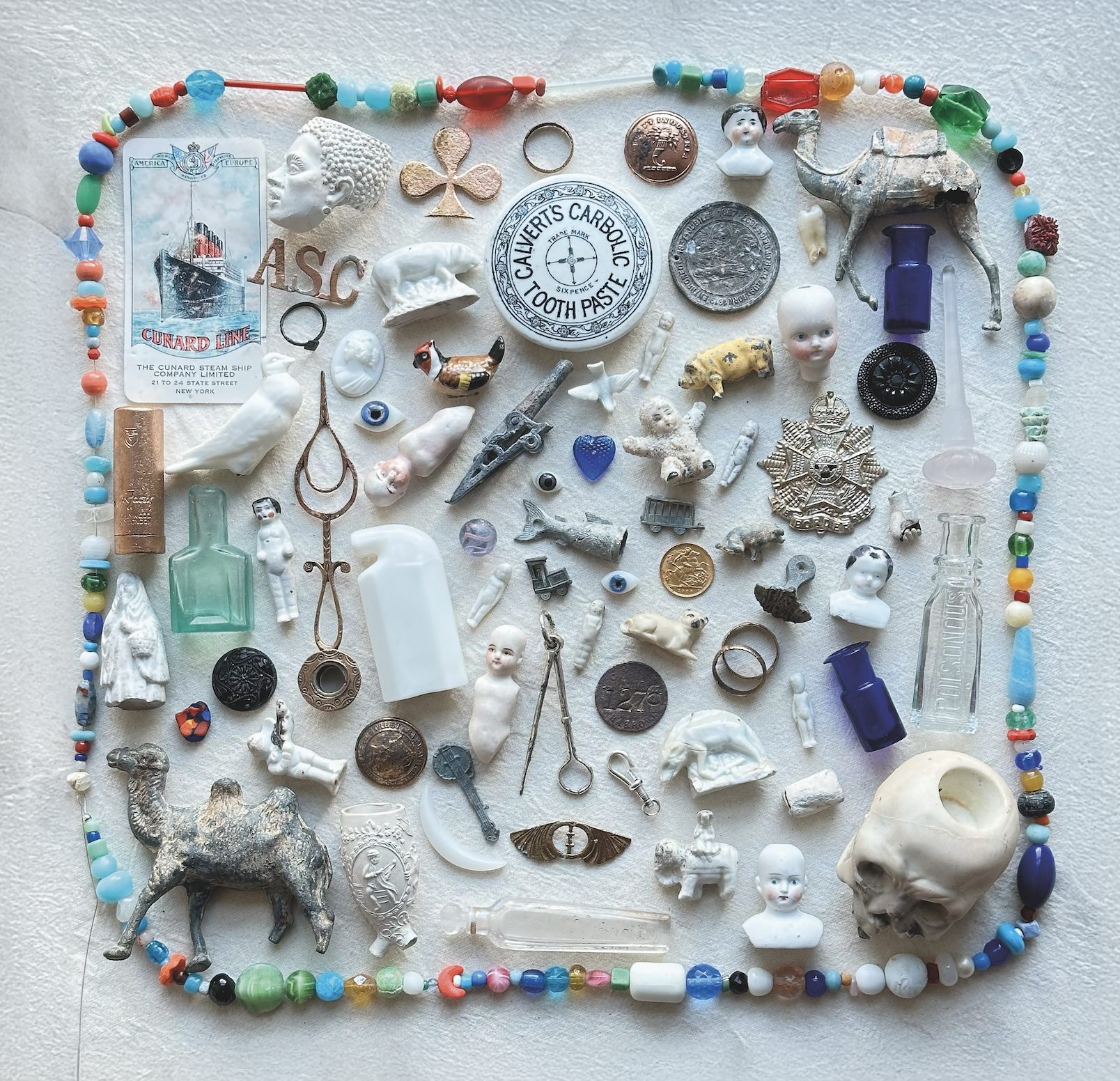
Some of Gail and Alex’s many thousands of finds
Gail and Alex live in the middle of nowhere in the Scottish Borders, where you can witness the ongoing restoration of their home on another YouTube channel. They scour the country east to west from Lancashire and Yorkshire up to Edinburgh, heads down, tools gently scraping the earth in a meditative search that almost feels like therapy. Estuaries and beaches are favourite locations, as are Edwardian and Victorian bottle dumps.
“They call them bottle dumps because the bottles are among the only things that survive,” says Gail, “but really they’re Victorian landfill sites. Before that they just had midden heaps and the rubbish was picked up and spread on farmers’ fields. Later, refuse was dumped on mostly unproductive land, or they would fill in old quarries with it. On old maps they’re called refuse tips. We usually go in after the bottle diggers have been and the rain has broken down the spoil heaps. We don’t do digging – we’re more like scavengers.”
They seek what they call ‘tiny treasures’ such as fairy pipes – 16th and 17th century clay pipes with bowls so small people who found them years later thought fairies must have made them. In reality, early imported tobacco was so expensive most people could only afford enough to fill a small pipe. “We’ve found very early ones from the 1500s,” Gail says. “They were used from the discovery of tobacco around that time until the mid-20th century. We find a lot of Victorian clay pipes. Cigarettes weren’t really a thing and cigars were expensive, so they smoked disposable clay pipes which you could probably get at the pub or tobacconist ready-filled. They’d use them a few times, then throw them away.”
Alex explains: “If you come larking with us you will absolutely find clay pipes. We’ve found them in our garden, and among shrubs in supermarket car parks. They made high quality ones for the wealthy, too, but working men and women smoked less elaborate ones.”
Poking through the silt and mud, finds are often half buried. “Once you get your eye in you start to notice the shape, colour and texture – that’s what we look for,” Alex continues. “The texture of a clay pipe is very different from a piece of porcelain pottery, for example.”
In the early days they would bring all the pipes home. Now they’re more choosy, just keeping the ones which have interesting or decorative features. Early pipes usually have the maker’s initials and mark on the heel, while later these marks were on the stem. “Mum researches them. We’ve found makers from Gateshead and Newcastle from the 1600s. There was quite a rivalry from one side of the river to the other.”
Charles Tennant & Son was a family clay pipe manufacturer based in Berwick in the 19th century. One of his sons moved to Newcastle and started making them there, Gail learnt. “If you find a pipe in the North East there’s quite a good chance it will be marked Tennant. Interestingly, Neil Tennant from the Pet Shop Boys is a direct descendant.”
“Mum goes on some real deep dives into the history of an object,” Alex says proudly. “That’s what we really love – connecting finds to people and telling their stories.” Tiny button finds are picked out with reverence. A fly button, perhaps, often with the tailor or draper’s name on it. “They’re usually local,” Gail says. “If you find a button with a name on it it’s probably a tailor or draper from that area. Sometimes they’re from the other end of the country and you wonder, did that person move here, or order their clothes from the south? There are stories in everything. We researched one tailor who worked his way up from a poor farm boy to owning a successful business and living in a huge house in Edinburgh.”
It’s social history that interests them – stories of ordinary people. “Theirs is a history that is being lost so it’s important to document it. If not, these stories will disappear,” says Alex. “It’s like putting together a giant jigsaw puzzle. We’ve found out so much about the lives of ordinary people.”
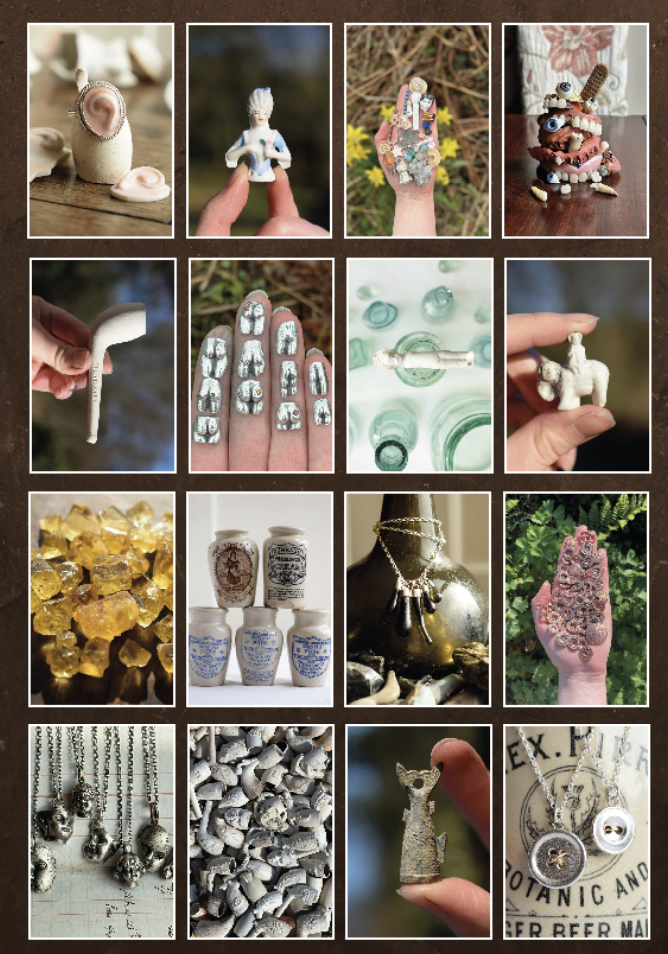
A selection of found items and pieces made by Gail and Alex
They share these stories through their YouTube channel, which they began in 2019. Back then, their internet connection was so poor, they’d have to drive half an hour to their nearest Sainsbury’s car park to use the supermarket’s wifi, Alex sometimes having to sit out in the rain with a coat over her head to get the video uploaded. Their channel was an instant hit, with dozens of new subscribers appearing every minute.
“We felt very awkward and camera shy to begin with, and even now if I thought about it too much I would worry,” Alex says, “but we’ve learnt to just get on with it. People from all over the world have been tuning in every week for years now. One about finding tiny garnets in Ruby Bay in Scotland has had over a million views.”
They also make jewellery and trinkets from or inspired by their finds, and sell them on an online shop called Folksy. It all sells out within days, much of it to America, mostly to their YouTube subscribers. Gail describes it as the weirdest shop going. There’s a beautiful silver pendant cast from a baby plum from their back garden, and another cast from a poppy head with a tiny leaf on the reverse. There’s a silver pin badge cast from a 1930s pressed glass bead, and beautiful rings inlaid with tiny sapphires. There are charms made from Victorian slate pencils used by children who would sharpen them on school walls. And there’s a silver charm of a little bottom cast from a tiny porcelain doll with a little pink sapphire in one of the cheeks. They’ve even made earrings and rings featuring tiny china doll ears.
The collection, bar the palm-sized leather-bound notebooks handmade by Gail, is set or cast in silver, hallmarked and stamped with Alex’s unique maker’s stamp. Neither of them knew anything about jewellery making until 2015, when Alex left school. They went to Seaham beach in Co Durham after hearing that beautiful multi-coloured glass dumped from a Victorian glassworks was to be found there. “You didn’t have the crowds of people looking for sea glass there that you have now,” Alex says. “People would come up to us and ask what we were doing.”
They went crystal hunting in the hills, scoured for Cheviot agate on the banks of the Coquet and Tweed, and began making jewellery, drilling holes and binding pieces with leather at first, then learning to work with silver. Before long Alex was a successful silversmith and, like her mother, an artist.
“Our first sea glass video might have been partly to blame for how overrun the beach at Seaham became,” Gail laments. Now they try not to mention locations. They had an experience filming a bottle sticking out of a bank near Berwick and a bottle hunter worked out where it was and undermined the footpath.
Ah, Berwick, the adventure that never was – for me, anyhow. They have found brooches there, a tiny silver dog, 400-year-old trade beads, and a hammered coin from the same era – old as the old bridge. Glass eyes from Victorian dolls. Entire pudding dolls. Pudding dolls? Tiny dolls the Victorians would put into puddings like we used to put sixpences in at Christmas.
“These little baby dolls are originally part of ancient tradition that comes from the Romans, as legend has it,” Gail says. “They would put a bean in the cake, and whoever got it was Master for the day. They still call them king cakes in America, where whoever finds the trinket in the cake becomes Queen or King for the day. The pudding doll was a big thing in the North East.” They’ve found more pudding dolls in the north than anywhere else. “Mudlarkers in the south don’t seem to find them anywhere near as much as we do,” Gail adds.
Their adventures continue in their studio, where they use all manner of dangerous looking equipment and liquids to melt coloured glass to turn into beads, fuse metals, or fire pots from clay they’ve dug from a nearby field. It’s all captured on another YouTube channel entitled Northern Mudlarks Make.
Wouldn’t you love a mother like Gail or a daughter like Alex? It’s in their blood, of course. They have traced ancestor mudlarks, only they wouldn’t have used the term at the time. “We’re very close. Very similar,” says Alex. “We share all the same interests and hobbies.” Gail says they almost read each other’s minds.
Their video – the one that would have been Berwick if not for the wind – features them on a rural riverbank hit by now receded floods. Straightaway, Gail pulls two beautiful glass perfume bottles from the sandy, stony ground. They go on to find five in total that they wash and display at the end of the video. There are three clay pipe stems stamped Tennants of Newcastle, one with teeth marks. There’s a tiny porcelain doll’s head; a handful of Victorian Codd marbles used as stoppers to seal carbonated drinks; a few beads; a quirky little porcelain leg, clearly that of a man; an old knucklebone games piece; and some pretty pieces of painted pottery.
The comments below the video are mostly from America. “You give me peace in our terrible days,” one says. “Thank you for sharing beauty and enthusiasm.”
For more on Gail and Alex’s adventures, visit: www.YouTube.com/@NorthernMudlarks
Their making channel is at: www.YouTube.com/@northernmudlarksmake
And for their Folksy shop, visit: www.folksy.com/shops/NorthernMudlarks/items
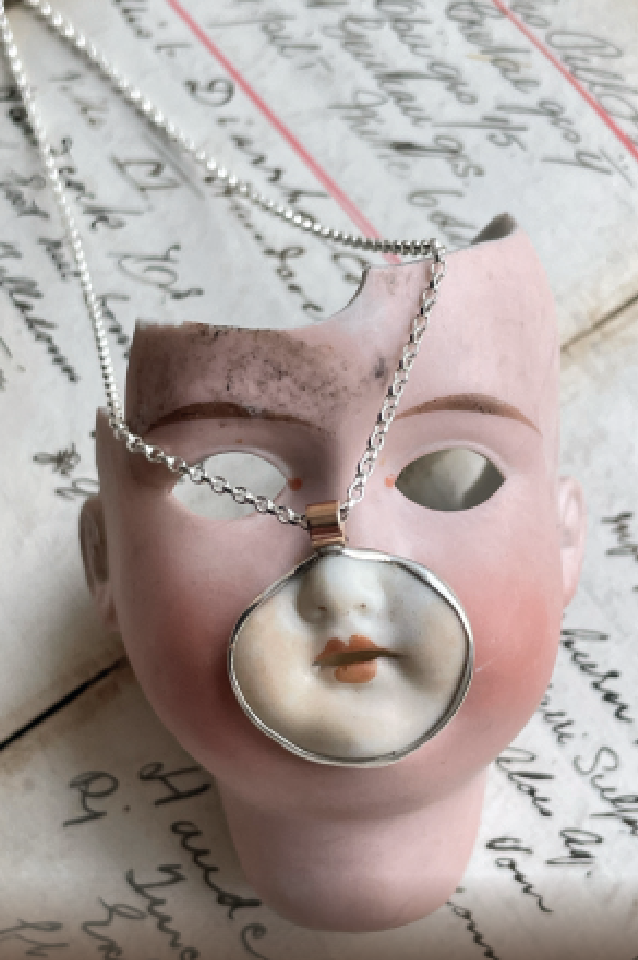
A pendant made from a doll relic