
Kes
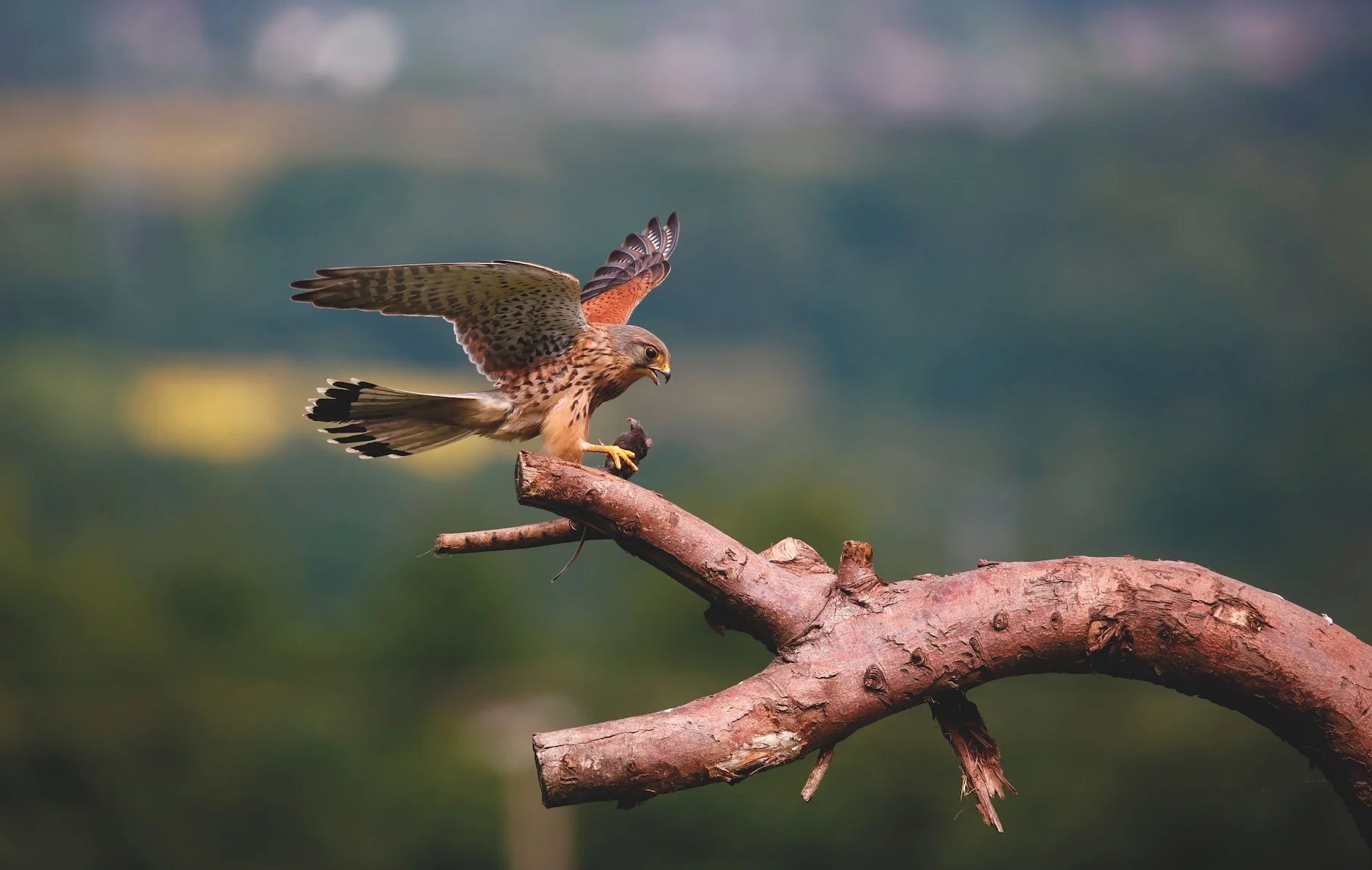
IAN KERR salutes that most accomplished aerial acrobat the kestrel, renowned for its skill and versatility in making its mark among our most treasured birds of prey
Watching a kestrel hovering on a windy day is to witness a masterclass of aerial skill, a bird using the elements in the endless pursuit of food.
Look closely and you will see its wings continually flex and bend while its broad tail fans and tilts side to side, working like a rudder to hold the bird in position. Only the head, held downwards for checking the ground below, is motionless; its large, keen eyes watching for the slightest movement to betray the presence below of a small mammal, bird or reptile.
If the bird is confident, it will dive vertically, taking its prey in a single snatch of needle-sharp talons before the victim knows what is happening. If the kestrel is in any doubt there is prey to be had, it will drop lower to hover again, re-checking the ground from a better position.
Only a few of these plunges end with the reward of a small meal. Many more fail, leaving the kestrel to try again elsewhere, its aerial skill lending it its old country name, ‘wind-hover’.
The kestrel’s favoured food is the vole, once described to me by a farmer friend as “a little chunk of meat with a leg at each corner.” It’s also willing to take mice, small rats, birds, frogs and lizards. I’ve even found the skins of adders, our only poisonous snake, at kestrel nest sites and places where they settle to eat.
The kestrel is the most plentiful and versatile of our four British falcons. It can exist just about anywhere, from mountain and high moorland to forest and farmland; even in the heart of our cities – anywhere it can hunt successfully and raise young.
It is adaptable, and in a lifetime of bird-watching I have witnessed a big shift in kestrel population and habits. In my younger days, when I was actively involved in ringing kestrels, mainly broods of white-downy youngsters, we regularly found them using ledges and crevices, even very small crags on the moors and rocky outcrops in forests.
That has now changed because of the presence of larger birds of prey which were absent a few decades ago. Then, our largest falcon, the peregrine, was few and far between, having been almost wiped out by the post-war use of organocholrine pesticides. These substances found their way to peregrines through the smaller birds on which they fed, building up in their bodies and killing them or causing them to lay eggs with abnormally thin shells which failed to hatch.
Goshawks, wiped out by game-keeping and other persecution in the Victorian era, made a comeback as a result of being released by falconers in an apparent effort to establish a wild population to be exploited for sport. Meanwhile, our now familiar buzzard was a rarity in Northumberland, only becoming common over the past two or three decades.
Now peregrines regularly haunt moorland crags while goshawks and buzzards routinely move out from forests and woodlands to hunt higher open ground. This has resulted in competition and danger for upland and forest kestrels, forcing them to frequent other areas, mainly on lower ground.
Although the kestrel has always frequented lowland sites, that has increased and far fewer now breed in the uplands. But, as mentioned, the kestrel is versatile, and unlike larger raptors it can nest almost anywhere. Like other falcons, it doesn’t build a nest, simply laying eggs and raising young in scrapes of whatever material is at hand. It may use tree holes, cavities in buildings, church towers and bridges. I’ve even known kestrels to raise young in temporary sites including holes between bales in haystacks, while they also take readily to large nest boxes.
Talking of churches, I recall a hilarious incident when a colleague and I were ringing a brood of kestrels at a chapel in Burradon, North Tyneside. Naturally, our presence attracted local children, and we heard one boy excitedly telling the others that kestrels were “birds of pray” because they nested in churches!
Kestrels also regularly use the old nests of other species, particularly crows. Back in the days when the Tyne was home to thriving shipyards, enterprising local crows, with no trees at hand for twigs or sheep to provide wool for nest lining, would occasionally build nests from wire and line them with rags, sacking and other soft materials. Kestrels had no hesitation in later years in taking over these strange, rusting metal nests high on cranes and other structures.
The kestrel can survive almost anywhere. It is just as content to hunt the grassy banks of busy roads and motorways, and over derelict industrial land, as it is to hover over pastures and farmland in its daily hunt for food. Areas with high concentrations of mammals, particularly voles, can attract small concentrations in winter and it is not unusual to find four or five hunting the same fields so long as there’s enough food to go around.
The kestrel is not above a bit of piracy, either. I recall two cases on Holy Island of local barn owls hunting at dusk and being ambushed and robbed by kestrels before they realised what was happening. In another incident, a kestrel tried to rob a short-eared owl, though this proved a much tougher proposition, taking just one harsh, barking call from the owl to send the kestrel packing.
Most kestrels are fairly sedentary and tend not to travel far from their birthplace. Ringing large numbers of chicks has shown that most don’t move much further than 60 miles from where they were born, though there are notable exceptions. Chicks ringed in Northumberland have been found some 600 miles away in distant areas of France, while others have moved to southern Ireland, Belgium and Holland. However, a youngster ringed at Smugglers Leap in Kielder was found dead two years later 1,500 miles southwards at Safi in Morocco, showing that some are much more adventurous and prone to wanderlust.
The kestrel is a fascinating bird. Perhaps next time you see one hovering by a roadside it might be a good idea, if you can park up safely, to pause and admire that aerial skill. You won’t be disappointed.