
Time travel
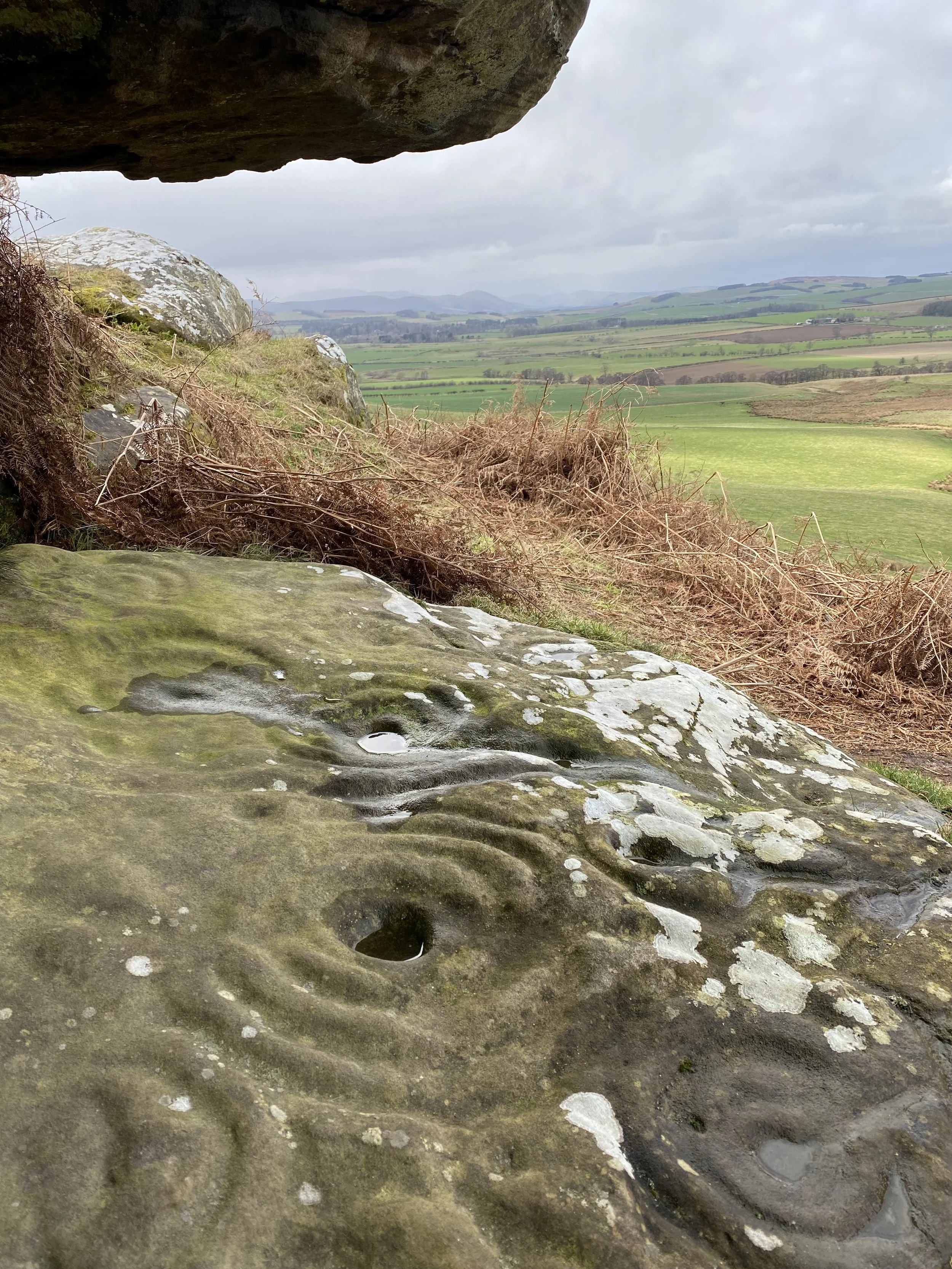
The rock shelter by Jacky Seery
First published in edition 196 of The Northumbrian, Oct/Nov 2023
Mike Pratt chief executive of Northumberland Wildlife Trust, marvels at the sense of tranquillity we can all enjoy in the wild and hidden natural places of the region
It’s hard to believe that a place so hidden can exist not very far off the A1 in Northumberland. Tucked into a side valley, on a small crag, I’m squatting under a rock shelter, an overhang of fell sandstone which juts from the cliff just below head height.
It’s a cramped refuge with an incredible view; a natural lookout in which to crouch away from the rain and gaze along the line of the River Till and into the distant Cheviot hills. A place to feel folded into the land and its history.
It’s not only this natural shelter and its position which are so inspiring. The floor of this intimate cave is covered in rock carvings; circles and swirls, some faint, some still strongly defined, picked out thousands of years ago by who knows who and for what purpose.
This little niche of prehistoric art has survived largely unnoticed, hidden under a rocky sheep lean in the Northumbrian hills for millennia, perhaps from Neolithic times. It is one of many such sites the Hexham-based world expert in prehistoric cup and ring marks, Dr Stan Beckensall, and others have discovered over recent decades. I’ve visited many of these and mentioned them in this magazine several times, and this is one of the most incredible. Indeed, that it is here and in such good condition in the 21st Century makes it something of a little miracle.
There is hardly enough room under the rocky protrusion for two smallish people to sit beside the carved rock floor. The site isn’t easy to find, and even when you do locate it, the rock art isn’t immediately visible. You can see it from slightly above on the approach path, defined for us by the badgers who live above it, or immediately on entry to the shelter – but not from the area beyond because of the angle of the 2m x 1.5m slab.
This indicates to me that it may have been designed to be reserved for those who made it, unlike the large open hillside rock art sites up the hill nearby and at Lordenshaws near Rothbury.
In contrast to these large open sites, this feels like a secret sacred place. Like those larger sites, however, it is a portal in time to a prehistoric past when humans ritually carved manifestations of natural magic. It could of course be many things, and the not knowing adds to its mystery.
The point is that it still feels magical and unknowable. It is the sort of small-scale natural feature used for something once significant in a part-hidden place we imagine and write into folk tales.
It pulls you in, this fragment of a lost symbolism which still speaks loudly of a human need for seclusion, secrecy, ritual and recognition of our place in the landscape and the cosmos. I hope to return one day at dusk to join the badgers and other night creatures experiencing it on a starlit night.I purposely haven’t named it so you can discover it for yourself, as I did, from Stan Beckensall’s wonderful books, though as mentioned, it’s not an easy one to find and getting there depends on permissive paths. I am telling you about this stunning place because it has something that I particularly love about our region – the almost palpable feel of long association with the land and the nature that makes it so special.
This, and its accessibility. We all know the spectacular coast is easily accessible, almost too accessible at times, as this means popular places are sometimes swamped. But you can also be out in the middle of what feels like nowhere, a one-off and wild place, and within an hour or less be in a market town or urban setting as if what you have just left was a dream.
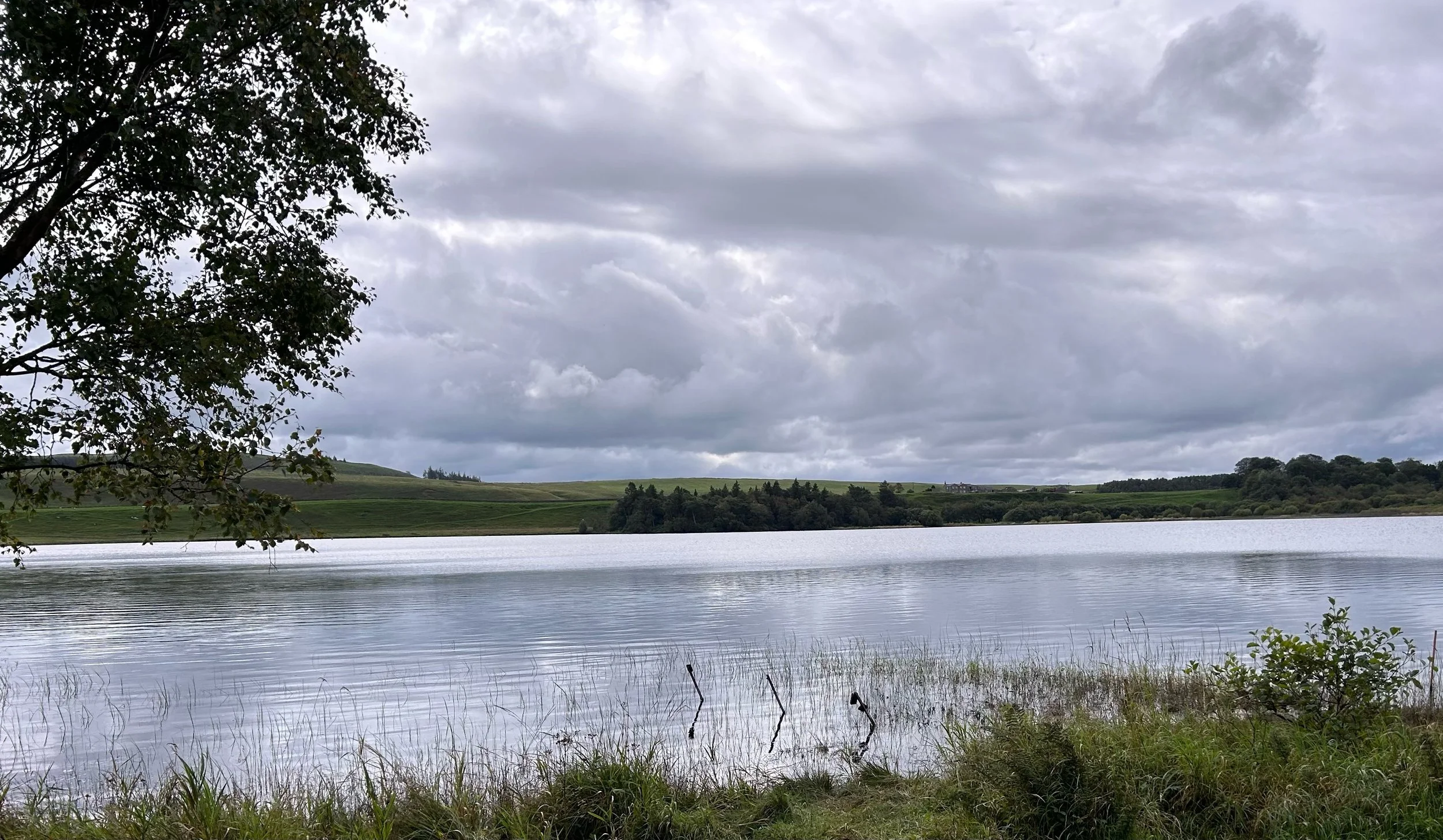
The lough by Mike Pratt
Another example – I was in fact being interviewed on film, along with several other people, about the National Park’s Hadrian’s Wall Recovering Nature project, centred on Greenlee Lough, the other day. It was a sunny early autumn day and the lough was serene and epic. I glimpsed the less well-known side of Sycamore Gap way in the distance, marvelled at the red darter dragonflies and reed buntings, and forgot I was being filmed because it was all so absorbing.
My mind floated off to the potential future that is being planned to make this the first of a string of sites managed with nature restoration in mind. These areas all lie between one coast and the other, a string of green pearls full of wildness. Then somebody shouted: “Mike, can you walk back 200m and come back down again, I need to get you coming into shot again?” and my visionary bubble was burst.
Later, at The Sill discovery centre, I attended a somewhat less absorbing committee meeting and wrote some board papers (all part of the essential governance and admin of our charity). It took only about 35 minutes to get back to the office, and even as I completed more mudane tasks, I could still feel a sense of place and Greenlee’s tranquillity within me; a sense of the wild that remains everywhere around us in this county.
What a privilege it is to exist in this rich land. I guess the important thing is that, with all the modern pressures of the world, we must ensure this unique connectivity between special landscapes, nature and spaciousness which so enhances life in this part of the north (and where I always maintain we are landscape millionaires if nothing else) must be maintained for future generations.
There has to be one part of England, maybe alongside Cumbria and parts of Yorkshire, that still feels deeply ingrained in its naturalness and its deep history and sense of place, and this is it.
Mike’s book, Infinite Wonder, Loving Nature Back to Health, is available via Northumberland Wildlife Trust at www.nwt.org.uk at selected bookshops, and at Mike’s website: www.livingmindfullywild.com