
Mind the gap
First published in edition 197 of The Northumbrian, Dec/Jan 2023/2024
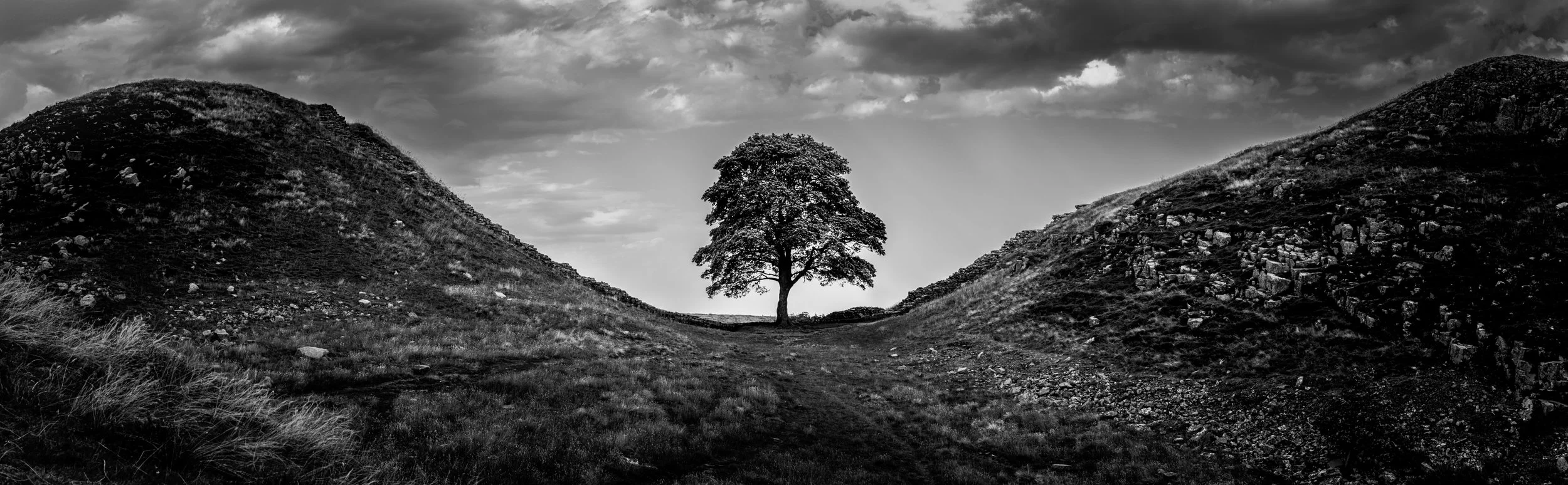
John Ashton considers the lasting power of the now unoccupied Sycamore Gap and its part as a sacred place, long before it cradled a famous tree, which would have been known to and might have inspired our saints Wilfrid and Cuthbert
When you cross the threshold of a sacred place, you do not merely enter it; you invite what is already there to enter you.
An assortment of folk, perhaps a couple of dozen of us plus a few dogs, made our way to the dip in Hadrian’s Wall just west of Housesteads Roman fort to pay our respects to a tree felled in the night. We stood, our shadows long in the low autumn sun, by the stump in a kind of communion, as if before an altar. The tree itself lay awkwardly across the adjacent wall, branches and leaves largely intact, like a fallen soldier taken by surprise.
I closed my eyes, lost in the rattle of the tree’s drying leaves as they caught each fickle gust. Every day for near-250 years, this sycamore planted in the late 1800s by a previous landowner, John Clayton, to be a feature in the landscape, had whistled, rustled and sighed in winds that in this exposed spot rarely desist, and this was its last song.
Even without the tree, the natural cradle that had framed it, which appears like a sudden lapse in concentration in the otherwise implacable line of the great Whin Sill, would make any traveller catch their breath. There is surely no other point on the Roman wall where nature seems so dismissive of human vanity; where the stones appear so provisional as they cling precariously to the precipitous gradients on either side.
Who knows how many souls, passing this way over the centuries on foot, on horseback, or with the aid of internal combustion, have felt the tug of this place? Among them, no doubt, would have been two men of destiny – contemporaries whose lives animated either side of a struggle that lasted only a few years and is now almost forgotten, yet had consequences that changed our country and the world forever.
Both men were tireless travellers, both would at one time or another have followed the old Roman road that ran just south of the wall. Both, surely, would have paused when they first saw the gap and felt a little smaller in the face of what they would have seen as the work of a divine hand.
It is easy to imagine that Cuthbert might have paused to contemplate the perfection of that work as he made his way on foot, perhaps to Carlisle to preach in the church that later bore his name. Wilfrid, always in a hurry, riding out with his retinue from his new monastery at Hexham, might have taken it as a sign sent to spur him on.
Most of us, if asked to say which of Christendom’s many internecine rifts has left the biggest mark on our national tapestry, might point to Henry VIII and the wedge he drove between Canterbury and Rome. But that was not the only conflict between rival Christian establishments in our country; perhaps not even the most momentous. For almost a millennium before the Reformation, Canterbury and Lindisfarne were locked in a winner-takes-all dispute, one the bridgehead of an expansionist Roman Church, the other the last English bastion of an Irish Christian tradition inspired by the early desert fathers, and at that time unsurpassed throughout Europe as a centre of learning, culture and faith.
In the eye of the storm were Cuthbert and Wilfrid. And it was their choices, above all, that made the outcome inevitable.
The stakes could not have been higher. Ostensibly, the argument was about matters of ecclesiastical practice that might now seem quaint, such as how to set the date of Easter and how monks should cut their hair. But what was really being contested was the very soul not merely of our region, but of England and the English.
For Rome, fresh from pilgrimage there, Wilfrid was pressing north, sweeping all before him. Indomitable, restless, a man of action at home with wealth and power and skilled in courting both (though quick to fall out with anyone when thwarted), his mission was to impose a monoculture of Christian practice and administration, orderly and hierarchical, from the Channel to the Cheviots.
To accomplish his aim he sought to crush the decentralised, diverse, intuitive, and syncretic forms of devotion of which Lindisfarne stood with its mainly Irish monks as the leading example: loyal to Rome but hospitable to spirits not entirely susceptible to its control, nor even perhaps entirely encompassed by any narrow reading of Scripture.
Cuthbert, taught by Irish monks, was a more enigmatic figure. No less tough and disciplined than Wilfrid, he was also humble, generous without limit towards the needy and infirm, parsimonious with his favour towards the kings and prelates who courted him, much given to solitary contemplation, and so immersed in nature that he seemed woven into its very fabric: his life seems an exercise more in grace than action.
Something had to give. In AD664 King Oswy of Northumbria convened a Synod at Whitby to adjudicate between the competing claims of either side. The stage was set for a dramatic showdown. Then, mysteriously, Cuthbert seems to have turned aside, declining even to argue the Lindisfarne case, though he was probably present in Whitby and only he among his peers could match Wilfrid’s authority and rhetorical prowess.
Cuthbert was revered across the north and might have stopped Wilfrid’s project in its tracks had he chosen to hold out against it. Perhaps he had come to the view that to provoke an irrevocable schism would do more harm than to accept the doctrines and authority of Rome. Perhaps Wilfrid had come to seem unstoppable.
With hindsight, one might wonder if Wilfrid and Oswy had simply stitched it all up in advance. Would Oswy convene a Synod on a matter that might seal his fate, had he not already arranged the outcome? Whatever the case, Cuthbert chose to surrender and at Whitby the great tree of the Irish church in England was felled, as it was to fall in its time in Ireland itself. The rest, as they say, is history.
Or is it? Today across the north, churches dedicated to St Wilfrid are numerous, but no more so than those to St Cuthbert. Cuthbert, not Wilfrid, became a cult figure, even in life. It was Cuthbert to whom miracles were credited; Cuthbert who reportedly visited King Alfred in a dream, stiffening his sinews against the Danes. Cuthbert’s incorruptible remains eventually (after further adventures) reached Durham, where even today thousands every year come to view the simple slab beneath which his remains lie.
Yes, Wilfrid is remembered and a visit to the crypt in the basilica he built in Ripon may be a moving experience, but it is rarely a pilgrimage. Wilfrid may have had his way at Whitby, but for most today he is just a name, while Cuthbert is loved. A great tree was felled long ago, yet today it stands taller than ever.
Every tree belongs uniquely to its place and time. Yet all trees lead towards the universal, commingled at the root with every other tree that has, and ever will, reach from soil to sky. Each is the Tree of Life, the Tree of Knowledge, the World Tree, the Wishing Tree, and the Liberty Tree. Each is the holy cross and every piece of timber is part of the same crooked timber from which we ourselves are cut:
When you bleed so do I.
But no tree ever truly dies.
So I fall, so again I rise.
Why else would an image of a felled sycamore that stood for so long at a remote spot on Hadrian’s Wall have flashed within seconds around the world?
John Ashton is an independent writer and speaker. He recently returned to the North East after a career in diplomacy and environmental politics. From 2006-12, under the Labour and Coalition governments, he was the first UK climate change envoy. Before that he co-founded and was chief executive of the think tank E3G. He now lives in Gosforth, not far from his childhood home in Jesmond