
Arctic explorer
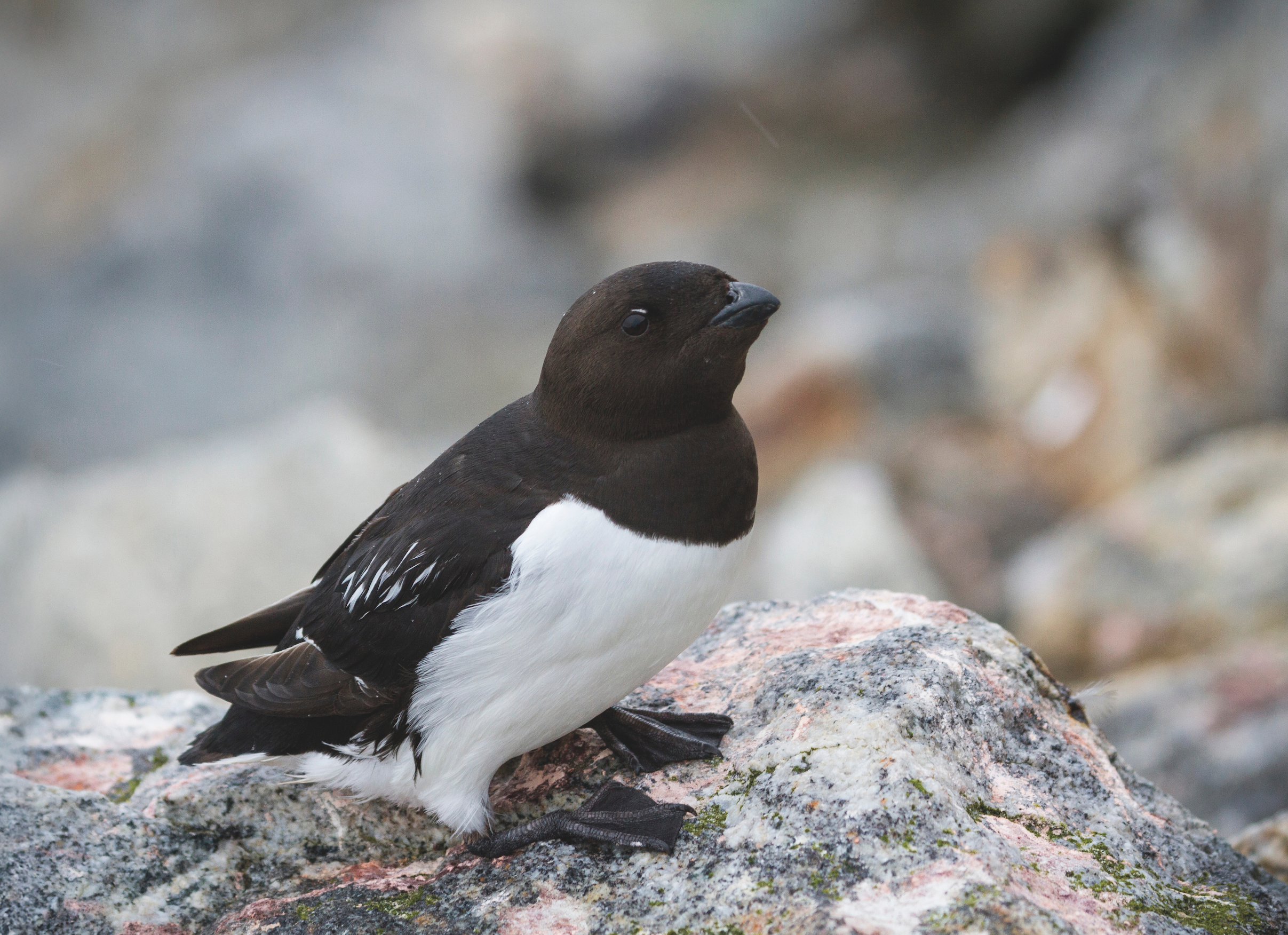
A little auk
IAN KERR profiles the little auk – a brave Arctic seabird that is often blown off course to the Northumbrian coastline, where it proves a courageous warrior against gale and storm
Birdwatchers along the Northumberland coast must be among the very few people who look forward to heading out into the teeth of winter storms. There is method in their apparent madness, however, as this is generally the only opportunity they have to spot one of our toughest seabirds, the little auk.
Only slightly larger than a starling and often aptly described as “chubby, stubby, with whirring wings,” they nest in huge colonies above the Arctic Circle and spend winter surviving on a rich diet of krill and other tiny marine crustaceans. Some remain in the freezing conditions just off the Arctic pack ice while others wander widely over the North Atlantic, congregating in the richest areas for krill. These tiny sea creatures, so vital to the little auk, are also the preferred food for creatures at the other end of the size and weight scale – baleen whales, which filter them by the ton from the cold seas.
When these flocks are hit by winter’s severe westerly gales and hurricane-force winds, large numbers of little auks can be caught up and driven eastwards towards Europe, ending up in the North Sea. This stretch of water has very little of their vital food, however, so they then face a race against time to get back to their usual oceanic wintering grounds or face starvation and death.
This is when Northumbrian birders get their best chance to get out onto suitable headlands and other watch-points along the coast – whatever the weather. It’s their best hope of seeing little auks as they race past, desperate to escape around the top of Scotland and into the North Atlantic.
Little auks are the smallest of the auk family which comprises the puffins, guillemots and razorbills which are such a spring and summer attraction in their Northumbrian breeding sites on the Farne Islands. In contrast, little auks are confined to breeding in some of the most isolated and inhospitable places on earth, mainly the islands of the Arctic Ocean. The Norwegian archipelago of Svalbard (Spitzbergen as it was always called when I was a lad) has an estimated 90% of the world’s population, with some 10-15 million birds. Large numbers also breed on the Russian islands of Novaya Zemlya in the Barents Sea, in colonies in Greenland, and on islands off the north coast of Iceland.
Little auks nest in rock holes and other crevices, often on mountainous cliffs, or choose huge areas of rocky scree slopes just above the sea, using inaccessible holes under the barren landscape of boulders and rocks. Taking full advantage of the short Arctic summer, their single eggs are laid in June and July, the young usually fledging in August and September. As the young, whose wings are not yet fully developed, attempt to fly down to the sea or pick their difficult way through the scree, they are at great risk of a range of predators. Large gulls and skuas constantly patrol the cliffs to snatch unwary youngsters, while the scree slopes are often frequented by Arctic foxes. These predators have adapted to have their cubs at this short annual period of plenty, when large numbers of young birds are available. Many thousands perish, but many more survive this early challenge.
Once in the sea the young are much safer from predators, but they must quickly learn the arts of fishing and flying as the brief northern summer comes to an end. Scientists report that only a tiny percentage of the population ever gets into the North Sea. Nevertheless, when they do occur they can be a spectacular sight. For example, on one stormy winter day in November 2007 some 28,000 were counted as they sped past the Farne Islands, which was then a record for Britain. That was just the count at one locality, but in rough seas and with many probably moving out of sight of watchers along the coast, the true number on the move that day must have been colossal.
Even when they’re close in-shore they have an annoying tendency (at least as far as birders are concerned) of simply vanishing through the wave troughs, which makes it extremely difficult to collate meaningful figures. Some will even take short cuts across headlands and islands in their anxiety to press on northwards, and during that spectacular 2007 passage off the Farne Islands, many hundreds cut across Holy Island. Fast-flying flocks raced over the island, some so low across the meadows that they had to rise to clear stone walls and hedges before disappearing over the dunes to reach Berwick Bay on the other side.
Inevitably at such periods, many little auks come to grief through exhaustion and starvation. On a couple of occasions I’ve watched sadly as individuals have repeatedly dived in shallow lakes and pools in a desperate effort to find something to eat. They also make easy pickings for large gulls which can catch them and swallow them whole, as I’ve seen on several occasions. Others perish at sea, and these big influxes usually result in many small, pathetic corpses being washed up on the beaches.
Winter gales can also blast them inland. There are numerous records of them being found grounded far from the sea. I recall one snowy winter night receiving a phone call from a woman who told me that she’d found a “baby penguin” in the back garden of her Newcastle home. I went round and sure enough there was a little auk sitting in a box in the kitchen. It had hit the snow-covered roof of her house and skidded down into the garden.
I examined the bird and despite its ordeal it appeared plump and healthy. The next morning it was taken to Tynemouth, pointed at the sea to get its bearings, and released, shooting off like a bullet towards the horizon. I like to think that after its inland adventure it eventually made it back to the Arctic to take its place in one of those vast breeding colonies the following summer.