
Just the tonic
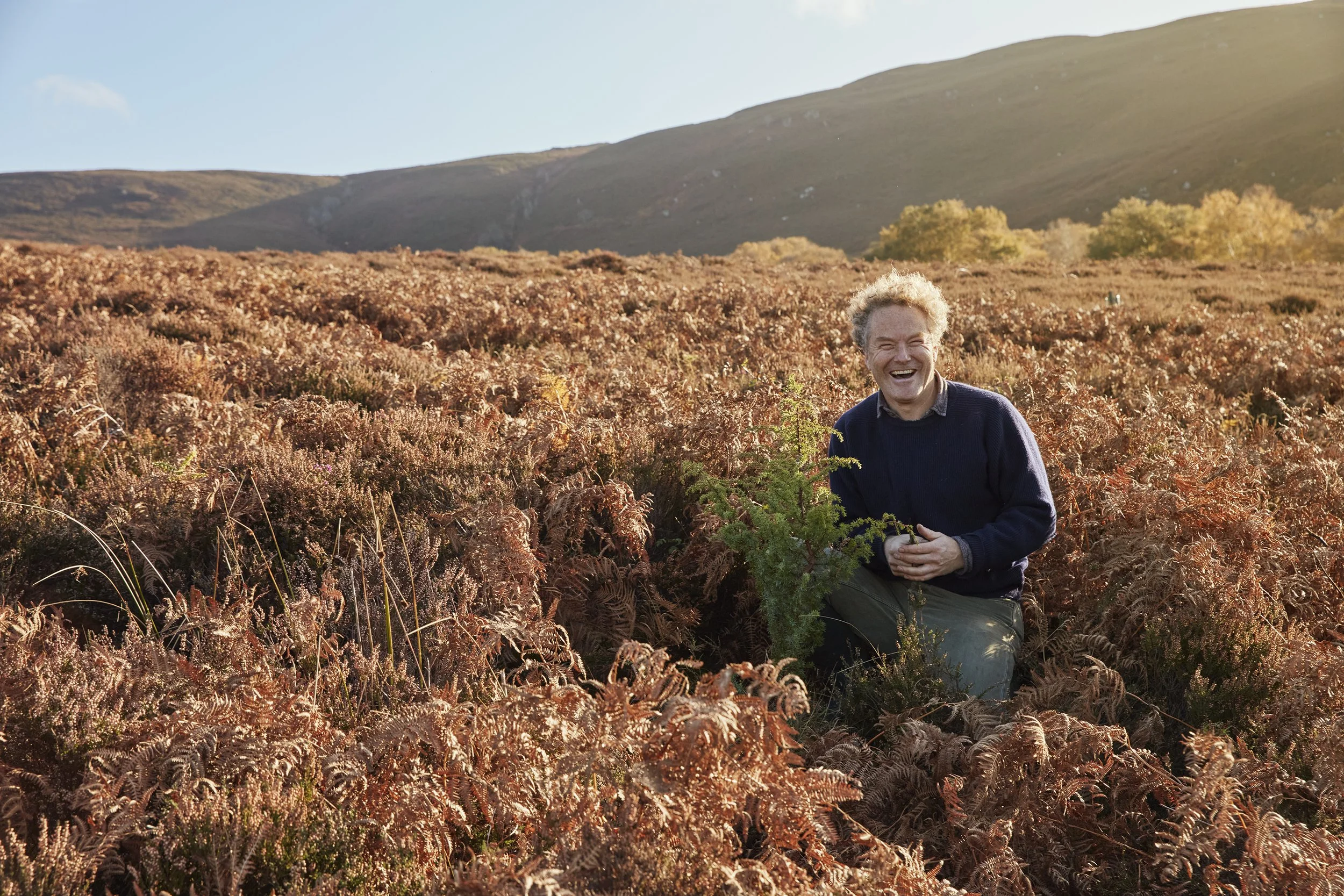
Walter Riddell of Hepple Gin
ANTHONY TOOLE discovers the wild and rugged country of the Hepple Estate, where wildlife abounds alongside the production of a renowned gin flavoured by local botanicals
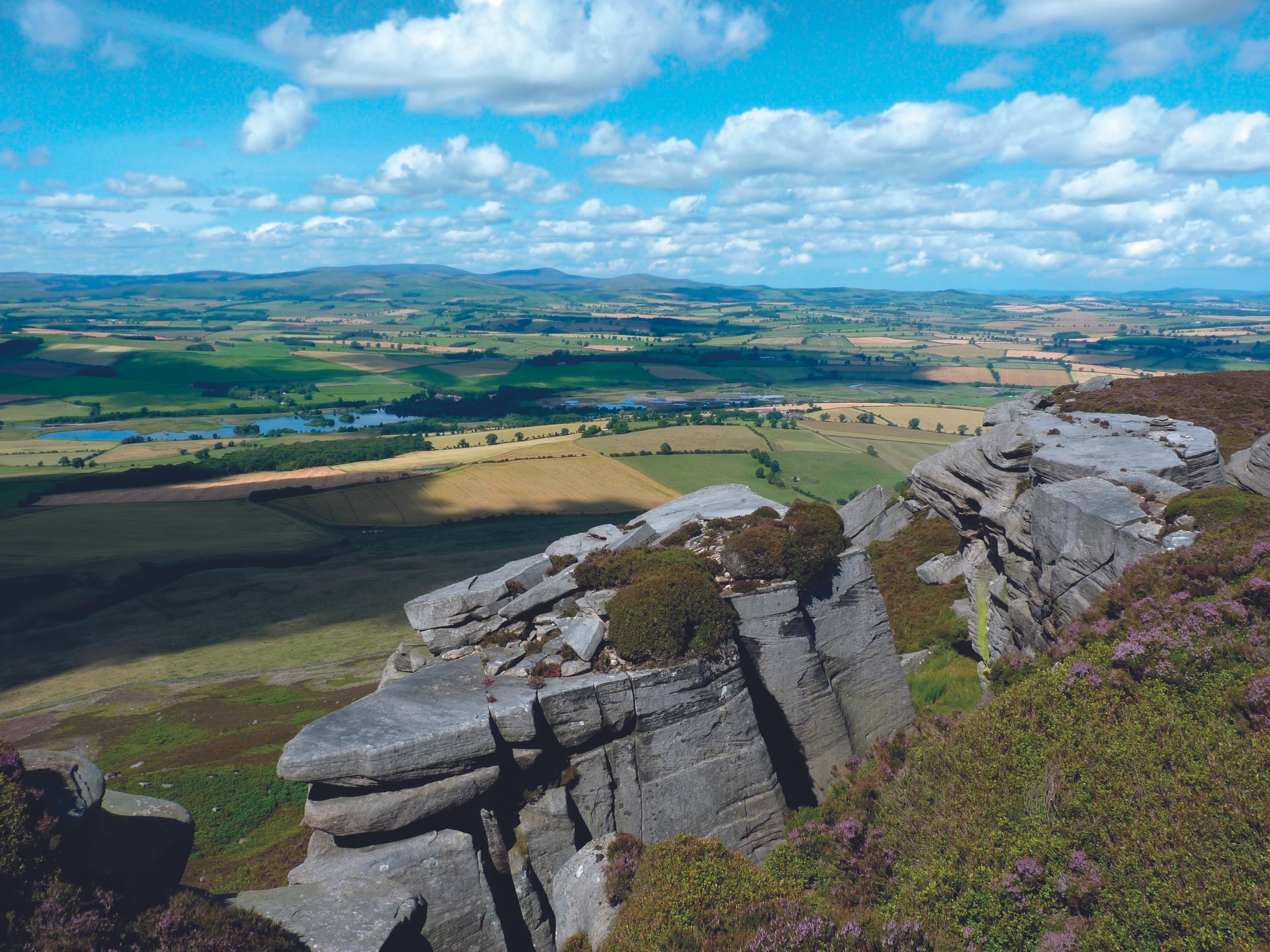
It is rare to come across anyone else on Ravensheugh and Tosson Hill, the remote outliers of the Simonside Hills. Yet the views from these high points are the finest of the whole plateau, extending over the full breadth of the Coquet valley and beyond to the Cheviots. These summits also mark the south-eastern boundary of the 4,000-acre Hepple estate, which descends the often steep, heathery slopes to the buildings of Hepple Whitefield, then on to the bank of the Coquet.
Since the early 19th century, the estate has been owned by the Riddell family who have used it for farming, forestry and shooting. In 2020, the present owners, Walter and Lucy Riddell, decided to put their emphasis on nature and the environment, and so began a process of re-wilding. When I meet Walter, he looks like anything but a landowner. He is busily clearing furniture from a barn he plans to turn into a field studies centre.His immediate concern is to make it presentable to an-all female group of lawyers who are to join him later in the day for a team-building get-together. Dragging himself away from this urgency, he leads me up a forest track toward the open hillside.
“We are involved, here at Hepple,” he explains, “with both the business and the natural worlds. Our plan is that by building the natural world, a range of opportunities will emerge to do things for business and people. But business must be secondary. It must be subservient, otherwise you’re jiggered. You are working against an extremely powerful taskmaster and provider. If you can get nature working for you, you can sit back and relax,” he laughs – “which is what all landowners want to do.”
We pass a herd of longhorn cattle, which, together with shaggy-coated Highland cows, have replaced the sheep that formerly grazed the hills. “Despite their horns,” says Walter, “these are gentle cattle, and low-maintenance. They are very hardy. Their birthing costs are low and they can be left out all year, with supplementary feeding only during the worst of weather.
“At Hepple, you don’t see machines driving around or big sheds. Old-style farming such as this is an outside job, which is good if you don’t want to spend money. The high-value, rare-breed beef gives us much higher returns.”
By eliminating the use of artificial fertilisers and pesticides, Hepple has been registered as organic since January 2023. The wide-ranging grazing of cattle and Exmoor ponies, aided by the removal of fencing, allows natural disturbance of the ground, which facilitates the seeding and generation of shrubs, trees and flowers. The hooves of cattle press seeds deeper into the soil where they are more likely to germinate.
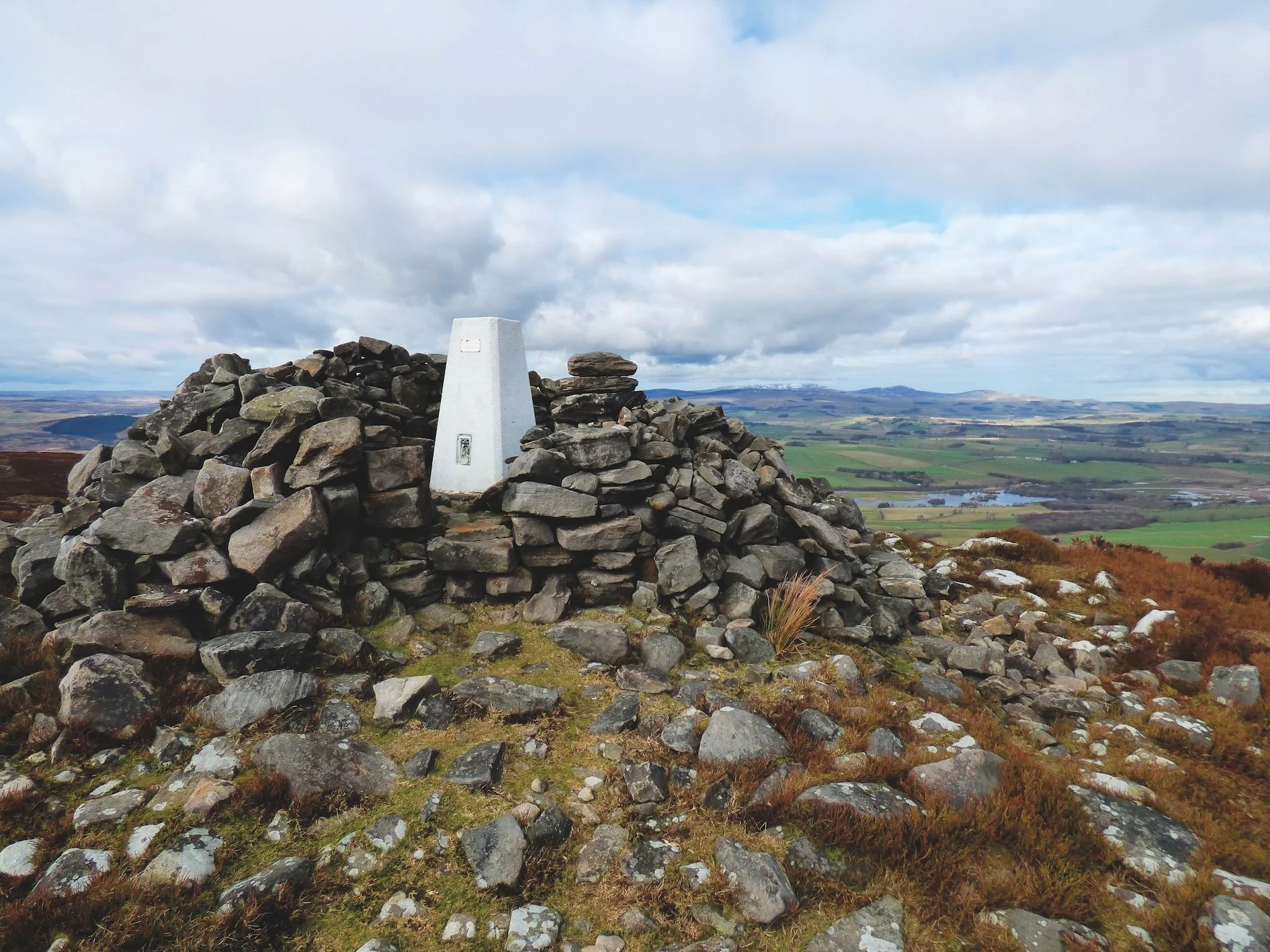
Tosson Hill summit
We continue to an area of high ground, from which the view alone, stretching from Ravensheugh and Tosson Hill in one direction and across the Coquet Valley to The Cheviot in the other, is itself worth the effort. Scattered across the land there is a collection of small ponds.
“We have blocked the ditches with leaky dams to create these pools and hold back the water,” explains Walter. “The slow release helps to create water meadows in the lower pastures. There seems to have been an explosion in insect life through our raising the water table. This also seems to be attracting more birds, such as ring ousels, lapwings and curlews.”
Indeed, surveys by volunteer entomologists have so far revealed more than half-a-dozen species of dragonfly and damselfly, as well as nearly two dozen species of butterfly. Birds of prey include merlin, barn owl, and peregrine, while among smaller birds are redstart, stonechat, whitethroat, various tits and warblers. Mammals include bats and red squirrels.
However, re-wilding is not simply a matter of leaving things to run wild by themselves. In contrast to his earlier, rather light-hearted sentiments, Walter admits, “You need super high-level skills. We work in conjunction with Newcastle University, Natural England and conservation bodies, and have brought in cattle managers, wallers, experienced ecologists and naturalists; people with a deep knowledge of wildlife who monitor our progress and record the changes. There’s an element of trial and error. We try a change, then go back or carry on with what succeeds.”
Helping to sustain this ecological approach to farming on the estate is another high-value product, which Walter admits might be an added attraction to the guests he was going to meet later in the day. Following our brief excursion onto the upper moorland, he brings me to one of the outbuildings, where he introduces me to Chris Garden, a chemical engineer who is responsible for the production of Hepple Gin. As a chemist, I am familiar with the theory of fractional distillation, which depends on the different boiling points of water and alcohol, but there is no substitute for seeing the genuine apparatus and having the details of the copper pot process explained by an expert.
On the hillsides above the farm are several juniper shrubs from which the seeds are harvested. These in turn are cultivated to grow the plants that generate their own seeds which provide the flavour of the gin. Also readily available on the land are the botanicals that flavour individual gins, bog myrtle, borage, blackcurrant leaves, Douglas fir among others.
“When I was growing up here,” says Walter, “it was always the wilder parts that were the most interesting to me, and it is those parts you can draw on to make gin. That was the idea behind the distillery. If you make a light harvesting footprint, you can extract one or two things that are of rare value. This is not yet successful from a commercial aspect, but very successful from an ecological viewpoint.”
Leaving the distillery, I return to the bridleway and follow it again, past the pools and onto the higher slopes. The track rises steadily onto heather moorland with extensive patches of bilberry and a scattering of self-seeded rowan saplings. After a little more than a mile, I reach a wooden shooters’ cabin at the edge of level ground called Boddle Moss. A footpath leads across this, past sphagnum pools and areas where the heather was burned a few years previously to promote new growth on which grouse can feed. Bilberry bushes have also taken full advantage of the cleared patches. While I see no grouse, there are large numbers of meadow pipits flying above and settling in the surrounding heather, through which the track continues to Tosson Hill summit.
On my way back to the valley, I pause once more at the largest pool, where predatory dragonflies, probably four-spotted chasers, dart incessantly back and forth over the full expanse of the water. At the same time, more than a dozen blue damselflies hover more sedately just above the surface at the pond’s edge. Their numbers alone hint that they might represent early fruits of the re-wilding of the Hepple estate.