
Seeds of learning
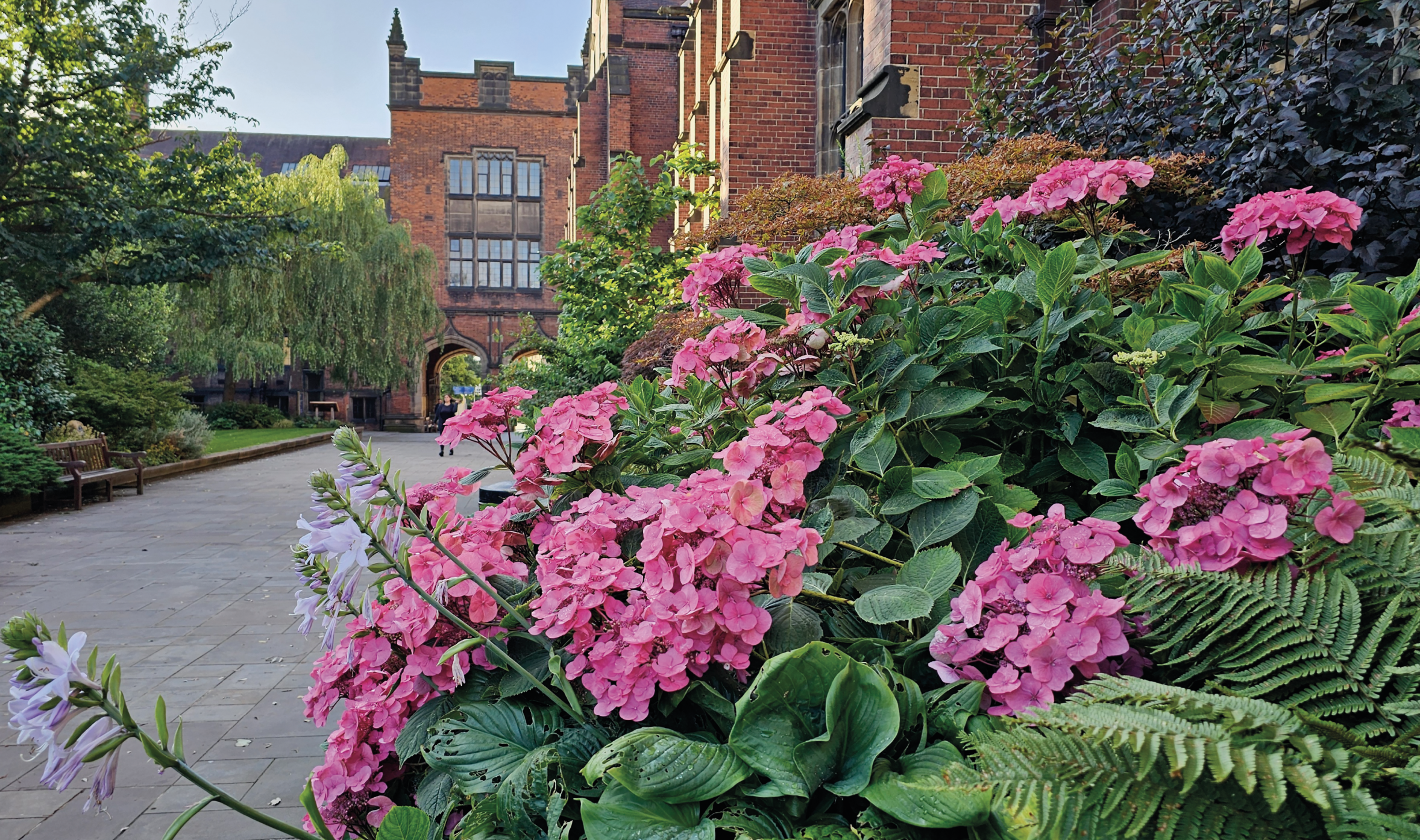
Vibrant pink Hydrangea and flowering hostas (all photos, Susie White)
First published in edition 203 of The Northumbrian, Dec 2024/Jan 2025
Susie White finds peace and tranquillity in Newcastle University’s Old Quad – a place of rest, relaxation and sublime planting which has formed the backdrop to countless graduation photographs over the years
It takes a hospital visit and a sunny afternoon for me to fully appreciate the gardens of Newcastle University Old Quadrangle. My husband has an appointment at the nearby eye hospital, and with an hour to fill on an early autumn day, he suggests I spend time in the gardens. I’ve often walked through the Quad, noticing the planting in the passing moment, but really looking is a different experience. It’s a chance to take in how special this place is.
The gardens of the Old Quad are enclosed by the oldest buildings of Newcastle University. The Armstrong Building, Hatton Gallery, and Architecture Building are built of warm red brick and light bounces off the walls and through the Neo-Jacobean Arches, symbol of the university. The Quad was once a thoroughfare and cars drove under them.
From World War I until after World War II, auxiliary army huts were sited in the quad. By 1947 all this changed and the courtyard was laid out and planted as a memorial garden dedicated to those who died in both wars. There’s a plaque on a low wall near the Arches and the annual remembrance service is held in the Quad.
Among the many memorial trees and benches, one especially catches my eye. Dedicated to Professor Chris Brink, who was vice chancellor of the university 2007-2016, the plaque reads: “He cared deeply about creating a well-designed campus accessible to all. The campus you see today was transformed thanks to his vision and commitment.”
To find out more I speak to Tom Vasey, who has worked for the university for 17 years, the last five as grounds manager for all the university estates and gardens. “Chris Brink invested a lot in the landscape,” Tom tells me. “He implemented the Coherent Campus strategy in 2009 and wanted to see a more standardised palette in terms of paving, railings and benches. A lot of money was put into it, and fortunately for us in grounds maintenance an offshoot was an initiative called Greening the Campus. Between 2015 and 2017, we were given extra budget for plants. It was a very creative time to be at work.”
Tom decides on plants with his equally long-term head gardener Paul Cowan and assistant manager Dean Murray, who has a lot do with choosing bedding and bulbs each year. For a public garden there are some unusual and inspired choices. “It’s fairly unique in the city for its planting,” Tom says, “and we are obviously very proud of it. It’s well-known within the university; it’s our jewel in the crown.”
They buy in where necessary, but have a small nursery at the main grounds depot at Cochrane Park where Paul grows annuals from seed. These are often varieties that are harder to source such as the brilliant orange Tithonia, known as the torch flower, or Ricinus, the castor oil plant. And there are some fun plants, too. Podophyllum ‘Spotty Dotty’ is a North American hybrid with large, umbrella-shaped leaves symmetrically patterned with mahogany spots; the kind of plant that makes you smile. “We have plenty of appreciation on social media,” says Tom, “and people really warm to the garden. We even get very kind donations to buy plants from people who’ve walked through and liked what they’ve seen.” This helps the team to make changes, and they have recently replanted the borders around the middle lawn, replacing tired hebes with more interesting irises, rosemary, cleome and a deep yellow abutilon.
The quad has three raised lawns, each edged in large stone blocks. The lower end near the Arches feels cool and green with specimen trees and foliage plants that do well in the semi-shade. Outside the Hatton Gallery a Eucryphia is in full bloom, a spectacle of glowing white flowers with yellow stamens. Among the crimson flowers of Crinodendron hookerianum, or Chilean lantern tree, are pendant seed heads splitting open to reveal white pearls.
Beneath cascading willow leaves is a shrub layer with hydrangea, tree peony, skimmia and lonicera, and below that a mix of leaf patterns from brunnera, epimedium, astrantia and bergenia. For winter there are hellebores and bulbs. For spring, primulas and ferns luxuriate in the moist shady soil.
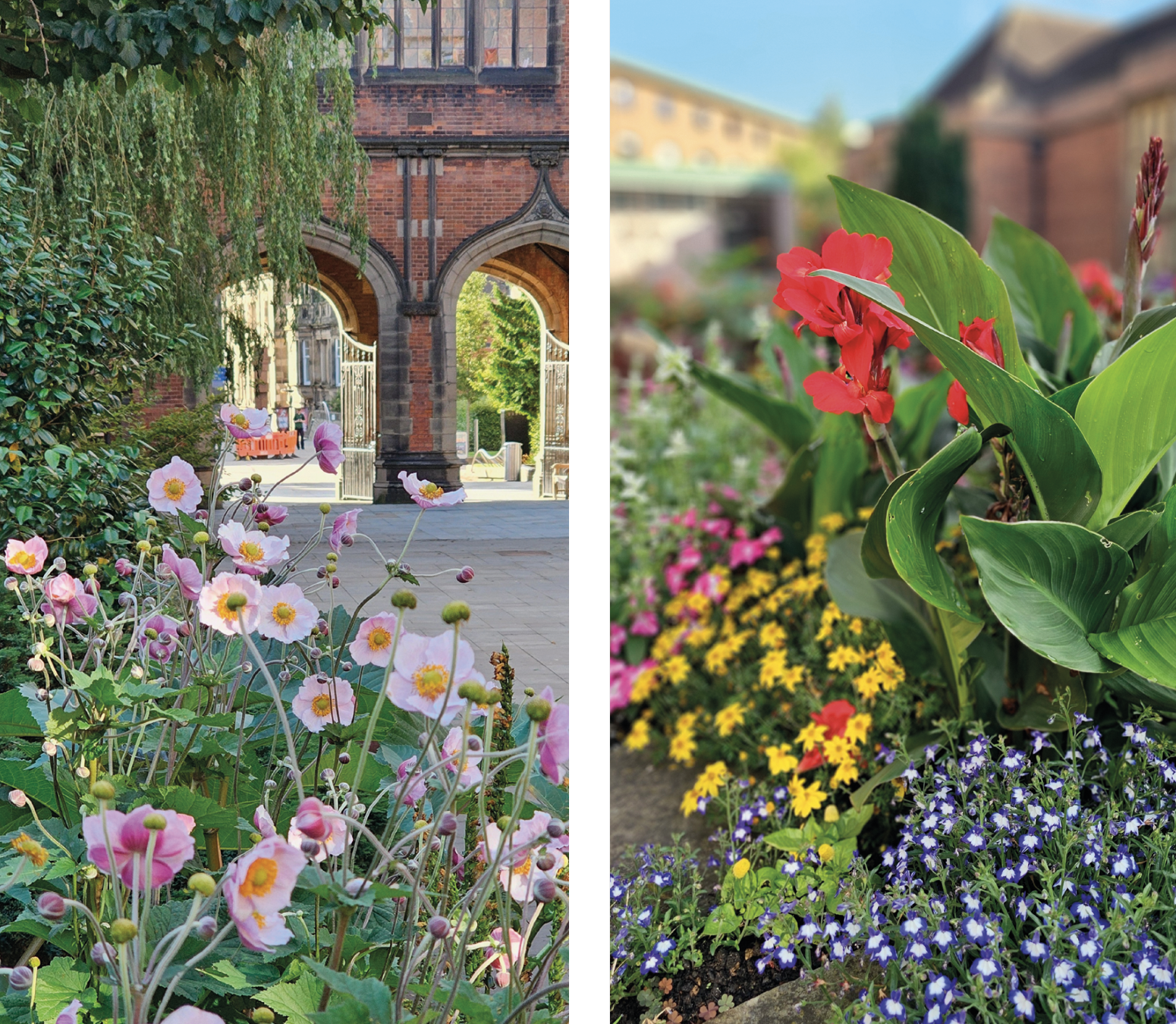
The famous Arches seen through Japanese anemones (left) and annuals for colour and pollinators
Each lawn has a different feel, from the greenery of the Hatton lawn to the more open middle lawn, and the ebullient, colourful flowerbeds at the top end of the Quad. Opposite, running the full length of the gardens, is a deep border outside the Armstrong Building, its lower, shadier end a mix of heuchera, dramatic ferns, variegated grasses and hostas. Shrubs give height, while euphorbias, white hydrangeas, cut-leaved acers and hardy fuchsias provide contrasting foliage.
Much to my envy, the shelter of the buildings allows the team to grow impressive specimens of Geranium palmatum, the Canary Island cranesbill which has purplish-pink flowers. Tall Kirengeshona palmata splays its maple-like leaves and waxy yellow flowers beneath a bamboo. As the border heads towards the sunny end it gains in colour, with orange berberis, purple acer, vibrant crocosmia and Lobelia cardinalis mixed with a shocking pink hydrangea.
The variety of foliage, from the huge leaves of rodgersia to the delicate multi-flowering Geranium ‘Rozanne’, gives constant interest and plants link to the lawn borders across the Quad. The School of Architecture, backdrop to so many graduation photographs, is draped in Virginia creeper. “Then, there are light-up letters on the lawn and champagne!” Tom tells me. “For Christmas, we have a 25ft tree sling lowered into place.”
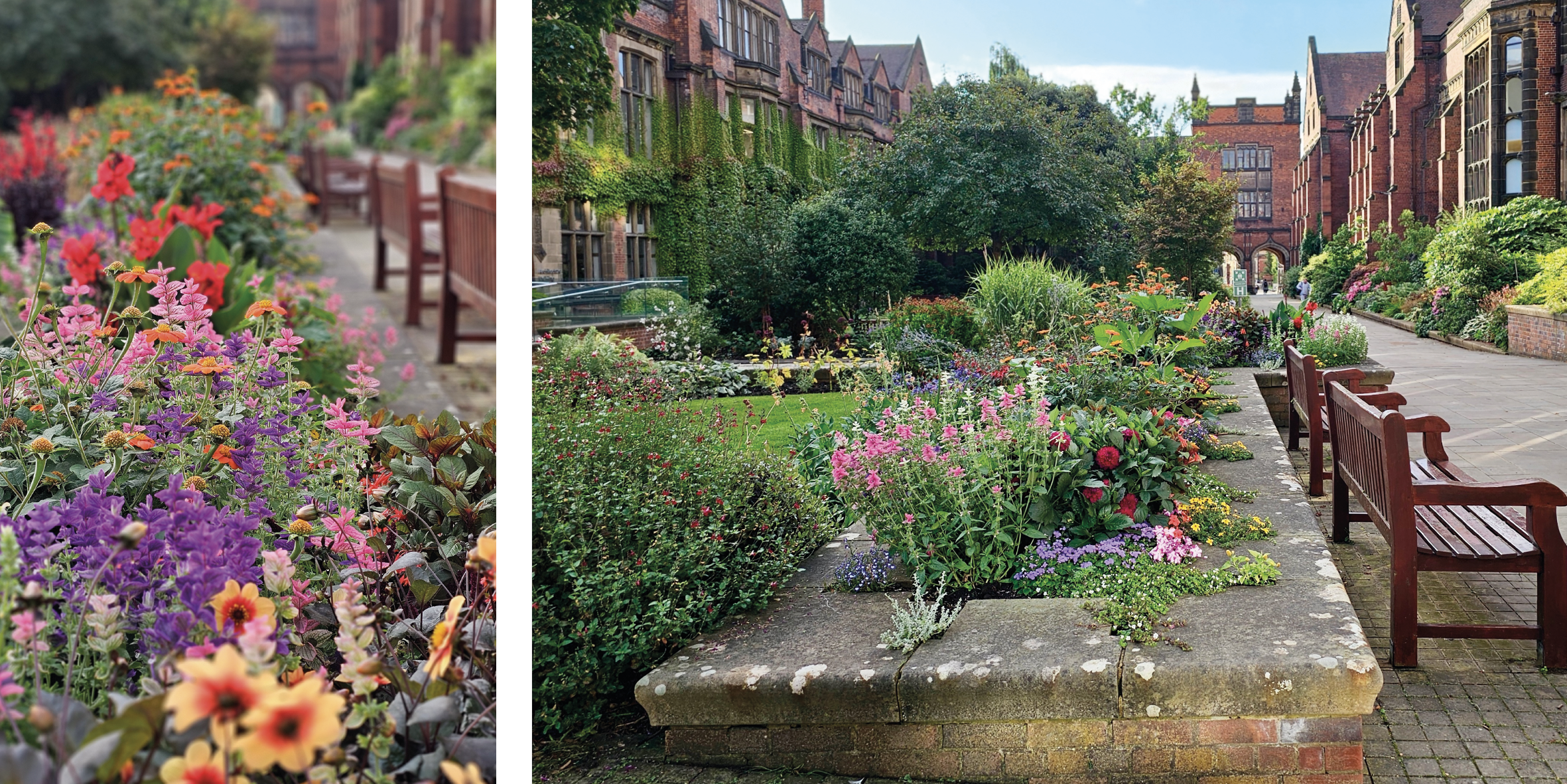
Annuals in glowing colours (left) and early morning in the quad (right)
This place is social as well as beautiful, and benches encourage people to linger. I sit on Chris Brink’s bench and watch as students, tourists and people taking shortcuts come and go. A man points out a bumblebee on an allium flower to his curly-haired toddler. I catch the words ‘Winnie the Pooh’ and ‘honey’ as the mother takes a photograph of them (it is of course honey bees that give us honey rather than bumblebees). This is a place for everyone. Near me, there’s lemon verbena which I squeeze for its refreshing scent and watch bees feeding in the phlomis.
The borders around the lawn furthest from the Arches are the most colourful. Happy in full sun are purple Angelica, dahlias, cannas, and zebra striped grasses. Angels’ fishing rods arch gently and vivid annuals brighten the border by the most used path. There’s painted sage, argyranthemum daisies, Salvia ‘Hot lips’, and butterflies on the tithonia. Low-growing lobelias, bidens, and boconia, all plants for pollinators, are planted into slots in the stone edging.
Outside the Old Quad, Tom’s team have made other improvements. Wildflower planting over the past few years has seen a new design scheme with wildflowers grown all the way down Queen Victoria Road. It’s a mix of annuals together with perennial seed to lengthen the flowering period. Even the bin store opposite the RVI has a green roof. But it’s the Old Quad gardens that create the colourful and restorative space at the heart of it all. No wonder then that they have been given a much-coveted Green Flag Award, testament to the work of Tom, Paul and their team.