
Living history
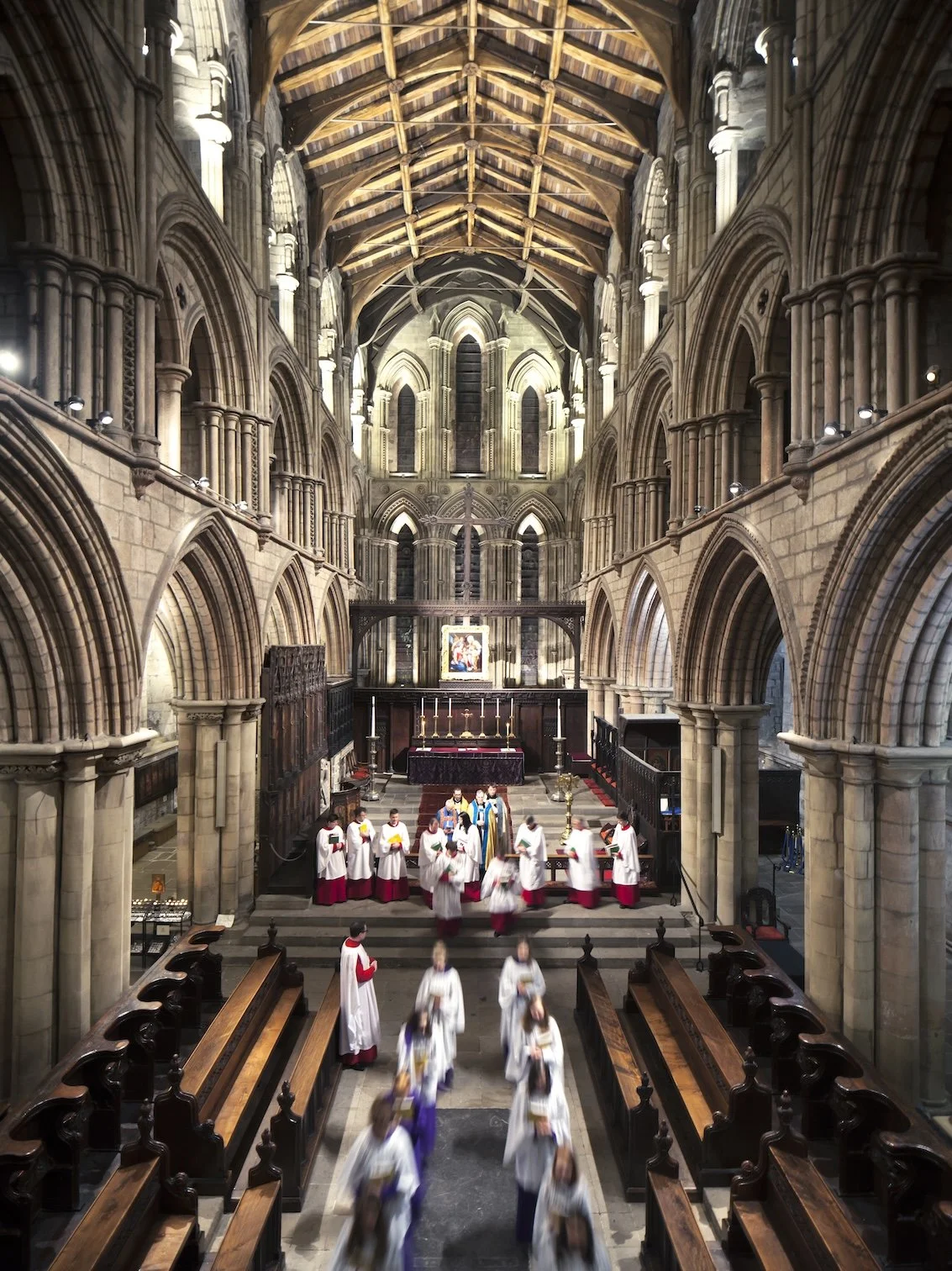
The Abbey’s magnificent high altar and 15th Century misericords
First published in edition 198 of The Northumbrian, Feb/Mar 2024
As Hexham Abbey marks 1,350 years since its foundation with a 12-month programme of events, Jane Pikett meets members of the group tasked with the care, conservation, and occasional serendipitous re-discovery of artefacts spanning 13 centuries
Dr Tom Kelsey begins the day with hot chocolate prepared just as he likes it by the ever-cheerful Caroline Hawke at Hexham Abbey’s Refectory Café. As he receives it, the twinkle in his eye indicates that, although aware of its indulgence, he’s not one to decline the occasional treat.
Tom is an enthusiast blessed with a ready smile, particularly when illuminating the long history of this place for others. In full, animated flow, he has just begun to explain the work of the Conservation Advisory Group he helped to establish when we are joined by Hugh Dixon, an architectural historian and former curator for the Northumbria region of the National Trust. Hugh is another integral member of the group of a dozen or so individuals, each providing distinct expertise, who have painstakingly uncovered, examined, documented and elucidated thousands of artefacts within the Abbey church, its former priory buildings and grounds since 2011.
The group’s achievements include a continually expanding catalogue of some 5,500 items which details the significance of each piece – an accomplishment which is particularly impressive as 2024 marks 1,350 years since St Wilfrid established the first place of worship here. That’s 13 centuries of carved stones, artworks, metalwork, textiles and structures, many remodelled and relocated, to be catalogued and cared for within not a museum, but a busy parish church open for worship and activities seven days a week.
“There is always so much to discover, which is wonderful,” Tom says, “and every now and again, someone stumbles upon a real treasure.” But is there ever a sense of being overwhelmed by the immense scope of history to be documented and interpreted? “Oh no,” Tom asserts with a smile, “because it’s simply too exciting!”
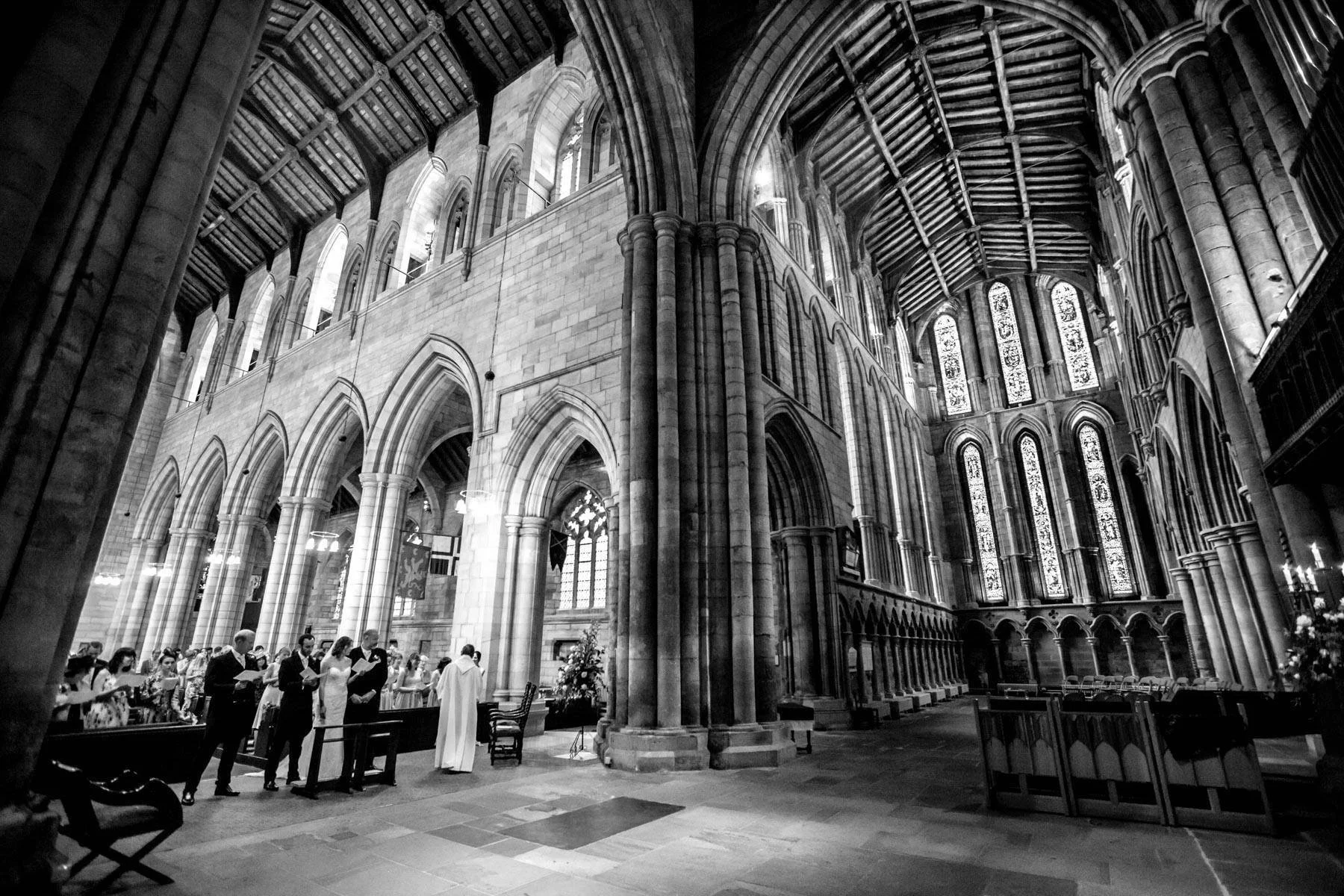
A view from the south of the Abbey’s massive crossing, showing parts of the nave and north transept
It certainly is, and this year the Abbey is presenting a similarly inspiring programme of events celebrating the foundation of St Wilfrid’s original church from which Hexham has grown. The year was launched by a Festival of Flame, with thousands of candles in the Abbey, an outdoor fire garden and music. A spectacular installation of thousands of origami stars has been raised to the Abbey ceiling and will remain on show until November, each star made by local people and visitors, and dedicated to those who have brightened others’ lives.
There will be a July flower festival; exhibitions; concerts; a summer festival of food and music; special services and events which will welcome thousands of visitors to this astonishing place, many of them for the first time. Visiting experts and members of the conservation group will present talks and guided tours, focusing on the Abbey’s collection of rare items which are recognised by institutions such as the Hamilton Kerr Institute, part of the Fitzwilliam Museum in Cambridge; St Andrews and Northumbria universities; and London’s Courtauld Institute.
It is rare to find documented history and material remnants of worship dating to the 7th Century, as here in the powerfully atmospheric crypt, the surviving part of Wilfrid’s church dedicated to St Andrew. The Abbey is also home to an 8th Century chalice; exquisite 17th and 18th Century silver; and the country’s largest collection of 84 medieval panel paintings, all requiring conservation. The night stair first trod by Augustinian canons in the 13th Century is still in daily use today; light shines through Victorian stained glass; there is an Anglo-Saxon bishop’s throne; 15th Century carved misericords; two rare timber chantry chapels; historic vestments; and significant architectural drawings. And since its foundation in 2009, the Conservation Advisory Group has played a crucial role in developing one of the most exceptional archives in a British church.
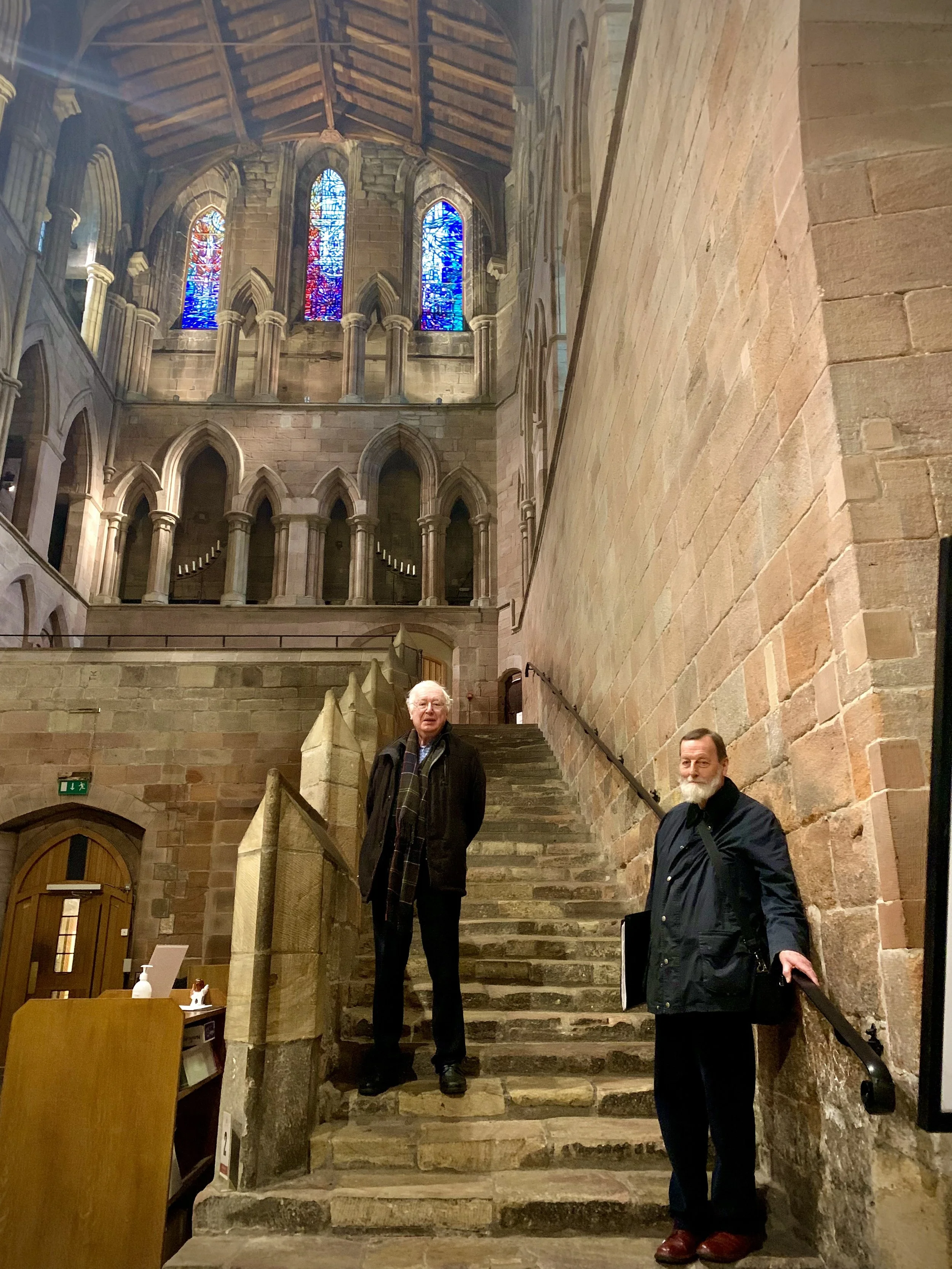
Exploring the Abbey with Tom and Hugh after hot chocolate and coffee, I learn that a substantial aspect of the expertise in deciphering discoveries involves detective work. For instance, Tom explains, scratches on the face of Jesus depicted in one of the Abbey’s medieval painted panels may indicate the disapproval of 16th Century puritans toward artistic representations of Christ. Many paintings were also subsequently whitewashed or painted over, he explains, and conservators continue to reveal hidden layers. Tom highlights 15th Century paintings of Christ, Mary and John the Apostle in one of the chantry chapels. Here, under a later layer of paint, a conservator has uncovered traces of lapis lazuli, a rare, very expensive blue pigment then available only from Afghanistan.
Exploring the Abbey with Tom and Hugh is to bring it alive in stories of those who have left their mark in centuries past. Tom points out a headless stone torso, what remains of a life-size sculpture, possibly of the Virgin and Child. It is now oddly situated in the Abbey’s north transept, but may once have welcomed visitors at the west door. Its amputations may, Tom says, be a legacy of Thomas Cromwell’s religious purgers, who were remunerated on a per-head basis.
Cupboards still yield discoveries, such as the occasion Tom and Canon Chris Simmons found a 1937 prayer book dedicated to Edward VIII. “It was obviously printed early in his reign, as one of the prayers in it commemorates the anniversary of the succession,” says Tom. “The prayer can never have been said, because Edward abdicated 40 days before the first anniversary of his father George V’s death.”
Hugh mentions a 1946 watercolour of the Abbey with proposed gardens at the east end. On the back are the signatures of three German POWs who created the gardens, now paved over. “Last year, we were visited by Mrs Dorothy Miller from Essex on a trip celebrating her 90th birthday. It turned out her father was Jack McKeown, who designed the gardens. He was friendly with Bill Taylor, a long-serving verger who knew Fred Davidson, a draughtsman in a Newcastle shipyard, who painted this picture. And Mrs Miller gave it to the Abbey 40 years ago. She was very helpful in providing valuable information.”
Tom and Hugh clearly enjoy these narratives, lobbing them back and forth like a ball over a net. They grant me rare access to the Abbey archive room lined with the meticulously organised files of the late Colin Dallison, after whom the room is now named. Colin, who held respected positions with the Abbey and the town, was a founding member of the Conservation Advisory Group. Before his death in 2021, he arranged for his 180 files of papers on the Abbey and Hexham to be transferred to the Abbey, constituting an enduring legacy of his meticulous efforts to document matters. Thanks to the generosity of his daughters, the Abbey also now owns a large number of his books.
This modest room is home to numerous photographs, books, records and objects. Hugh picks up a wooden box puzzle. It is Mauchline Ware – ornamental woodenware from Mauchline, Scotland, during the 19th and early 20th centuries. Featuring a print of the Abbey, it is both a keepsake and an entertaining enigma to unravel. There are also several copies of the architect Charles C Hodges’ huge 1888 Abbey monograph, lauded by Hugh as “the best record of any church in the country at the time.”
Architectural drawings include proposals to rebuild the Abbey’s ruined nave which resulted in national antiquarian debate. Eventually, designs by the gothic revival architect Temple Moore were approved and completed in 1908. Hodges, as resident architect, influenced many details of the new nave and the overall interior under the supervision of the modernising rector, Edwin Sidney Savage.
This room is also overseen by Peter Richmond, a crucial member of the group with his computer expertise. The Abbey website page Our Heritage links to material including articles from the parish magazine in the 1900s; guides to the Abbey’s roof bosses, ledger stones and grave stones; a perceptive interpretation of the east window; and more than 1,000 select excerpts from the catalogue of items
Former rector Graham Usher, now Bishop of Norwich, led a major project, completed in 2014, to redevelop the priory buildings lost at the dissolution of the monasteries and returned to the Abbey in 2012. A condition of a major grant from the HLF (Heritage Lottery Fund) for the project was that the Abbey’s possessions should be catalogued, so Graham invited Tom to establish the conservation group. Tom recruited Prof Richard Bailey, Colin Dallison, Dr Stan Beckensall, Hugh Dixon, Peter Richmond and others, and members have been actively involved since, particularly during the redevelopment project. Hugh reminisces, “It was an extraordinary time. Features, including medieval fireplaces and stairs, were revealed every day.”
Their work embodies the essence of archaeology; not necessarily digging in the dirt, but archaeology nonetheless. As Hugh says, “We found cupboards of stratified deposits – piles of papers and things. You could more or less tell which rector you had got to in each pile. Some, it has to be said, had been more organised than others.
“Of course, Tom is immortalised in inventing the great ‘Form 1’ to standardise the gathering of information for a database; closely followed by ‘Form 1a,” Hugh adds with a playful smile. “We joke about it, but it was important. Now the challenge is not just recording things, but keeping track of everything. This isn’t a museum, it’s a busy church, and things get moved. That means something catalogued as being at location 17b or wherever may of course be moved.”
Some important items have been awarded the international status they deserve due to the efforts of the group. “The Hamilton Kerr Institute in Cambridge is recognised for its expertise in medieval painted panels, so Tom contacted them,” says Hugh. “He got through to the international expert Dr Lucy Wrapson, and when she asked how many we have and Tom said 84, there was a wonderful silence, as they were unaware of them. They promptly came to investigate and we now know this is the largest collection of its kind in the country. In March, the British Archaeological Association is holding a study day here led by Professor Julian Luxford of the University of St Andrews. With two dozen medieval specialists attending, we ought to learn a lot.”
Members of the conservation group, such as the respected archaeologist Dr Chris Tolan Smith, are once more presenting their popular Ten-Minute Talks in February, this time with a 1,350th anniversary theme. Meanwhile, the group gathers weekly, its members actively engaged in various projects and documentation, including hundreds of photos taken by Chris Britton and the constant updating of informative leaflets written by him and others. Hugh explains, “We currently have a team researching Bishop Acca; two individuals specialising in the carved stones; group member Molly Kady writing a souvenir book; and Dr Christine Seal, a social historian, researching 19th and 20th Century rectors.”
Members of the group relish exchanging theories and interpretations, but have learnt to be cautious about sources and providing definitive answers. There is much about which experts may never be certain and there remains much to learn. For instance, says Tom, “The Russian Orthodox brass icon we have in the collection was displayed with a notice stating what little we knew about it. Then one day, a Russian visitor came in and shared the true story. In fact, I think we’d better do a talk about that.”
We study some grave covers; part of a collection lauded as “the best in the north” by the historian Peter Ryder. Some of these covers and other carved stones require proper placement, protection and interpretation – a challenge illustrative of many faced by their custodians. The carved stones date from Roman times to recent decades and in size from fragments of an Anglo-Saxon crucifixion weighing a few ounces to the Flavinus Roman memorial stone which weighs up to three tons. The challenge is to place them where their significance can be understood and they are not liable to damage.
The Abbey itself is a composite of various periods commencing with the 7th Century crypt, which lies below the most recent addition, the Edwardian nave. The font exemplifies this amalgamation of eras; positioned on Edwardian steps bearing a 12th Century stalk supporting a bowl that may be a hollowed-out Roman column. The cover is early 18th Century, while its wooden canopy, the tallest of its kind when it was made, was carved from medieval and Victorian wood by Joseph Ceulemans, a Belgian World War I refugee.
Another relic of that war are two stately pewter candlesticks at the high altar. Hugh says, “Everyone sees them, but no-one really looks at them, yet they are the saddest things here. They were commissioned early in 1915 by Canon Savage and designed by Temple Moore for the fallen of a war 1914-1915, because they thought it would be over by Christmas 1915. Of course it went on far longer, and both Savage and Moore lost sons later in the conflict.”
Nearby, we ponder the arrangement of medieval painted panels in the chancel. “They are all wrong,” says Hugh, referring to depictions of local saints set above the apostles, even above a depiction of the Virgin and Child. “You don’t subordinate the apostles and Christ to local saints, so these are clearly three bits of different furniture put together. It is an amazing assembly, but it is liturgically the wrong way around.”
Tom directs his torch towards the Man of Sorrows, another rare surviving medieval panel painting depicting Christ rising from the tomb. It is housed in a chantry chapel apparently created by Rowland Leschman, prior 1480-1499, whose tomb it contains. “Look,” Tom says, illuminating the scene, “here is Christ, his face scratched out, possibly by puritans, and the elements of the Passion – the dice the centurions used to cast lots for Jesus’ garments; the sponge they dipped in vinegar and offered Christ to drink from; and 25 pieces of silver. Yes, 25 – instead of the 30 Judas was paid for his betrayal. No-one knows why there are only 25. Some say the artist was innumerate, but I think he found out he was going to be charged board and lodging while he did the work and the coins as metaphorical payment – though obviously, I’ve just made that up,” he adds, smiling, having spotted my credulous expression.
And there it is. We dedicate another couple of hours to exploring, Tom and Hugh engaging in lively, good-humoured debate about numerous items until my head is buzzing. This is the essence of their role – to engage, illuminate and generate curiosity. And as Hugh notes, “A lot of ink has been spilt over all of this stuff. You can only offer your view and,” he says with a smile at his colleague, “you have to be polite about other people’s. Sometimes…!”
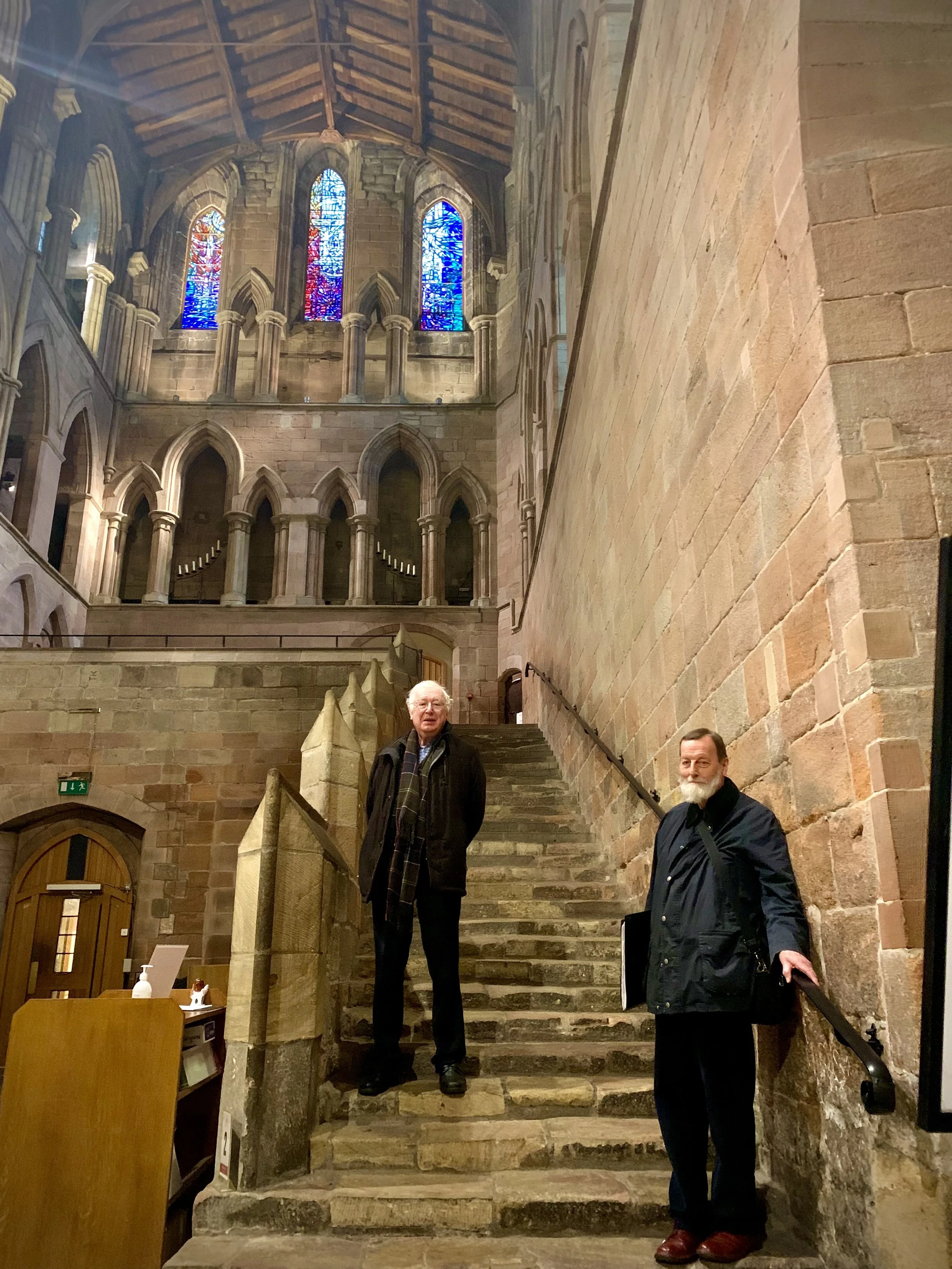
Tom (left) and Hugh on the medieval Night Stair, which remains in daily use today
A YEAR OF CELEBRATION
In 2024, Hexham celebrates 1,350 years since the foundation of St Wilfrid’s church from which the town of Hexham grew. Events include:
Feb 3, 10 & 17: The Ten-Minute Talks
At 3pm on consecutive Saturdays, these free talks shed light on the Abbey’s rich heritage.
Feb-Nov: Stars for Eternity
Thousands of origami stars are now suspended 45ft above the chancel, each made by local people or visitors and dedicated to someone special.
Mar 1: BBC Radio 4 Any Questions
Radio 4’s flagship topical discussion programme is broadcast from the Abbey with a live audience.
Jun 22: The Etheldreda Festival
An outdoor medley of local music and street food for all ages.
Jul 6: Three Choirs Festival
A musical convergence featuring the voices of Hexham Abbey Choir, Carlisle Cathedral Choir, and Newcastle Cathedral Choir.
Jul 25-28: Northern Saints Flower Festival
A celebration of colour, nature and creativity featuring dozens of breathtaking displays.
Sept 26-29: Hexham Abbey Festival
of Music & Arts
A joyful symphony of diverse performances, visual delights, and contemporary creativity.
Oct-Nov: Threads Through Creation
A dozen huge tapestry panels will reveal the wonders of the universe in vibrant, playful pieces to delight all ages.
Details of these and other events are available at: www.hexhamabbey.org.uk