
No strings
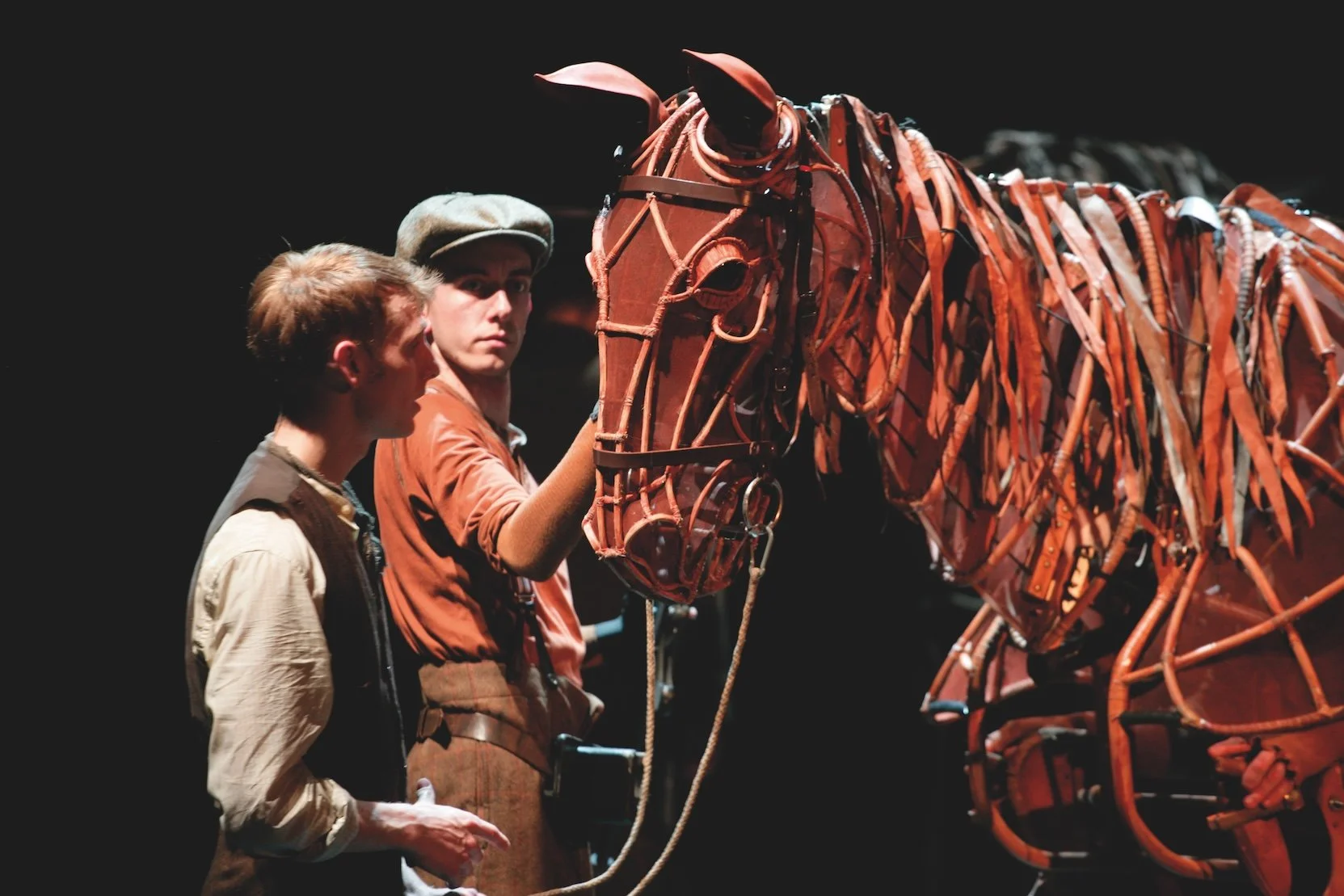
Toby Olié (rear) operating the head of Joey in the West End production of War Horse, 2009. Toby became an early pioneer of ‘declared’ puppetry – the theatrical technique that makes the show’s magic work; the audience can see the puppeteers, yet they soon stop noticing them as they invest fully in the puppet character
First published in edition 208 of The Northumbrian, Oct/Nov 2025
The stage phenomenon War Horse has been seen by more than 8 million people worldwide, including on its latest tour which visited the Theatre Royal in Newcastle. Rosie McGlade meets former Hexham lad Toby Olié, one of its original three puppeteers, whose latest production The Enormous Crocodile heads to Newcastle in spring 2026
Toby Olié is one of the UK’s – possibly the world’s – leading puppetry directors. He cut his teeth on the first ever production of War Horse, operating first the hind legs and progressing to working the head of its star, the groundbreaking, heart-wrenching horse Joey. He hasn’t looked back, and nor does he deserve to. Toby has carved himself a unique path in the theatre world and we should be proud of him back home, as he is of his roots in Northumberland.
Toby is in fact a Yorkshireman, having been born in Sheffield, but he was just six when he found himself in the library of Hexham’s Sele First School where his young eyes fell upon one of the Usborne How To titles familiar to so many childhoods. This one had a creature made from a knitted sleeve and egg cartons on the cover. A puppet. A dinosaur puppet.
“I was in the midst of my dinosaur phase, and I remember taking the book straight home and showing my mum. She said, ‘I haven’t got an old jumper, or goggly eyes – but try this’. For the theatre we used an ironing board. And I got my own copy of the book for Christmas. I had a very patient and supportive family. They had to watch me behind my ironing board putting on a show every couple of weeks, roping my sister in to play additional characters.”
Decades later, during the 2020 lockdowns, Toby made YouTube films featuring puppets fashioned from cereal packets, just as he’d done as a child, using the very same ironing board (which had accompanied him to university and stayed in his life for the purpose of ironing) as his performance space. This full circle moment inspired a book to help those with a passion for puppetry to get started in a world which has no clear path, planting the same seeds of magic he’d found in the school library. It will be published next year within the National Theatre’s Backstage Guide series.
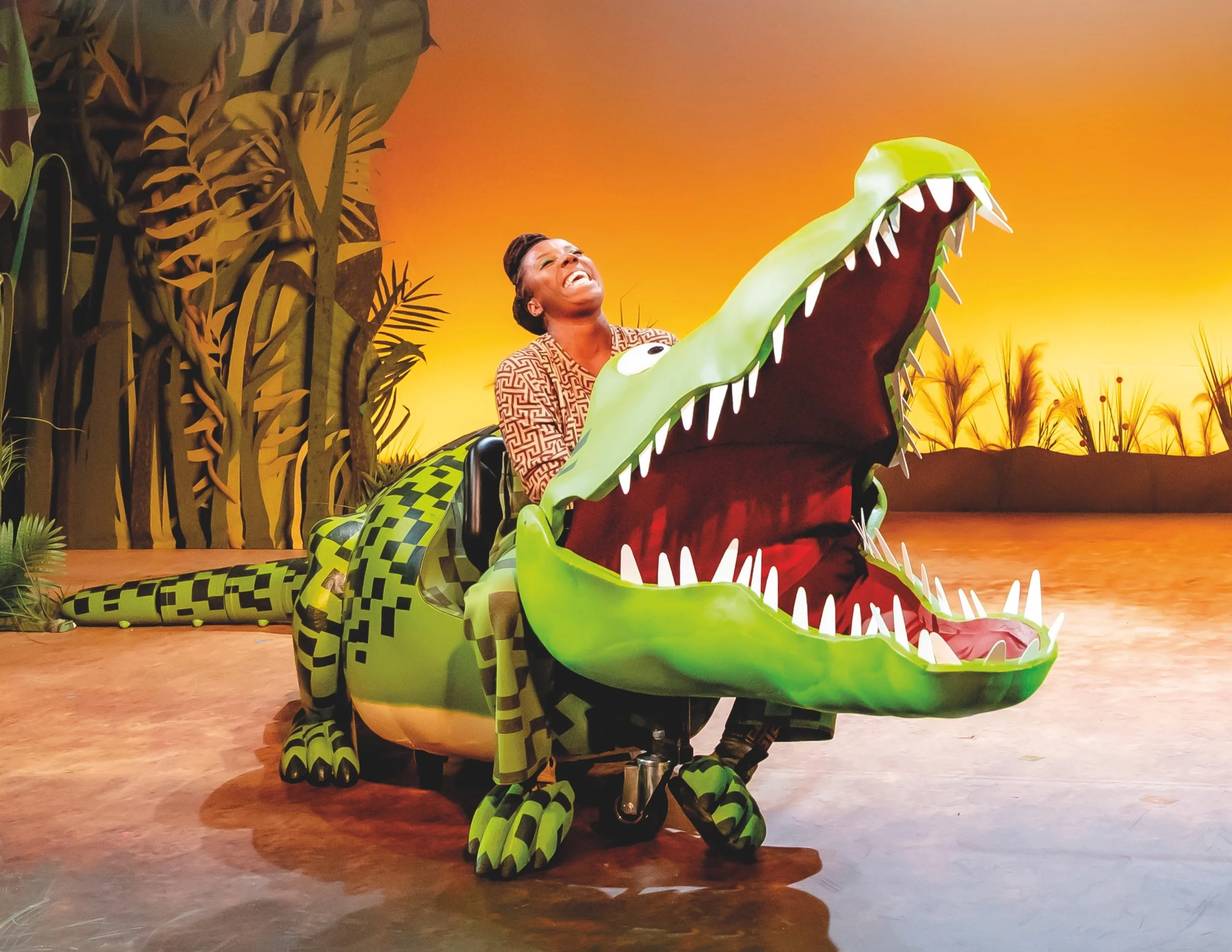
The magnificent star of The Enormous Crocodile, above
Other early influences were TV’s Sesame Street, The Lonely Goatherd marionette scene in The Sound of Music and, aged 15, a backstage tour of The Lion King in London, granted after Toby wrote them an eager letter. He was, he says, a shy child with an equal love for art and drama. Puppetry was a sweet spot in which he could integrate both passions and grow in confidence. “I went to Junior Youth Theatre led by Vivien Hubbock and Lesley Silvera, which was phenomenal. And at Hexham Middle School, the drama teachers treated us as a sort of equal. We were given a real sense of responsibility and collaboration and I’ve always carried that with me. Then at Queen Elizabeth High School in Hexham I took part in productions involving 100 pupils or more; huge plays and musicals led by drama teacher Kathy White-Webster and headteacher Tony Webster, who ran the school’s Youth Theatre together. I was incredibly lucky to have all those teachers, and I’m aware there is often much less opportunity in schools now. I was always looking at how I could integrate puppetry, and they encouraged me.”
Toby chose a puppetry degree at the Royal Central School of Speech and Drama in London, ready to finally surround himself with kindred spirits and launch fully into the puppet world. “But I was the only one on the course!” he says. Disappointing at first, it served him well. Very well, as it turned out. He learnt to bring puppets to life professionally and to conceptualise how they could fit into student performances, a little like he’d done at school. “From the beginning I was operating like a puppet department. We talked deeply about how to interpret ideas and think from different departmental needs and perspectives.”
In 2006, his final year, loving what he was doing but lamenting how he might have to wait years for a production that put puppets on the same big stage as human actors, Toby was approached by the National Theatre to audition for a South African-led production based on Michael Morpurgo’s World War I novel, War Horse. “It totally changed audiences’ expectations of puppetry, proving the art form can engage audiences of all ages, not just children. I’ve striven for that since, having puppets as emotional catalysts in shows that audiences of any age want to invest in imaginatively and emotionally.”
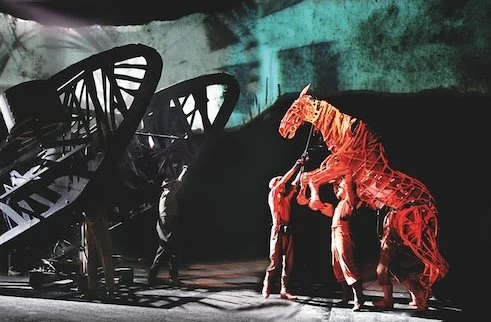
Toby playing the rear legs of Joey in War Horse in 2009
Toby says that with puppets, 60 per cent of the experience is what the show gives you, while the other 40 per cent the audience does for themselves. You see the puppeteers, but you choose to believe in the character. It becomes a uniquely charming and moving experience as you imprint your own emotions and experiences onto it.
He progressed from co-performing Joey in War Horse to become the show’s puppetry director, staying with the production for six years. “There were so many performances around the world, it became my responsibility to re-cast and train numerous performers for the London production. But lately, after many years making large-scale shows with actors and puppets alongside each other, I started to develop a hunger for smaller productions with only puppet characters.”
While few shows he’s worked on since would really qualify as small-scale, Toby has become one of the world’s go-to people for integrating puppets into a production or, indeed, making entirely puppet-based shows. He is now with The Enormous Crocodile, a musical adaptation of the Roald Dahl story. The script and songwriting process began in 2018 and in 2020 Toby was asked to dream up ways in which puppets could bring it to life. He wanted something bright and zesty which remained true to the Roald Dahl spirit; something children would love, spine-tingly here and there but not too scary, and which parents would be engrossed in. The cast needed to shine. “The singers had to carry the show musically as well as operate as puppeteers. And there were only five of them, so the enormous crocodile needed to be huge but manageable, while at one point being able to disguise itself as a coconut tree and as a see-saw. And the audience needed to pick up the show’s ‘language’ from the get-go.”
This is familiar territory for Toby. “The creative team knew what they wanted the puppets to be and do, but they didn’t know how,” he says. Figuring out the concept behind everything is his speciality, and he thrives on the challenge. “A puppet comes with a lot of visual baggage,” he explains. “Often you have two or more puppeteers surrounding a character, and they need to be integrated into the aesthetic and not distract from the show. I didn’t want to hide anyone as the animals’ characterisation in the script was so playfully human, so I devised a way to have the puppet and performer as one entity, with the performer part of the puppet body.
“We have that language for the main animals – the crocodile, hippo, elephant, bird and monkey – and the croc was the main way into this. We call it the croc-mobile. The body is a free-wheeling cart, the actor’s legs are the croc’s front legs, while behind it has static legs and a long, articulated tail. It’s nearly 5 metres long in total. The performer is steering the croc-mobile and having to sing as well – it’s a full-on musical – while animating its head and legs. So while the crocodile is this evil thing going through the jungle looking for children to eat, the actual operation is like a naughty kid on a go-cart. It’s really fun.”
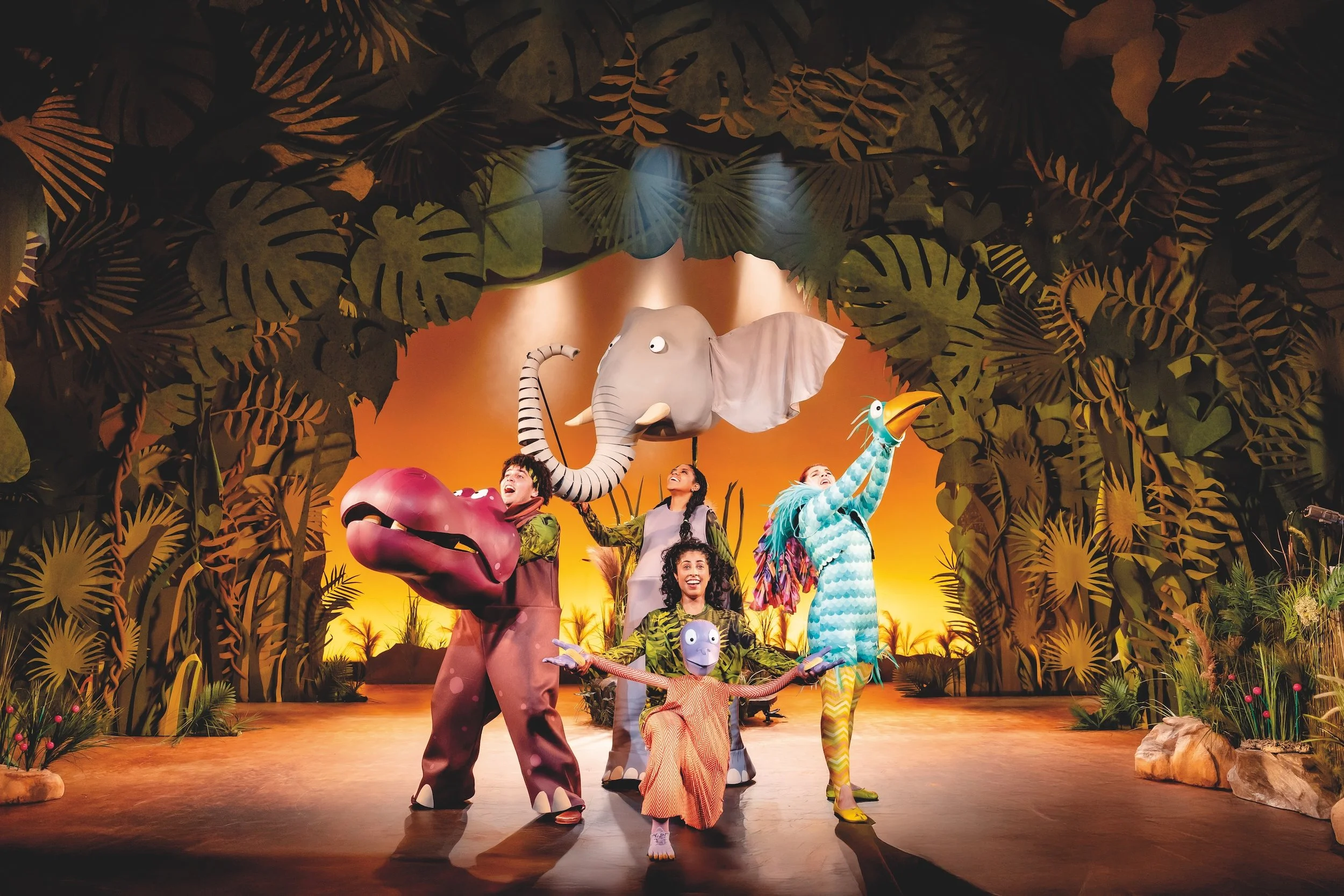
Some of the puppet characters in The Enormous Crocodile
Toby designed this menagerie of puppets with his colleague Daisy Beattie. She was in charge of the puppets’ internal mechanisms while he led on aesthetics, and they bounced back and forth, making puppets that were as expressive as possible. “It’s been very satisfying. You see a family come in and the parents are thinking ‘okay great, this isn’t for me, but it will keep the kids quiet for an hour,’ and by the end of the opening number the parents are as hooked as the kids. It’s lovely.”
The production opened in Leeds at Christmas 2023, has played Regent’s Park in London, and is now touring the USA. Next year it will return to the UK, arriving at Newcastle’s Theatre Royal in May. “This year we had to make a second set of everything so two shows could run concurrently,” Toby adds. “I co-direct the show, which means overseeing the entire rehearsal process. Very often the cast are amazing singers and actors but haven’t done puppetry before, so I’m teaching them the skills from scratch.”
Toby’s style of ‘declared’ theatrical puppetry has yet to make it big in the film and TV world, but there is growing interest. “I’ve been approached by people from the world of big tech and by a leading movie director asking how the theatre style of puppetry, where you see yet don’t see the puppeteers, could work. It’s an amazing question and it’s curious that people are reaching that stage at a time when computer graphics and AI can generate such lifelike images. Even Disney, I believe, is going back to hand-drawn cartoons.
“I think it’s subconscious. As humans we still hanker for primitive storytelling and what we do is very declared, like a caveman telling a story by a campfire. Puppetry is very open, it’s just the act of it, and to the viewer it feels astonishingly magical. It’s interesting that people seem to be striving for it, particularly with AI, where people can upload a picture and have it animated without a care for the people who created the original image. I get mad just thinking what that’s doing to the world, let along to art. I still champion the handmade processes in puppet making.
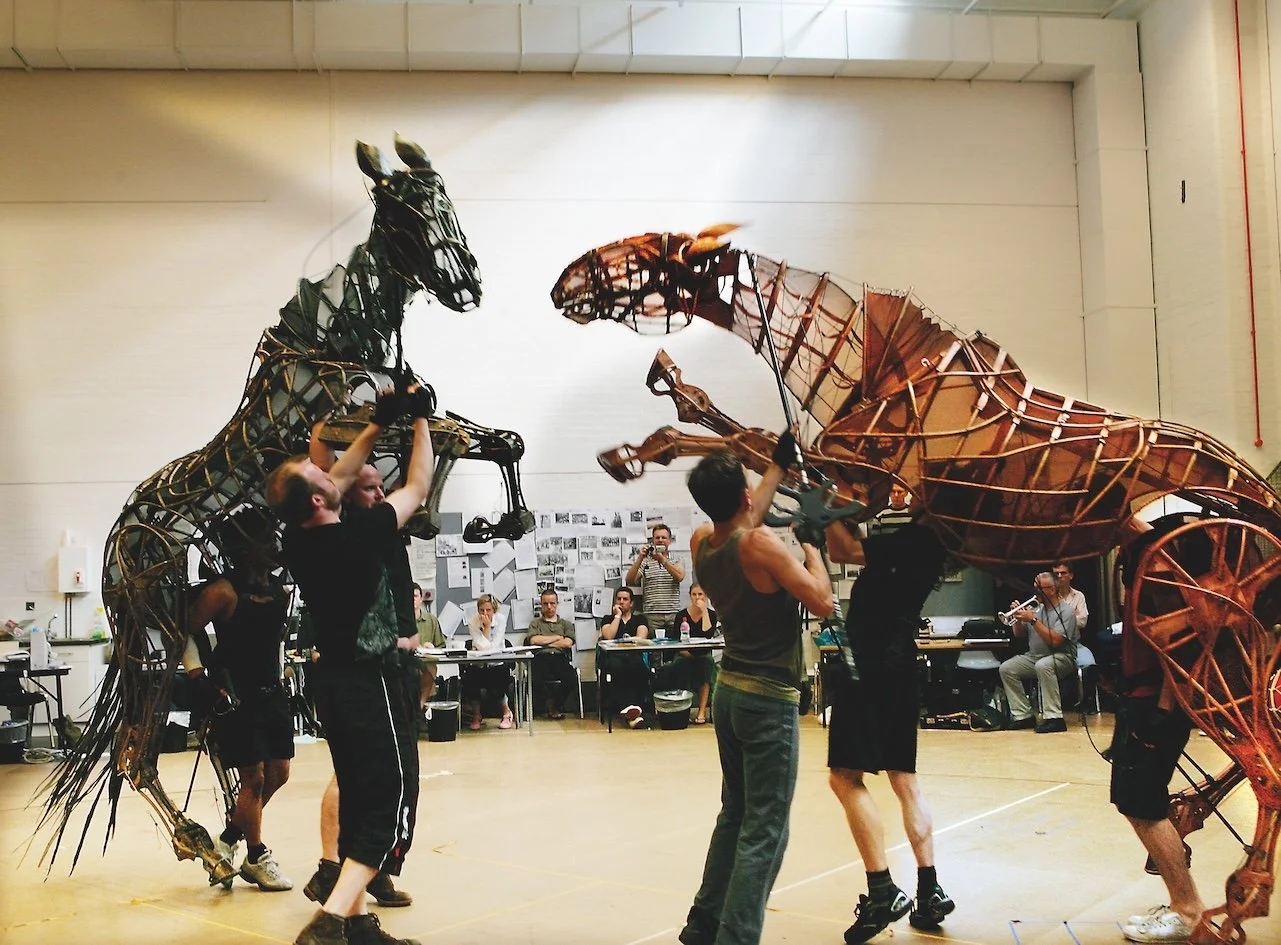
Toby in rehearsal for the 2008 National Theatre revival of War Horse, operating the rear legs of Joey
“All of our Enormous Crocodile puppets were initially sculpted in clay to make a pattern and then turned into foam. I think the audience feel it subconsciously, the immediacy of it. We chemically have the ‘uncanny valley’ effect with screen animation, where something is so close to reality it actually freaks us out. A puppet goes in the opposite direction, and asks you to join it.”
Back in theatre territory, Toby has been working with puppet maker Daisy Beattie again, creating puppets for the Royal Shakespeare Company’s adaptation of The BFG, another Roald Dahl classic, which has just begun rehearsals. It is on in Stratford this Christmas and Chichester next March. The puppet making process often feels like having a baby, he jokes, but with longer pregnancies. “I don’t have kids, I have a dog, but you dream up this puppet and then birth this creation after a two-year gestation period.” He’s building up quite a sizeable family. There is the puppet cast of elephant, tiger, orangutan, butterfly and fish from Running Wild (2015-2017), which brought another Michael Morpurgo tale to life. In 2017, Toby’s designs for the National Theatre’s Pinocchio pitched the boy’s innocence against a towering, monstrous adult world. In 2022, George Orwell’s Animal Farm toured the country with an entirely puppet-led cast: Napoleon, Snowball, Squealer the pig and Boxer the horse, with sheep, cattle, geese, hens and pigeons. Earlier this year was the gorgeous adaptation of the storybook There’s a Bear on My Chair with its huge polar bear and cross little mouse. There have been, and inevitably will be, many others. Toby’s Animal Farm and Running Wild both visited Newcastle’s Theatre Royal. In 2018, he worked with former War Horse co-puppeteer and Middlesbrough artist Finn Caldwell to create the stage version of The Hartlepool Monkey, bringing it to Northern Stage in Newcastle and Hartlepool Town Hall. “It was both sympathetic to the monkey and to the people of Hartlepool, and the response was phenomenal, so open-hearted,” he recalls. “I love being able to bring these productions to the stage, particularly in the North East, where tiny Toby and his cereal boxes began.”
• The Enormous Crocodile heads to the Theatre Royal in Newcastle, May 21-24, 2026
• Rosie McGlade is a co-director of No Strings International, a Newcastle-based NGO which uses puppetry to convey life-saving messages worldwide (www.nostrings.org.uk)