
Brambly hedges
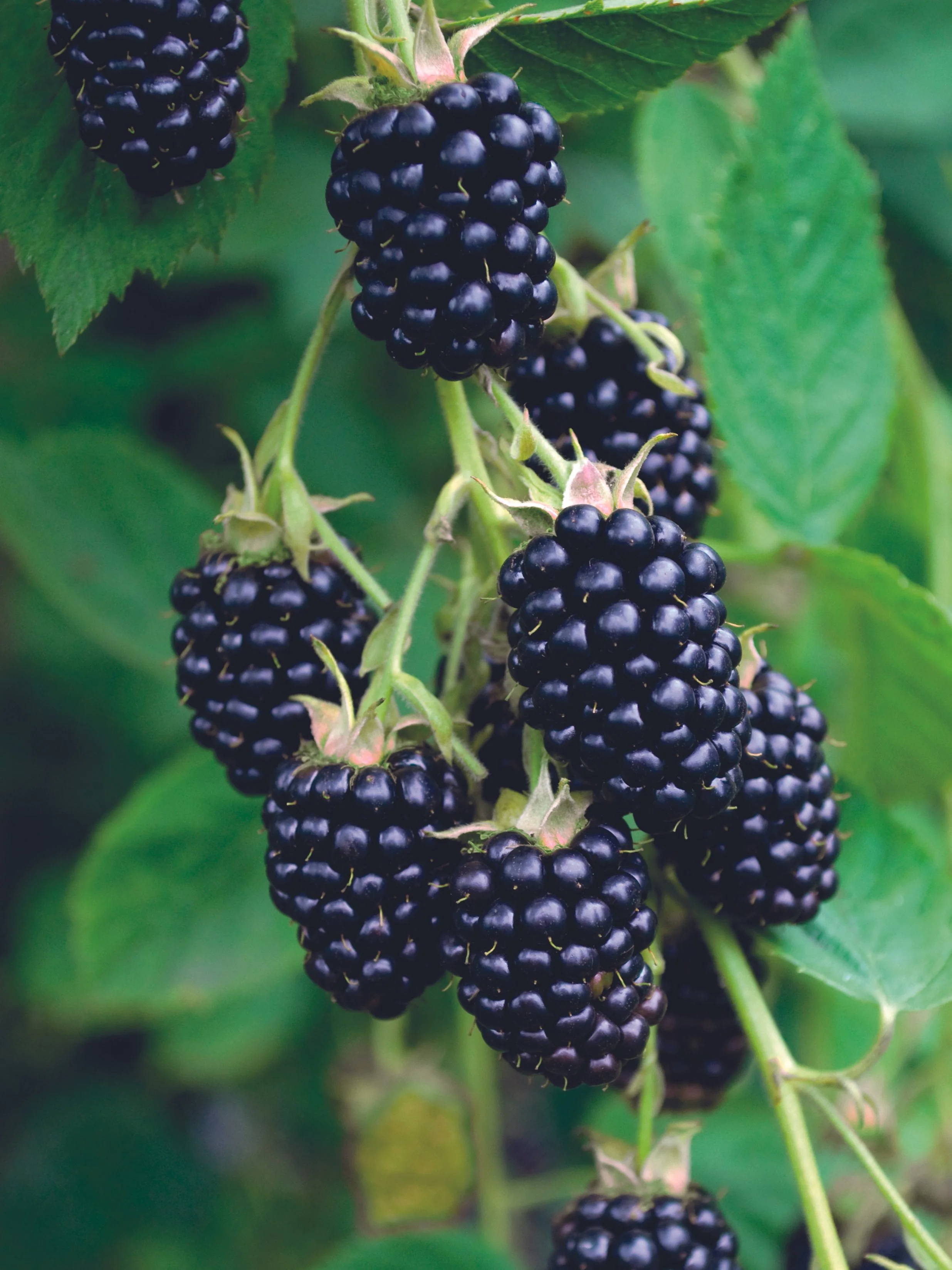
The humble blackberry – (free) food of the Gods
This week, Charlie is mostly foraging among the brambles
One of my favourite times of year is early September. The light starts to change; it becomes more mellow, and it has a last bit of hope about it before we slide into autumn. As a child, this was always a time of mixed feelings: part of me dreading going back to school, the other part eking out the most fun before the grey socks went back on.
One of our favourite things in early September was picking blackberries. This was a mini-adventure, as the best place for it was quite a hike from our house. We would arm ourselves with baskets, dogs, long-sleeved shirts, old Dunlop wellies and the staples of life – orange squash and Tuc biscuits.
Once we’d walked up Dawson Lane for about a mile, we turned left by a tumbled-down stone barn. If we were lucky, the resident barn owl would fly out, giving us a steely stare as it went. Once past the barn you were on an ancient track bounded by old hawthorns. This meandered down a hill until at long last you were in an old quarry. The south face of this was (and I imagine still is) lifting with what we called brambles.
The first blackberry is like all first things – gin and tonics, bacon sandwiches, draughts from mountain streams – a real treat, and we would bundle into the bushes and stuff our faces.
The blackberry has, as I am sure you know, a unique taste. You have to be discerning and pick the blackest, juiciest ones – not the raspberry-looking ones or the fly-blown dusty ones. The right one, really glossy and plump, will explode a sweet, juicy, berry flavour into your mouth but with a moreish hint of tartness. If you like oysters, you will agree that they taste of the sea. Well, I think blackberries in September taste of the countryside in late summer.
We were not the only ones enjoying the feast. Labradors are omnivores. The ones we had at the time ate Christmas lunches while we were at church, their beds and Granny’s hand-made shoes. Watching the stand-up things eating always stirred the inner labrador and shortly they would be plucking berries from the lower branches. They quickly became choosy and would spit out anything not up to scratch. It is a genetic thing, and our dogs today love an amble down a thicket of blackberries as much as their forbears.
I have so far described the blackberry as a delicious treat. But it has a dark side; it is a prickly creature, using its thorns to climb wherever it likes and at considerable speed. If there is an open area of ground with a bit of light, a few blackberry seedlings will disappear almost before your eyes, a combination of multiple plants and explosive growth resulting in an impenetrable thicket within two or three years.
The danger of these thickets is getting stuck in them. One day out shooting, I was tasked with beating a small wood that was basically a huge blackberry bush. It was about 6ft tall, with old and new growth creating an impenetrable, prickly mass. A huge oak that had come down in a recent storm was lying diagonally across the thicket, and I thought this would offer a good vantage point to see if the dogs were making any headway. Then I heard a holler from across the fields and spun around to see what it was about, only to be separated from the tree and find myself heading backwards at speed into the brambles. This made for a nasty landing.
When the dust settled, I took stock of my surroundings. I was in the middle of the brambles, the odd nettle brushing my face to add to the fun. I couldn’t move – I’d been ensnared. It was quite a creepy feeling, like being a fly in a web. I hollered for help until eventually, after an hour or so, I was rescued. The rest of the team had been having drinks and thought it was odd that I wasn’t the first one with his head in the gin bucket, so a search party was dispatched.
I think you’ve probably heard enough of my encounters with Rubus Fruticosus (which sounds like a lethargic Roman), so let’s have a look at the life of the blackberry. It is an ancient resident of these islands, so much so that seeds were recently found in the stomach of a Neolithic man dug up from mud on the Essex coast. A well-established resident of our woodlands and hedges, it provides food for a wide range of animals. Roe deer like the leaves which also provide food for caterpillars. These are usually moth caterpillars – the brown-tail moth, fox moth or buff tip-moth. Don’t you love moth names? They are so evocative. A brown-tipped Bennett perhaps not so exciting . . .
The blackberry flowers that come out in May or June are also a sign of the seasons changing. They attract a myriad of pollinating insects; a sign that summer is getting going. I have read that in some places, such as Ireland, honey is produced by bees which forage almost exclusively on blackberry flowers. BeesWiki.com explains: “Blackberry honey is most commonly sold in its raw form and has natural antibacterial, antifungal, antiseptic, and antibiotic properties. It promotes faster healing for wounds, burns, and ulcers. It stimulates the immune system and promotes faster recovery from infections.” If that isn’t a super food, then I don’t what is.
One other contender is the blackberry itself. This is a compact source of numerous beneficial vitamins, minerals, fibre and antioxidants. All these goodies can help to reduce inflammation, which is reported to lower the risk of diseases like cancer. Blackberries can, however, also affect your balance if made into whisky. I was introduced to this elixir by a gamekeeper in north Northumberland. A snowstorm came in and he suggested we take shelter under a huge hedge. From his pocket he produced a flask of blackberry whisky. It’s a bit like sloe gin, but with that moreish tartness that left us after a happy hour or two with an empty flask. Fortunately, this time I didn’t need rescuing, or maybe I did. To be honest I can’t remember.
The benefits of blackberries also appear regularly in folklore. When people were buried in more open churchyards, blackberry bushes were often planted to stop sheep nibbling and eroding the grave, while some believed the briars would keep the resident of the grave in. This rather morbid theme is carried on in Christianity, many Mediterraneans believing that Christ’s crown of thorns was made with blackberry vines. Another legend says that the blackberry was once beautiful, but Lucifer cursed it because he fell into a bramble patch when he was forced out of Heaven. On September 30 he is supposed to re-enter the fruit, which is why you’re not meant to eat them after that date.
Obviously, this story is bonkers; blackberries are still beautiful in my book and if I fell from Heaven any kind of cushion would be more welcome than hard ground, as I can attest from my own ensnarement. September 30 does make sense though, as after this date the berries start to go off.
As in all folklore, there is a positive side to the blackberry. Apparently, they can ward off evil spirits, negative energies, and even vampires. I would say they are lucky and wonderful things. As Edmund Blackadder said: “I thought that a cat had done its business on my pie, but it turned out to be an extra-large blackberry.”
Charlie Bennett is co-owner of Middleton North near Wallington, where he works to support existing wildlife and attract new species alongside sustainable stock farming designed to add to the diversity of wildlife in the area. For information, visit: www.middleton-north.co.uk
• Charlie’s new book, Climbing Stiles, A Wander Through the Countryside & Beyond, is available in hardback priced £14.99 at bookshops and online at: www.charliebennettauthor.co.uk