
Sound and beauty
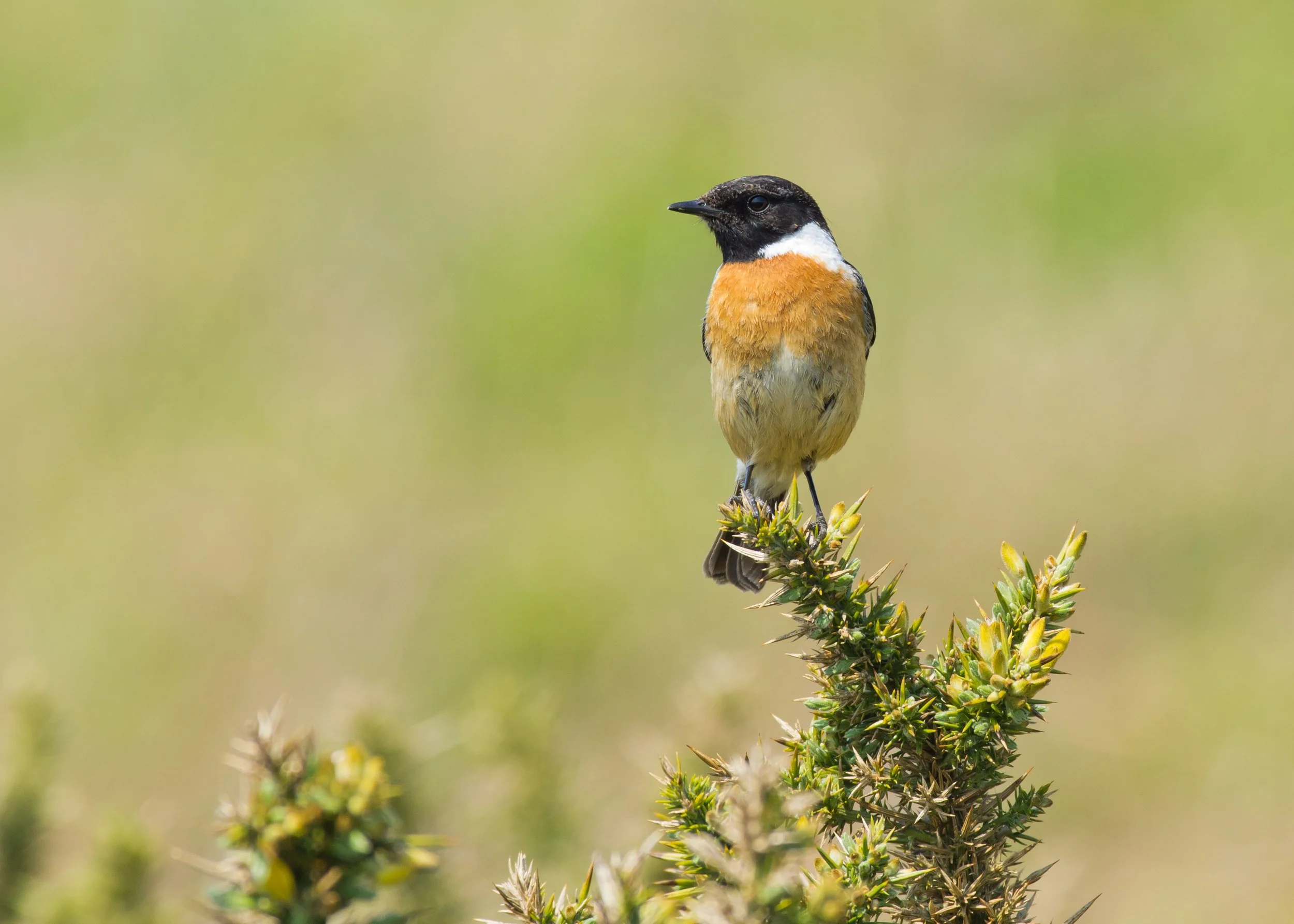
IAN KERR celebrates the stonechat, one of our most attractive and colourful small birds, which is also known for its distinctive song
A small number of birds take their names from the sounds they make, the cuckoo being the classic example and the species anyone can mimic.
Then there’s the kittiwake, the graceful little gull whose breeding season calls echo both against the crash of waves at its sea-cliff nesting sites and against the roar of traffic on the Tyne Bridge and riverside in Newcastle and Gateshead.
Another species is the chiffchaff, a small warbler which repeatedly sings out its name in woodland as it defends its territory from others.
There’s also another bird you can easily imitate, but you must first take a pebble in each hand and tap them sharply together. That gives you the sound of another of our aptly named birds, the stonechat.
Stonechats are one of our most attractive and colourful small birds. They inhabit a variety of rougher habitats, mainly coastal sand dunes, the extensive system around Druridge Bay being a prime example, and moorland areas where over the past century much of their open habitat has disappeared under the onward march of forestry.
While coastal dunes remain the stronghold of the species, modern methods of upland forestry could now help it. Instead of just blanketing huge areas with trees, the switch to more sympathetic methods with mixed woodland and open areas could be of benefit to stonechats and a host of other more open-country birds.
Stonechats are largely missing from more intensively managed farmland which covers much of our lowland areas, although they do occur in pockets of land too poor or wet to raise crops or provide good grazing for cattle or sheep.
I regularly visit one such area of former marshland, which was reclaimed during the 18th and 19th centuries by the digging of miles of deep drainage channels. This has left a sizable ‘island’ of damp, rough and still very rushy terrain surrounded by good arable land.
The fact that this area still very quickly floods after winter snow and rain despite its drainage systems makes it pretty much useless for farming except for rough grazing.
Several pairs of stonechats live and breed here in isolation, well away from their more usual coastal and upland localities. I’m sure the same applies to other similar pockets of land across the county and the rest of Britain.
That absence from farmland is nothing new. Naturalist George Bolam, generally recognised as the founding father of modern ornithology in the county, was writing as long ago as 1912 about the noticeable retreat of stonechats from many areas of Northumberland as farming became ever-more efficient.
Male stonechats are among the most strikingly handsome of our small birds. Their heads and faces are black, which contrasts sharply with a wide white neck patch. Their breasts are a rich orange, fading to white lower down. Their backs are brown and darkly streaked. They have pale mottled rumps and their tails are dark. Females are paler versions with smaller and much less distinct neck patches.
They are among the smaller members of the much wider thrush family, which also includes robins, redstarts, bluethroats, nightingales and wheatears, as well as our familiar blackbirds, song and mistle thrushes and our wintering redwings and fieldfares from Scandinavia, Russia, the Baltic and other parts of northern Europe.
Stonechats are much the same size as robins and have the same rotund appearance. Like robins, they are also not particularly shy, often perching high on bushes, walls and fence lines and giving that sharp, tacking warning call – the noise of those two pebbles being knocked together – when they are alarmed either by our presence or that of their many ground predators.
They conceal their nests in tall grass and other vegetation and often raise a couple of broods of young in good breeding seasons. Those sharp alarm calls are often the first indication from anxious adults that they have eggs or young in the nest or fledglings hiding nearby.
Other members of the family, particularly redstarts and wheatears, are summer visitors to Britain, but the stonechats are permanent residents, usually not straying very far from their breeding sites in autumn and winter.
That can cause them very real problems and lead to wild fluctuations in their population. They are prone to the vagaries of our climate. A succession of good breeding seasons followed by mild winters, which seem to becoming more regular these days, can lead to an increase in the populations with new areas, particularly in the uplands, being quickly colonised.
But when the opposite happens and winters are harsh, many of these upland pairs perish, leaving large areas without pairs in the following spring seasons. It then takes several years of good summers and successful breeding seasons before the population recovers – at least until the next time.
At one stage of my career I was involved in an intensive survey of a huge moorland area to check for breeding species and logged a healthy population of stonechats raising their broods. A severe winter followed with prolonged snow cover on the hills. The following spring, return visits to continue the survey showed a marked absence of these birds, the winter having wiped them out from that particular area.
Some birds do move from higher ground in winter, but they seldom seem to go very far. Like many resident breeding species, they are reluctant to move away from established breeding sites.
Those at the coast fare better in winter because the weather is seldom as severe as on the higher ground. On Holy Island, the area I know best, seven or eight pairs regularly breed in the dunes or in rougher patches of uncultivated ground.
Often in winter some of them will simply move a couple of miles to spend the winter around the edges of the village or around the harbour, the temperature there being a degree or two better than out in the open. Even so, I’ve never known stonechats to follow the example of other members of the thrush family and venture into gardens to take advantage of the food many people provide.
These are birds which could benefit from climate change and the trend towards warmer and drier summers, but that’s something which remains to be seen.