
Return of the wild swans
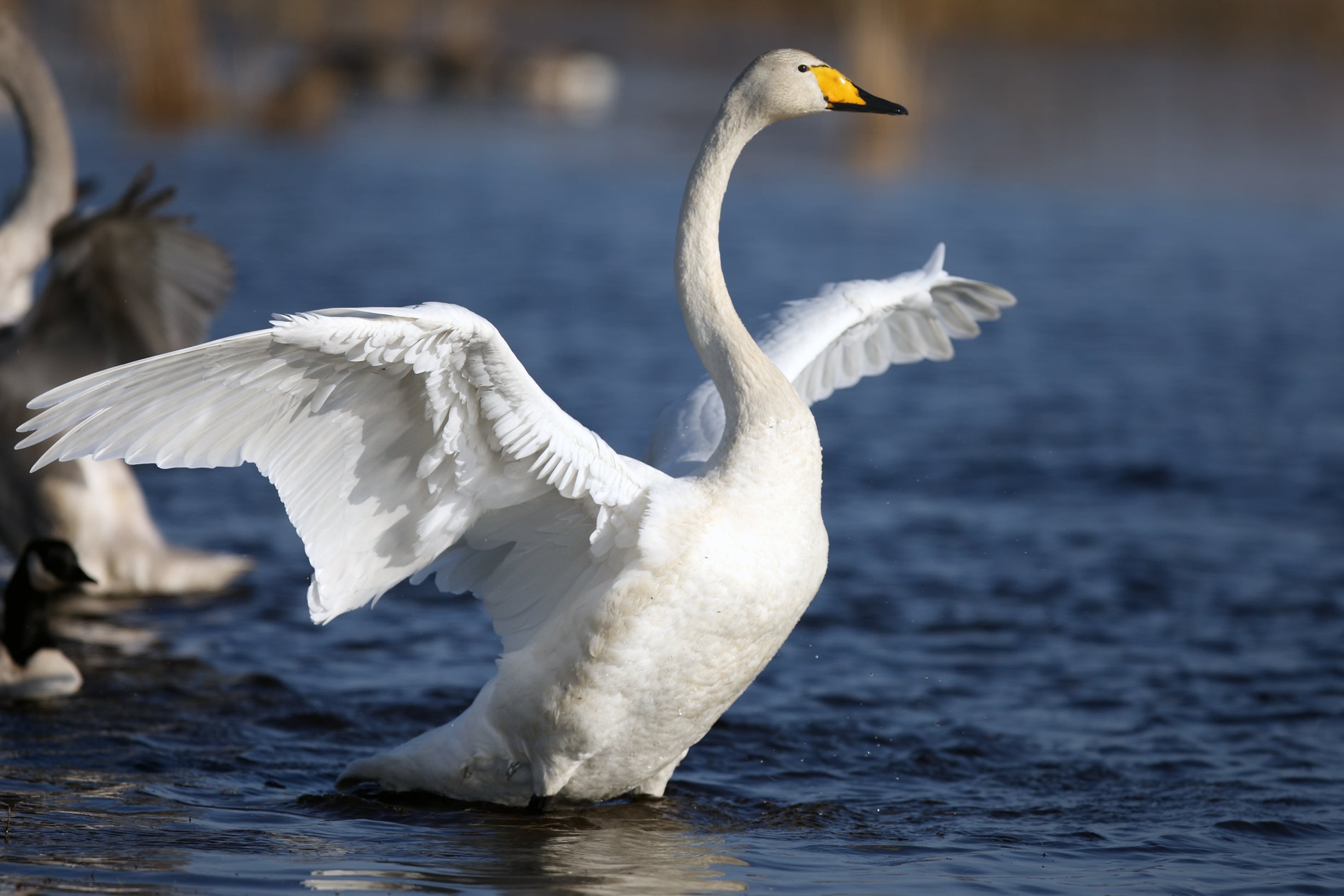
A whooper swan
First published in edition 196 of The Northumbrian, Oct/Nov 2023
Ian Kerr profiles the whooper swan and its distant cousin, the Bewick’s swan
Among the millions of migrant birds which flood into Britain each autumn from across the northern hemisphere, none are larger or present a more impressive sight than the whooper swan.
With its brilliant white plumage, 6ft-plus wingspan and far-carrying trumpeting call, the arrival of thousands of these birds is one of the highlights of autumn.
This is the old countryman’s “wild swan”, to differentiate it from our largely resident and often tame mute swan, whose fascinating lifestyle I detailed in this magazine earlier this year.
Whooper swans migrate in flocks often containing family parties, the greyish youngsters sticking close to their parents throughout the journey and staying with them as they gather to graze in fields, on ponds, on larger lakes and reservoirs and, occasionally, on mudflats and estuaries.
Around 16,000, mainly from breeding populations in Iceland, arrive in Britain, usually from October and into winter, and remain until the following early spring when they return northwards.
Local birds regularly congregate in fields behind Druridge Bay, while others use lowland areas of the Tweed Valley, though parties can turn up virtually anywhere there is suitable grazing and water for safe roosting.
Highly gregarious, there’s no more splendid spectacle than whooper swans, heads and often wings raised, trumpeting excited greetings as others glide down from the sky to join them. Then, as quickly as it started, the whole flock settles back to the serious business of feeding.
Many of our swans have heads and necks stained yellow, red or brown, the result of feeding on submerged weed in mineral-rich waters, particularly on their breeding grounds on Iceland’s highly volcanic landscape.
Watching such a group is usually one of the highlights of a day’s outing during the colder months, indeed one close friend of mine has a saying: “It’s always a good day when you come across swans.”
Whooper swans are creatures of habit. As they begin their return migration during March and April, parties tend to congregate in the coastal fields around Beal, on the coast opposite Holy Island. The area seems to be a regular feeding and resting pit-stop as they move northwards towards Scotland and onward back to Iceland.
Their annual migrations led to one tale, which might or might not be true, dating back to the days of the Cold War, when the former Soviet Union and Britain and its western allies were continually probing one another’s air space and defences. The story involves RAF radar operators detecting a mysterious high-level blip on their screens moving steadily southwards down the North Atlantic towards Scotland. Jets were scrambled to intercept and investigate the oncoming unidentified intruder.
Imagine their surprise and probably relief and amusement when the jet crews discovered the blip was nothing more threatening than a large flock of whooper swans sweeping southwards at well over 20,000ft. They were moving in conditions so cold, and with oxygen levels so thin, that we humans would not have survived. Yet they seemed unbothered by the extreme conditions.
Regular gatherings of whooper swans are always scrutinised closely by birdwatchers because occasionally they also hold a much more highly prized species, the slightly smaller Bewick’s swan, from its breeding grounds in Siberia.
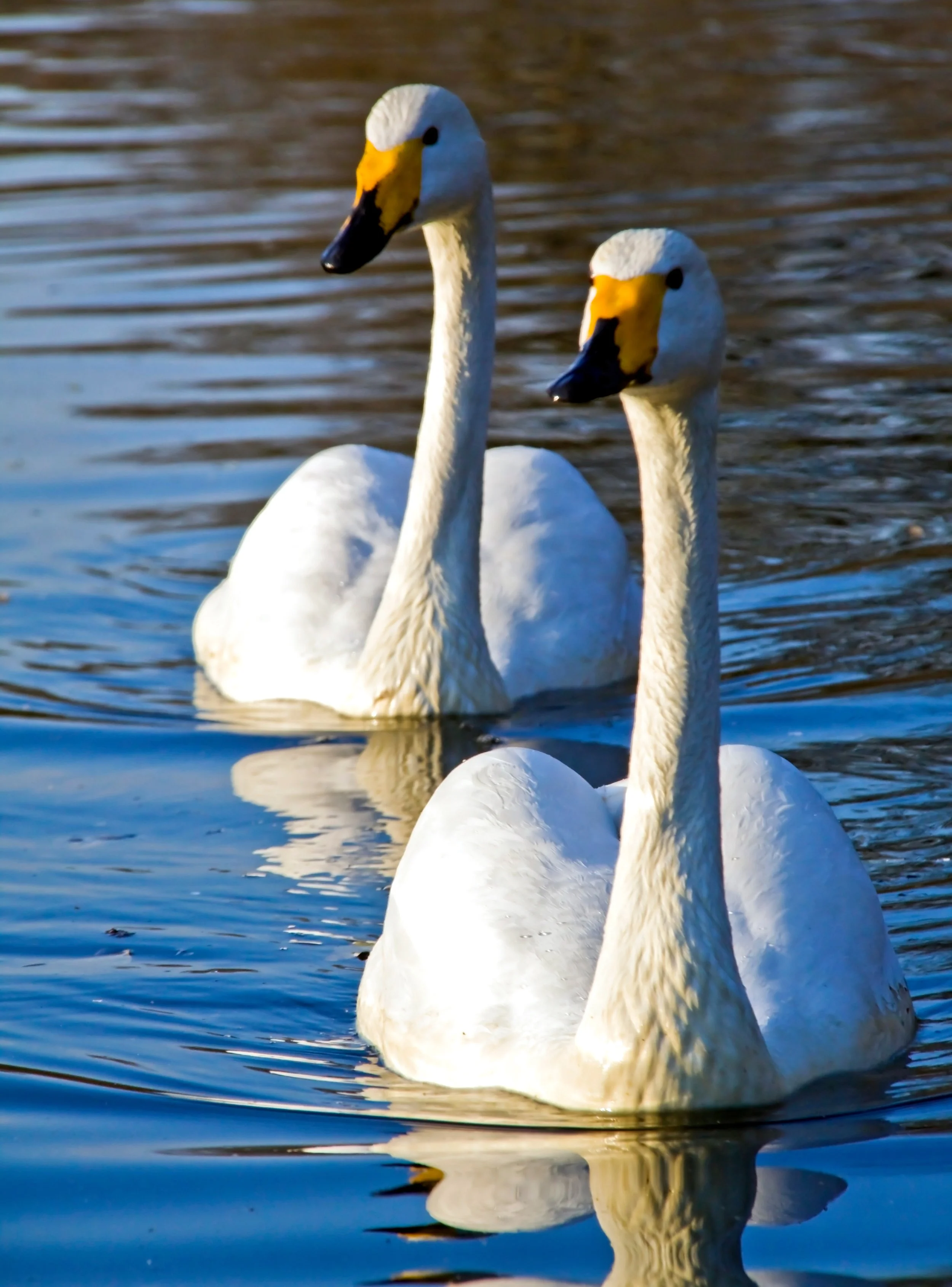
Bewick’s swans
Apart from the size difference, which isn’t always easy to spot, whooper swans have mainly yellow bills with black tips, whereas Bewick’s have bills which are more or less half yellow and half black.
Bewick’s swans, which were much more frequent locally in the past, have now become a rare visitor to our county, and in some years none are found at all. That’s a great pity because they have an important historic link with Northumberland and are, of course, named after Thomas Bewick (1753-1822), our famed local woodcut artist.
It was finally proved to be a separate species in 1829 after a detailed examination of an adult shot at Haydon Bridge, near Hexham. The discovery was announced in October that year at the first public talk in Newcastle of the newly formed Natural History Society of Northumberland, Durham and Newcastle-upon-Tyne – now the slightly less wordy Natural History Society of Northumbria.
Nicholas Wingate described the discovery of this separate species and, having been a close friend of Thomas Bewick, promptly announced that he was naming the new swan in his memory.
However, here the story gets a bit confusing. While Wingate was busy in Newcastle, down in London another leading authority, William Yarrell, had come to the same conclusion. After examining swans shot in the south of England, he also announced that there was a previously unrecognised species which he too had named in Berwick’s honour.
Yarrell, writing at the time, claimed it was his decision to name the new species in Bewick’s honour and that Wingate, who had also come to the same conclusion about the new species, had immediately adopted the name he had proposed. It seems that even back in the late 1820s one-upmanship was alive and kicking in scientific circles, and after all this time we’ll probably never know the real truth of who first came up with the idea of honouring Bewick.
These days, the Siberian breeding population of Bewick’s swans is declining and around 23,000 now migrate annually to winter in Western Europe. Between 3,000 and 4,000 normally reach Britain, most of them wintering on marshes and washes in Cambridgeshire and Gloucestershire, where they are an annual attraction at Slimbridge reserve run by the Wildfowl & Wetlands Trust.
The trust was formed in 1946 by ornithologist and artist Peter Scott, who discovered that most Bewick’s swans have unique bill patterning which enables individuals to be identified in the same way that whales can be identified by the various cuts and injuries they’ve received on their tails and fins.
Sadly, appearances of Bewick’s swans in our region are now few and far between. But it does mean that those flocks of wintering whooper swans will always attract close attention from hopeful local birders, because just occasionally they can hold one of their much rarer cousins.