
Time’s arrow
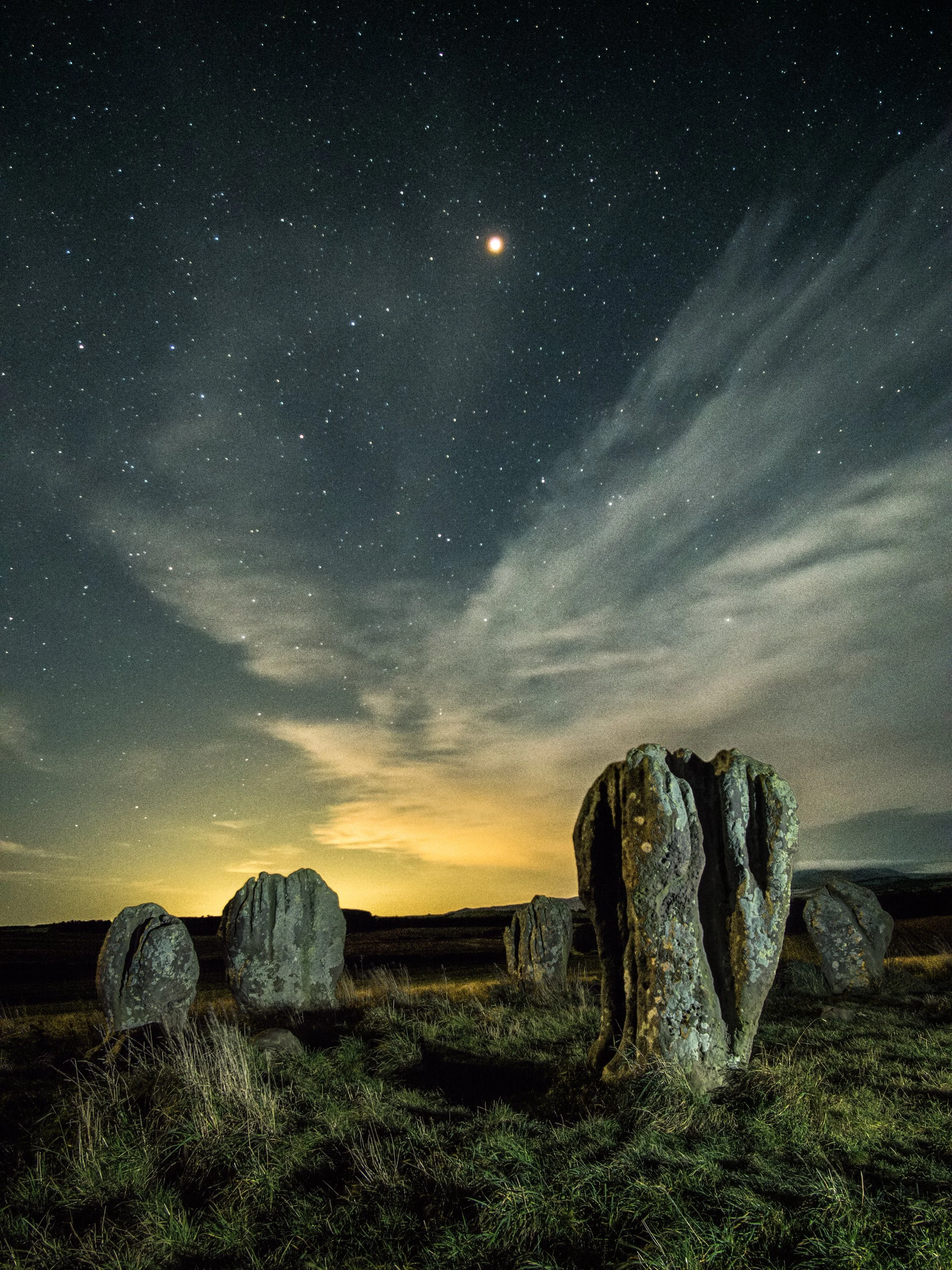
Mars over Duddo Stone Circle (October, S)
First published in edition 197 of The Northumbrian, Dec/Jan 2023/2024
Northumberland’s prehistoric archaeology is internationally renowned, as are its dark skies. Now, photographer Ged Kivlehan combines the two in haunting images of Neolithic rock art and Bronze Age monuments lit by starlight which began its journey to earth just as these prehistoric marks were made. Here, he explains the inspiration behind his work...
A barefoot man walks over the soft ground of an estuary and the hot, dry spell which follows bakes his footprints into the clay. As the water levels change, layers of silt and then peat fill the depressions, preserving the footprints over centuries until erosion reveals them seven millennia later.
Humans have always left marks on their surroundings. Many are inadvertent, like those footprints discovered on the Gwent Levels in the mid-1980s. Even when we’re aware of the marks we make, they are often little more than the by-product of a more pressing or meaningful activity. Yet these incidental marks can become a store of meaning for a forensic scientist or archaeologist millennia later.
In places, for example the Cambridgeshire Fens, the preserved footprints of family groups and their domestic animals have been found preserved in time, thousands of years after they were made.
Some traces are ephemeral, gone almost as soon as they are made. But those that remain because of what they represent, or their age and process of preservation, can become charged with meaning.
Then there are the marks left deliberately. Spray-stencilled handprints on rock surfaces, images of animals on cave walls, wedge-shaped impressions in clay that were the first writing; even the masterpieces in the National Gallery. These may share many of the features that give incidental marks their meaning, but because they are deliberate – an attempt to convert thoughts, feelings or impulses into something permanent – they possess even deeper power.
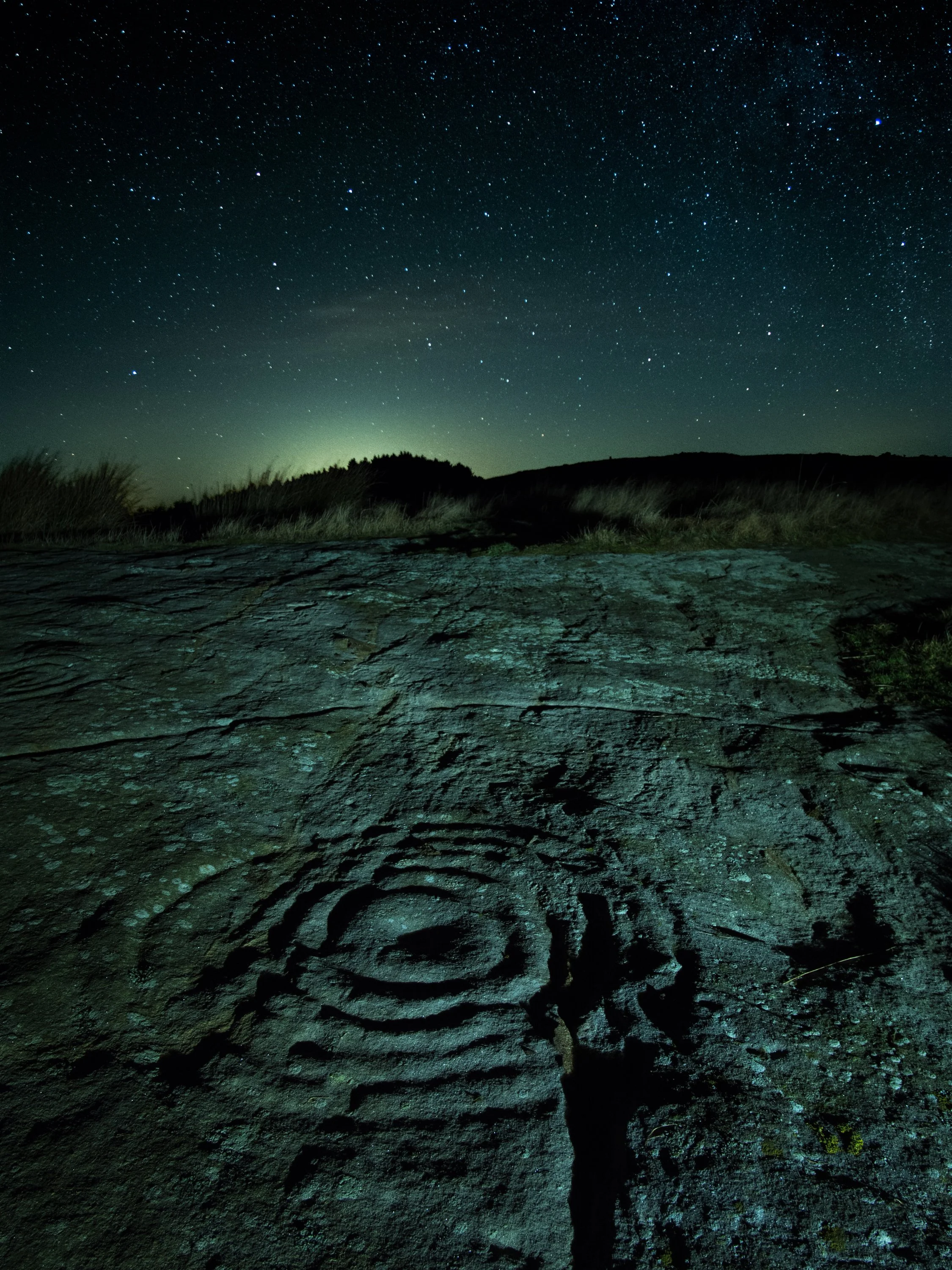
Chattonpark Hill with Scheat, Deneb and Sadr (December, NW)
As a former art teacher, I have always been interested in the process of human mark making and the perception and interpretation that accompany it. A map, for example, is a collection of words, symbols and colour rather than a picture or description. To someone who’s never seen a map before, it might be confusing or even meaningless, but with some knowledge of its code it can be interpreted and used as a tool. At the same time, it can be seen simply as a beautiful object; a fusion of mathematics and art to be put into a frame and admired.
Whereas figurative art may be filled with clues about an artist’s thoughts, abstract art prompts us to suspend our natural tendency to seek rational meaning and instead respond emotionally, or on a sensory level. The proximity of artist and viewer in time, location or culture makes this easier, while some art may never give up its secret because the gulf between maker and viewer is too great.
Northumberland’s rock art falls into this category. Unlike incidental marks whose age, cause or circumstance gives them meaning, there is no key as to what was in the mind of the person who, 4,000-6,000 years ago, chose a particular location to cut designs into the rock.
These markings do not depict birds, animals, people or objects. They don’t appear to have any figurative element, and the passing of thousands of years since their making serves only to deepen the enigma. This rock art seems to invite, and at the same time deny, explanation. Yet strangely, rather than detract, this adds to its power.
With that in mind, my response to the Neolithic and Bronze Age sites in these photographs is primarily aesthetic. It is not an attempt to interpret, but to convey the experience of being out in the landscape with the stars and galaxies above, close to marks produced by people who, though remote in time, must have seen the same wonders overhead as we do.

Blawearie early Bronze Age cairn with the Plough and Pole Star, Comet ZTF C 2022 E3, and the Pinwheel, Whirlpool and Sunflower galaxies (January, N)
Photographing the sites in this way is also an attempt at a kind of proximity with things that are far off; an attempt to express something of the scale of time and distance that the experience evokes. The starlight in the photographs will have left its star as the rock was being carved some 6,000 years ago, only to reach the camera on the night the photograph was taken.
In this landscape, marked over ages by wind, water, ice and volcanic activity, it is perhaps reasonable to assume that the ancient peoples who left their marks here led lives intimately connected with the landscape and the heavens. It is possible too that they had their own profound sense of the interconnectedness of the elements of the natural world as the seasons changed and the sun, moon and stars wheeled above them.
Light is especially important in these photographs, not least because of the practical demands of working in darkness, but also because of the significance of light in the images. Stars’ distance from us is measured in terms of light (6 trillion miles to one light year), but the transformative impact of light on the subject is also vital in the photographs. Oblique light throws rock art ridges and troughs into dramatic relief, accentuating their form, revealing how distinct they remain after thousands of years and conjuring images of how they were when new. Could it be that for the far-off people who made these marks, light – sun, moon, star or firelight – was an important consideration in their making and purpose?
We cannot know, but when I’m beside one of these rock panels in the early hours of the morning, I do know that millennia ago, another human not unlike me stood here and, much like me, tried to communicate an idea. And just for now, that is enough.
The images on these pages were taken by the kind permission of landowners or their agents to whom the author is extremely grateful. Please note that access to Duddo Stone Circle at night is not permitted and was only possible here by prior arrangement. To see more of Ged’s work, please visit his website at: www.gedkivlehanphotography.smugmug.com
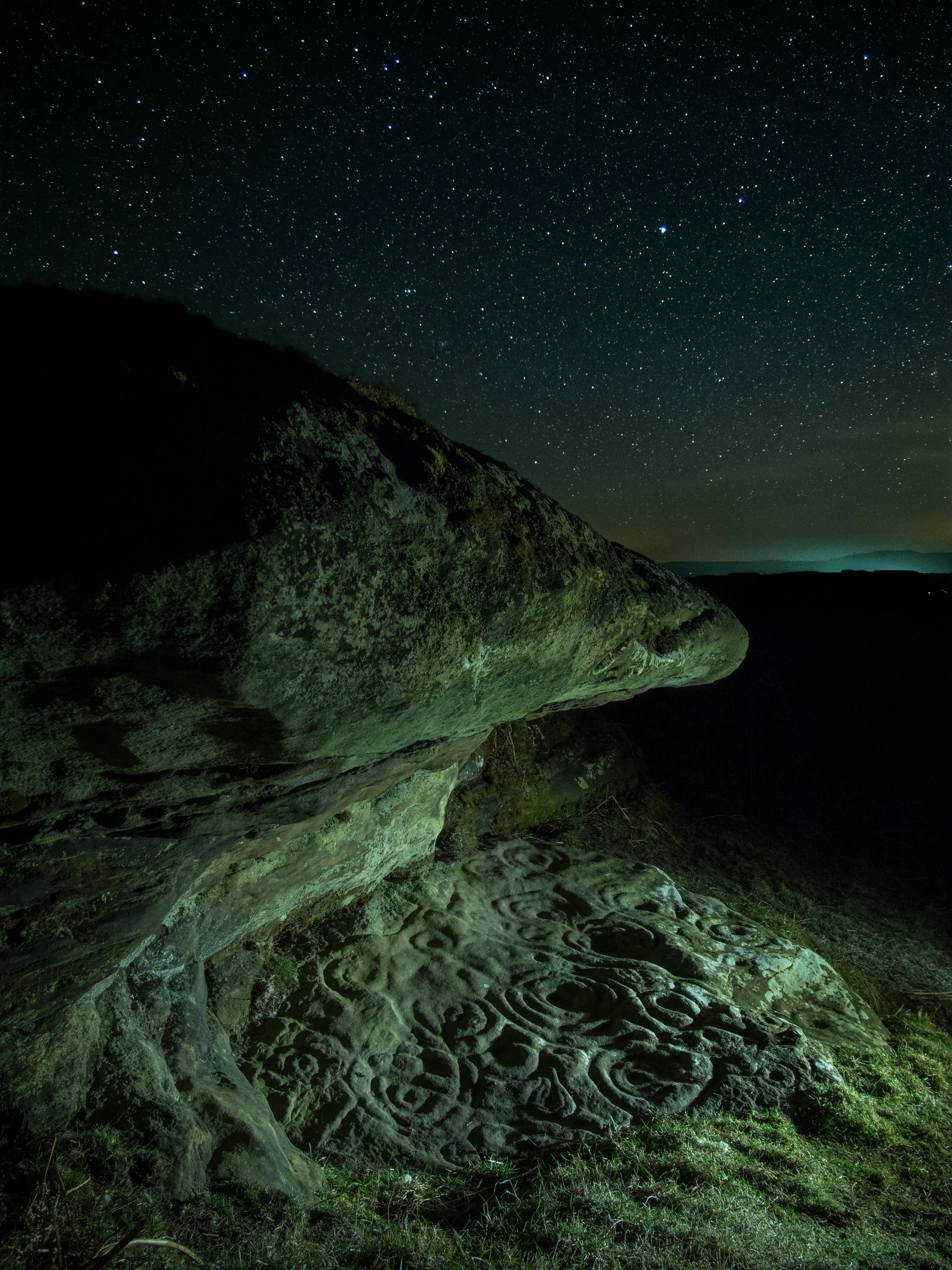
Ketley Crag with Procyon, Gomeisa and the Messier 48 open cluster (March, SW)
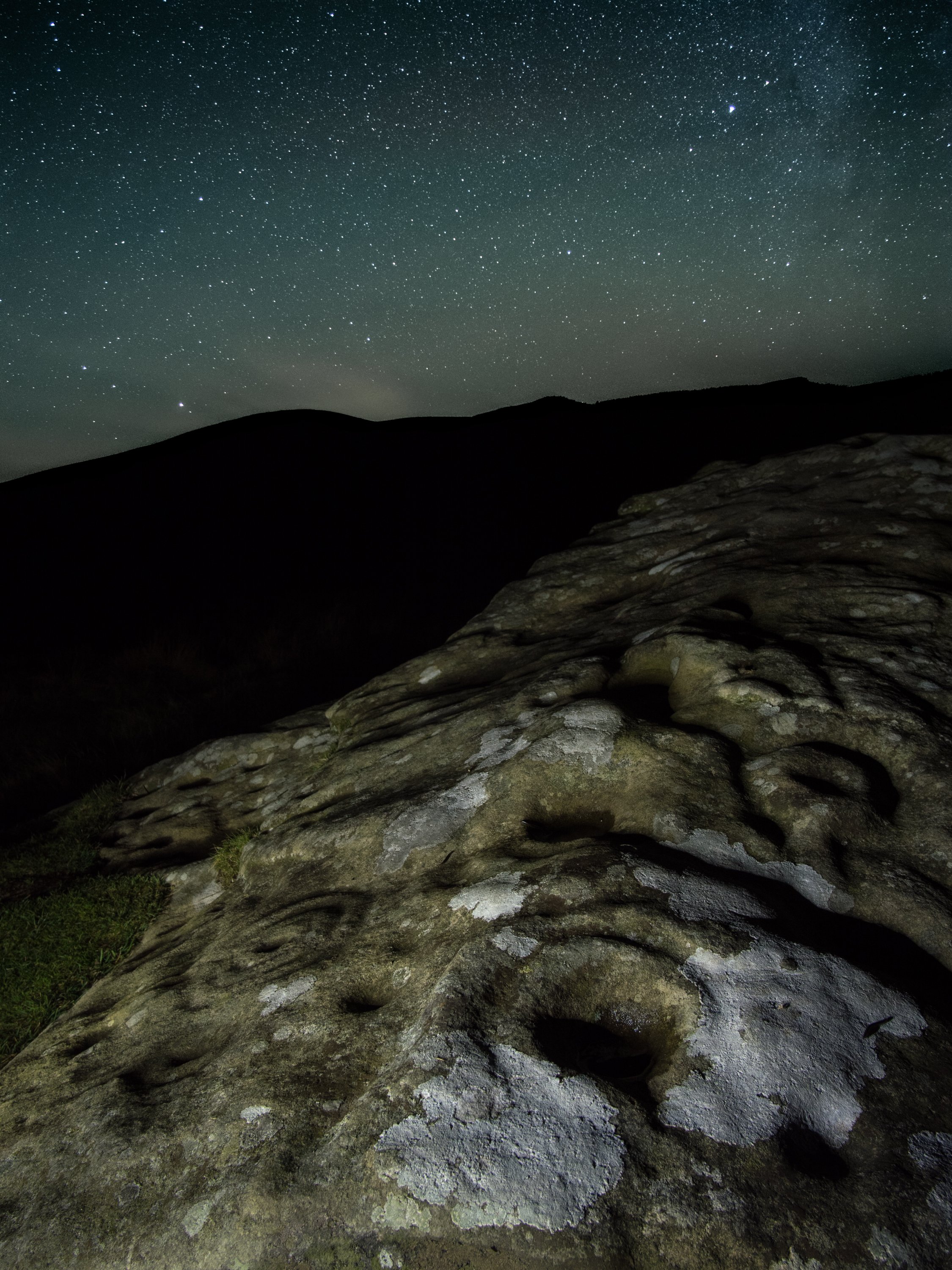
Saturn and Altair over Lordenshaws (October, WSW)
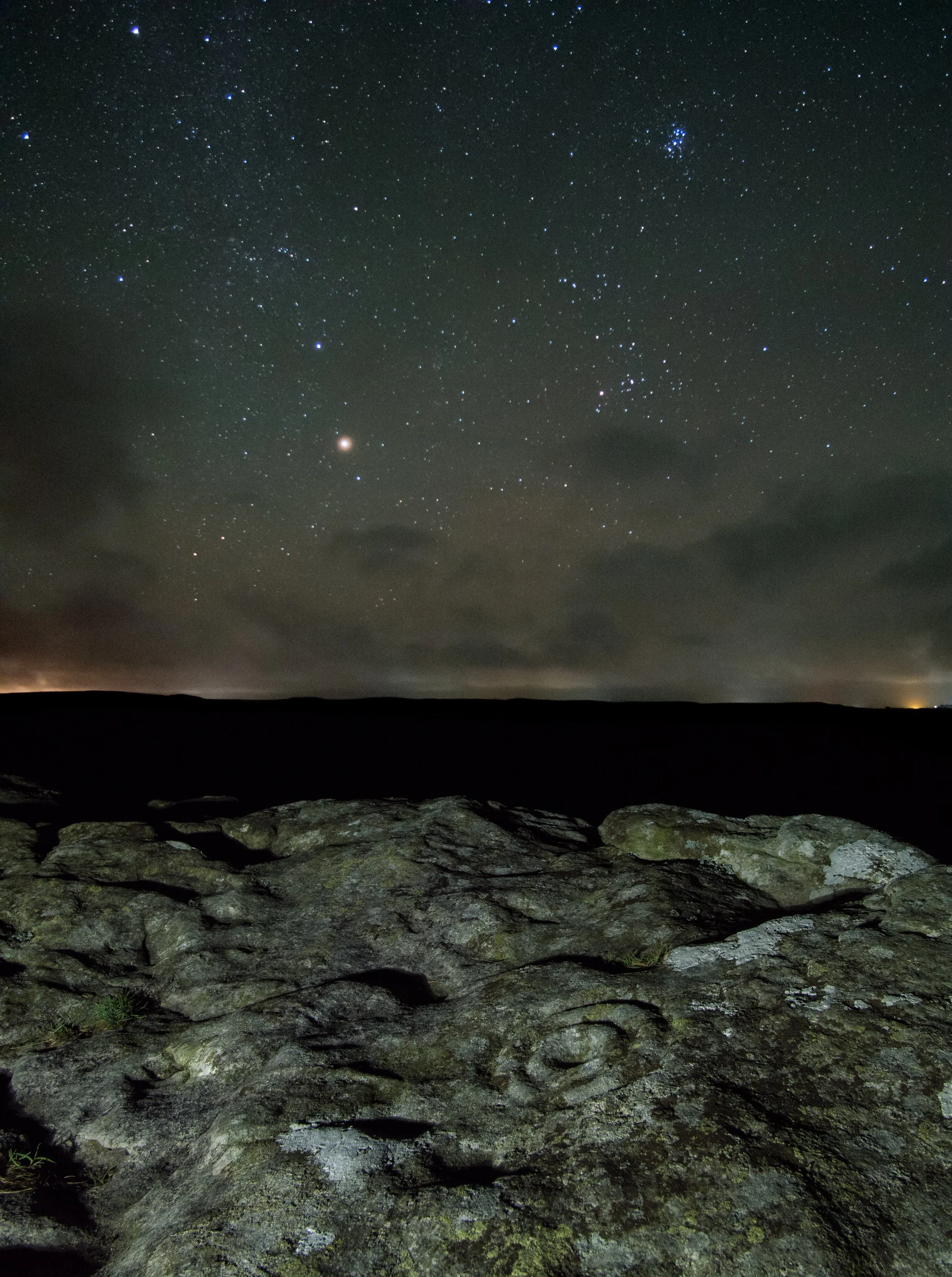
Old Bewick with Mars, the Hyades and the Pleiades (October, ESE)
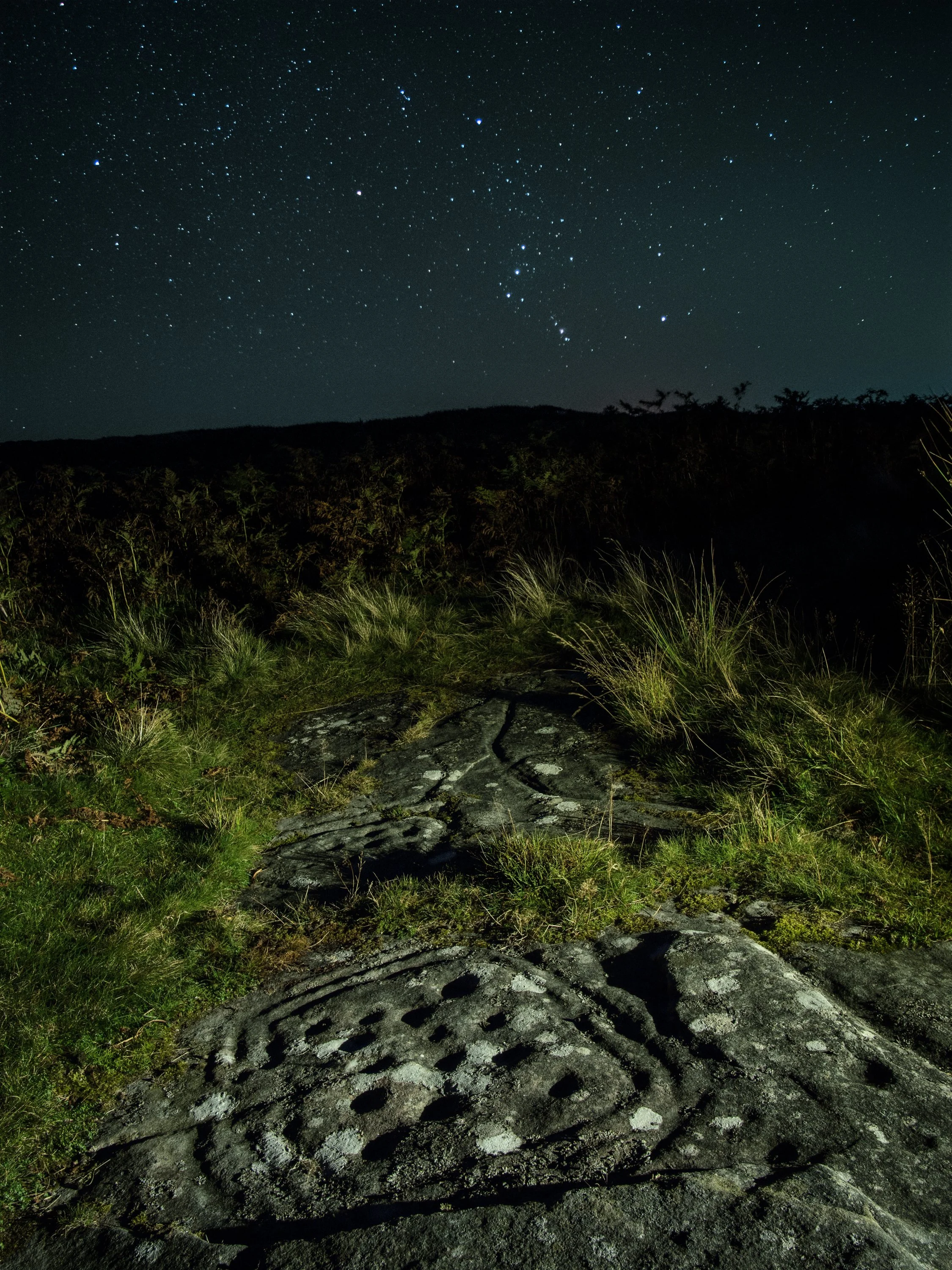
Orion rising over Dod Law (September, SE)