
Seasons of snow and sun
First published in edition 197 of The Northumbrian, Dec/Jan 2023/2024
Anthony Toole savours the contrasts in landscape, bird and plantlife presented by a walk along a favourite trail in winter and in spring
As a winter’s day, it was perfect. The sky was almost cloudless, snow covered the ground a few inches deep, and though the temperature hovered around freezing, there was no breeze.
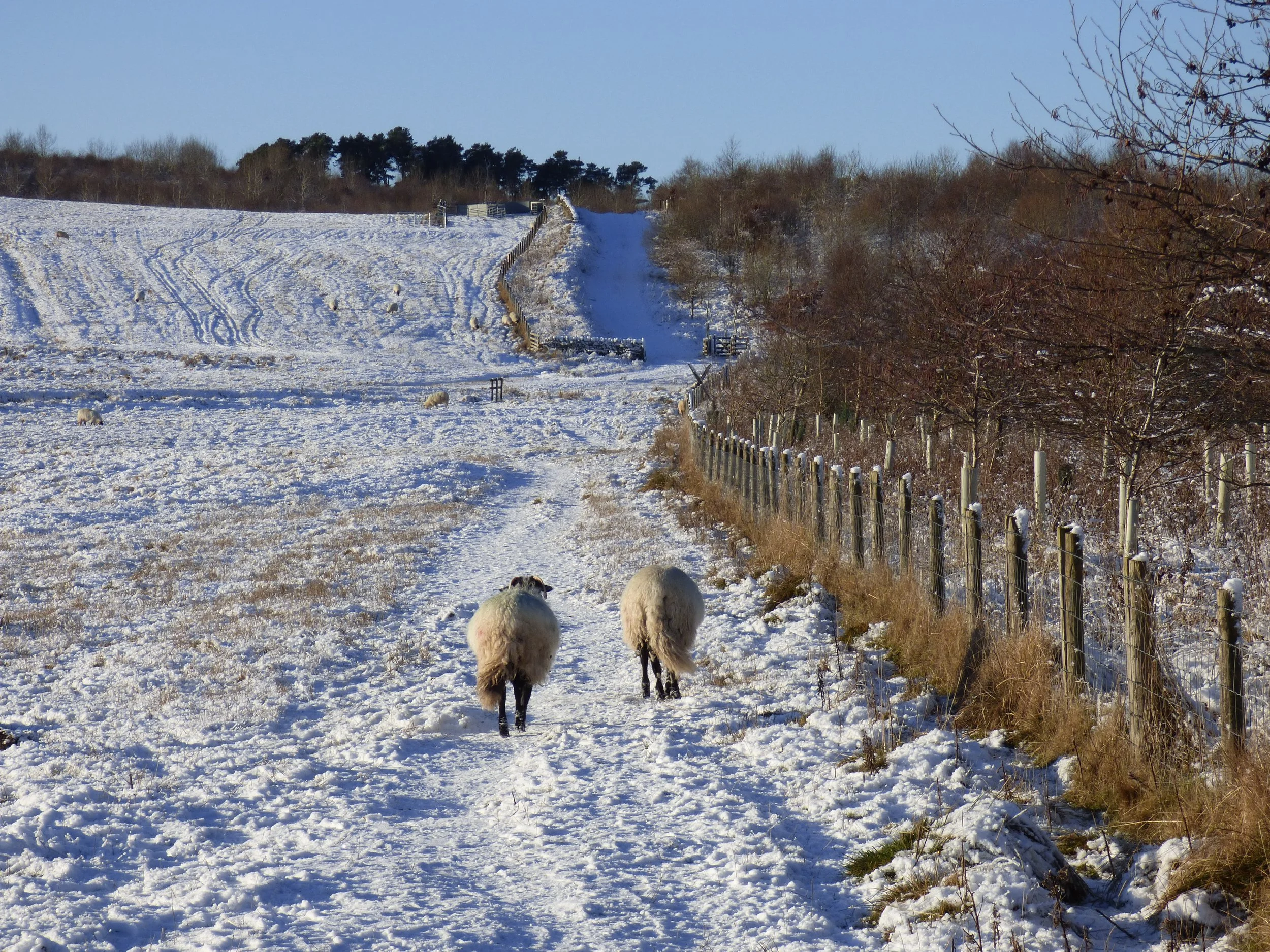
I left the car in Elsdon just before 11am and followed the footpath parallel to the burn from the bridge that crosses it just south of the village. The water flowed sluggishly between and beneath the veneers of ice reaching out from the riverbank and in some places bridging the metre or so width of the stream. The few withered leaves that still clung to the branches on the riverside plantation would hang there a little longer and the sheep went about their business, unfazed, some nuzzling away the snow to reach hidden vegetation, while a pair strolling along the path ahead of me calmly moved aside as I drew near.
As you may have read in a recent edition of this magazine, this land, The Haining, was gifted to Northumberland Wildlife Trust in 2022, its previous owners having spent a decade developing its 80-hectare area as a haven for nature. A mixture of mature and young woodland, pasture, wetland, and hay meadow, it would not fully display its riches until the spring, yet the prints on the snowy ground showed that it was already popular with walkers on this winter’s day.
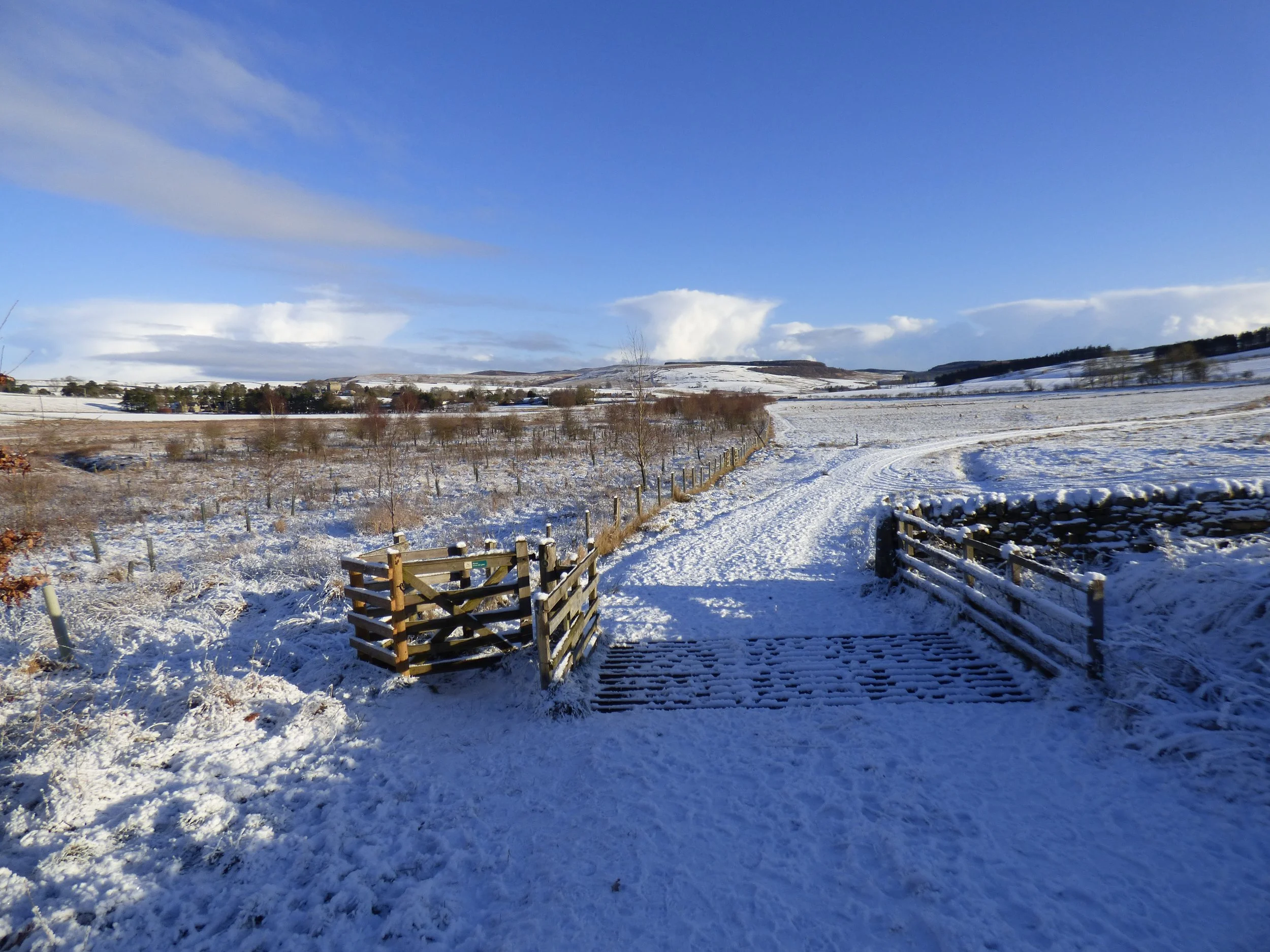
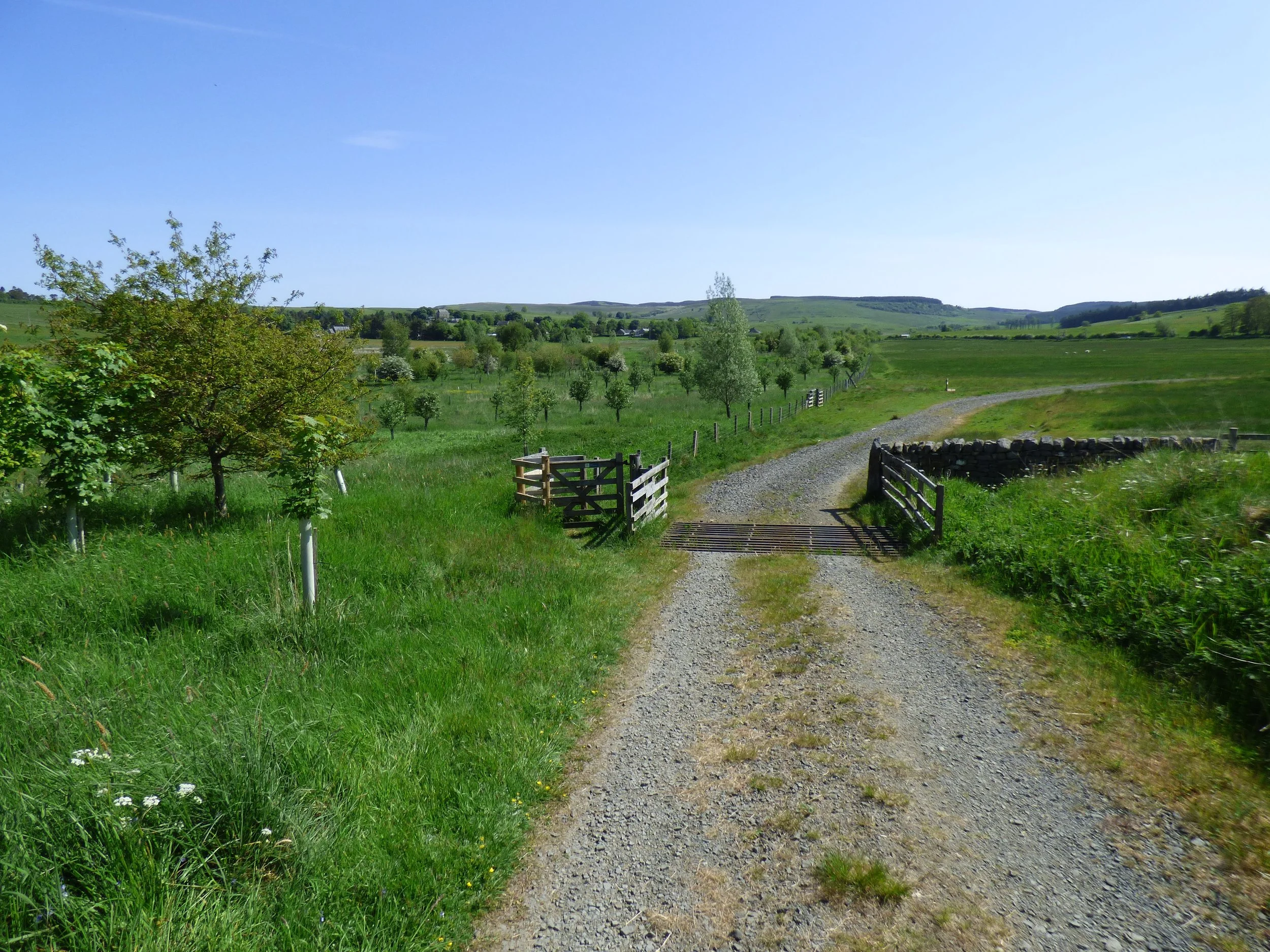
The cattle grid looking back towards Elsdon in snow and spring
The footpath crossed a wooden bridge over a silent tributary and joined a broader farm road. This led over a cattle grid and up a gentle incline before turning abruptly right then left and past a line of mature trees to reach a farmhouse. Northumberland Wildlife Trust plans to let this building, now fully renovated, as holiday accommodation.
About 100 metres beyond the house, I took the path into a wood. With no breeze to disturb it, the snow lay thick on the tree branches, the deep silence interrupted only infrequently by the chuckle of a passing blackbird or the sharp tweet of a robin – the only birds I saw. The trees were a mixture of aspen, alder, birch, willow, hazel and oak, with the occasional holly or stunted conifer. The hazels alone retained some withering green leaves and immature catkins awaiting spring. Frozen molehills punctuated the path, which toward the end of the wood converges with a bridleway that runs for a mile to Monkridge. A final few metres past a conifer plantation brought me to the road between Elsdon and Raylees.
I could have followed this road to return to Elsdon in a few minutes, but I had only been going for an hour and the small hill which rose ahead beckoned me. I crossed the road and followed the bridleway gently uphill past a ruined building where I now felt for the first time the breeze that had been absent from the valley and which, though light, carried something of the chill of the snowy slopes it had crossed.
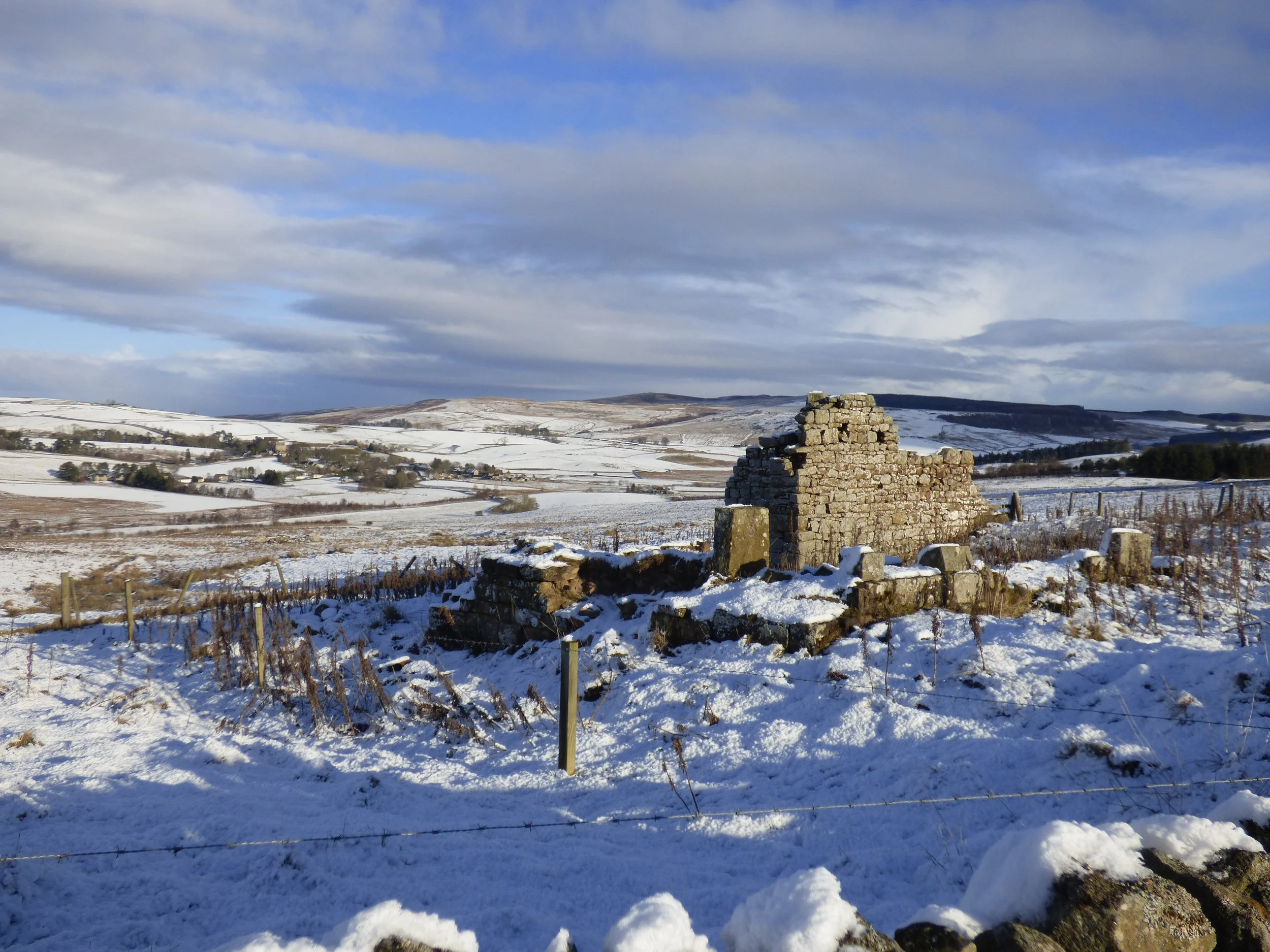
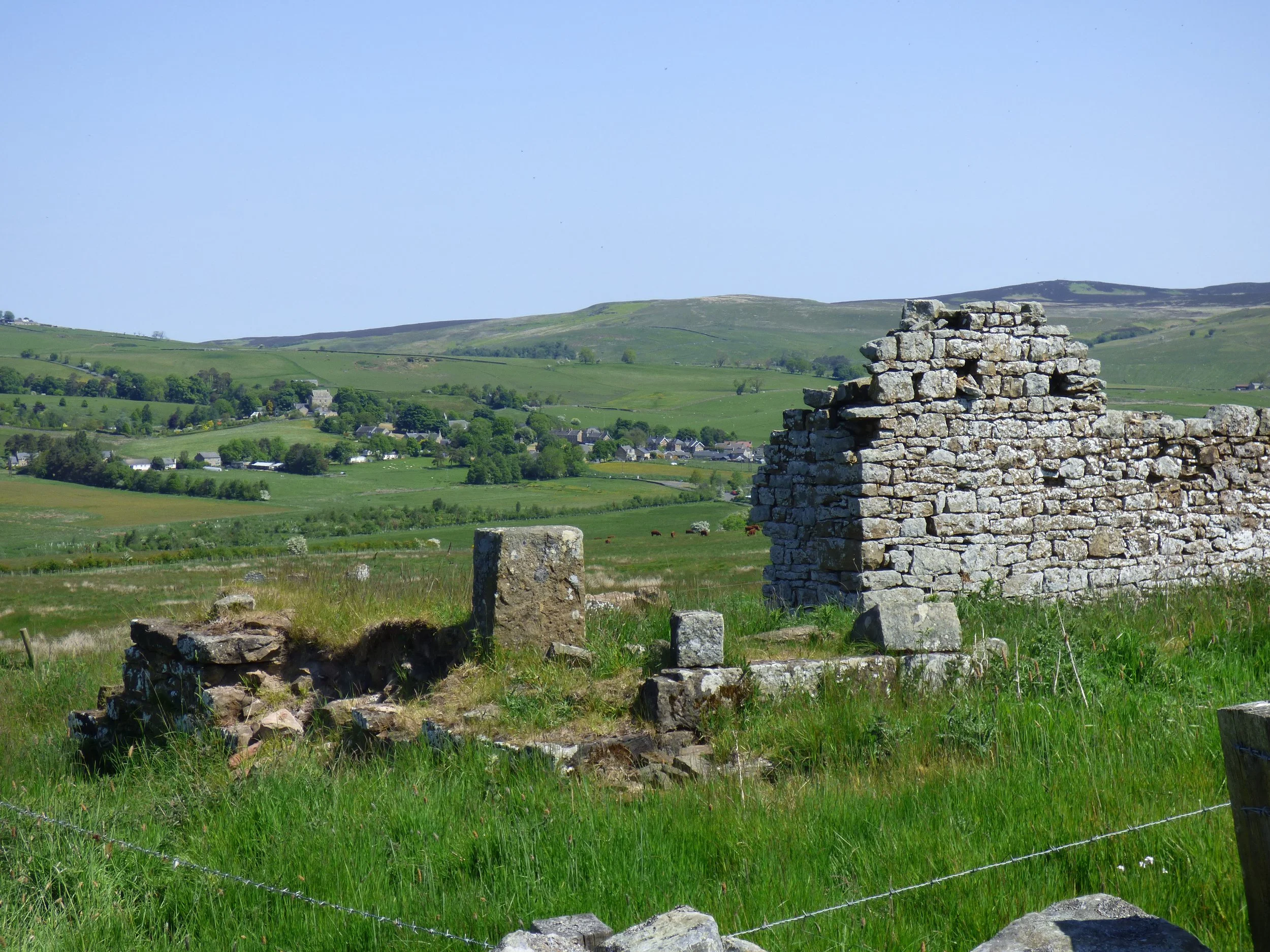
The ruined building and Elsdon in the background
A further 10 minutes brought me to the broad summit and an extensive view from Benshaw Moor, past Darden Pike and a distant Cheviot whaleback to the hills that stretch west to Kielder, Elsdon lying in the near valley.
Beyond the summit, I joined a footpath down past a farm to reach Elsdon two hours after I left it. On the way, a single fieldfare flew onto a hedge. These Scandinavian thrushes, winter visitors, normally gather in flocks, often mingling with their relatives the redwings, so to see one alone was unusual.
I returned to The Haining six months later on a day as clear and sunny as my previous visit, though considerably warmer. Swallows and house martins swooped low over the burn, their flight paths taking them under the road bridge. Sparrows flew into and out of the hawthorn blossoms and a pair of pied wagtail chased each other along the roadside.
The first field was well grazed by the small flock of sheep, now accompanied by their lambs, so that flowers, mainly buttercups, plantains and speedwells, were abundant only under the fenced-off strip of riverside woodland. At intervals along the track I came across the discarded green shells of pheasants’ eggs.
The tiny stream flowing under the wooden bridge seemed deeper than previously and was populated by pond skaters and red damselflies. Past the cattle grid a barn owl, rather than quartering the field, flew over it in a straight line, almost certainly at this unusual time of day carrying some small prey to demanding chicks in a nearby roost.
To either side of the track approaching the farmhouse lay flower-rich meadows. Amid the buttercups, speedwells, cow parsley, vetches and clover, were parasitic yellow rattle plants which fixed themselves onto the roots of grasses, limiting their growth and thereby allowing the flowers to thrive. A few mayflowers and fritillaries hung about in a damp channel by the side of the roadway.
The hay meadows extended beyond the farmhouse, though the lawn inside the walled enclosure appeared to have been cut recently, and sported only daisies, buttercups and molehills.
Through the woodland, I passed large stones, possibly the relics of a collapsed wall or one-time sheepfold that had been buried under the snow on my previous visit. Now they were in the process of being buried again, this time by fern and nettle. Ash and hawthorn were in full flower and scent, while feathery seeds floated past like snowflakes. Birdsong, the trill of skylark and warbler and the squawk of a pheasant, was continually interrupted by the insistent bleat of lambs. Spiders’ webs hung from the trees and peacock and orange-tip butterflies fluttered through open sunlit patches. Near the road, the growing tops of the more recently planted conifers appeared to explode from the confines of their protective plastic sheaths.
The bridleway up the hillside across the road was guarded by a flock of curly horned sheep and a herd of black bullocks, one of which was distinguished by its white face. The breeze was quite strong but warm, and the air so clear that from the summit I could pick out the screes and heather patches on the distant Cheviots. A hill does not need to be high to give a good or extensive view – it merely needs to be in the right place.
I descended as before, through the final hay meadows to Elsdon, watched this time by a pair of wood pigeon rather than the solitary fieldfare of my winter visit; the latter probably by then busily feeding a brood of chicks somewhere in Norway.