
The beachcomber
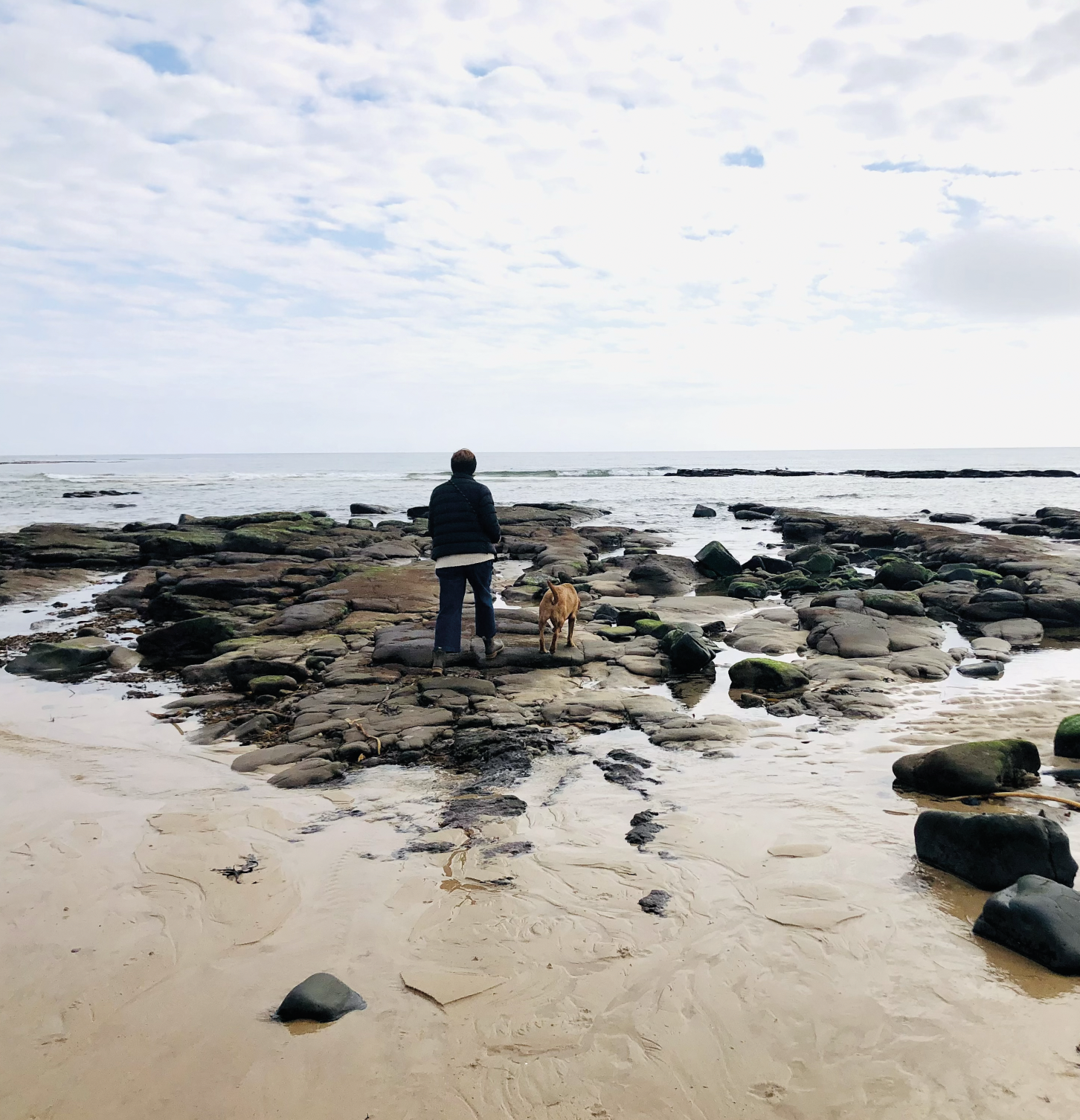
ROSIE MCGLADE enjoys a day at the seaside with her dog Jim, where they meet artist Nikky d’Aguilar and Dennis the Labrador – and discover her beautiful pressed seaweed art
Low Newton beach this morning and the sky is that milky blue you only seem ever to see over the Northumberland coastline, often through clouds as you come off the A1; a lovely low blue line on the horizon waiting for you.
It’s already the summer holidays and it’s warm, 23 degrees, and yet there’s barely a soul between us and the distant sea at low tide but a boat and a man stoking a cooking pot. It’s a pan of boiling water – sea water – beside it is a lobster – blue, proud and rather magnificent. The man is retirement age, local, and places the lobster in head first, upside down.
“It’s dead already,” he says as we watch its legs twitch. “That’s just reflexes. Normally I put them in the freezer first but this kills them just as quick. Seawater,” he adds, “is the best thing you can cook them in; it’s already seasoned.”
With me is Nicola d’Aguilar, also local. I introduce her: “She’s an artist who makes these incredible works out of pressed seaweeds.” He’s not come across them, he says, and I assure him he will before long. Nikky has only been doing this two-and-a-half years, but people fall instantly in love with her work and she can’t keep up with demand. Her normal painting routine is now somewhat out of the window.
Seaweed. He knows lots about it, but for culinary purposes. They chat. The sea spaghetti season is over, it’s a little tough in the summer. He makes Japanese-style stews with sea lettuces and dulce. Some he dries, like Nikky hopes to, to add savoury flavouring to salads and things. “There’s no seaweed here that’s bad for you,” he says, though acknowledges with a chuckle that sweet kelp must have been given its name long before the English discovered sugar.
What a lovely man, we both say on our way back to her house. I turn – was he even real? But there he is by the rock pools, breaking open his lobster.
Having seen Nikky’s work, the seaweed on the sand has a whole new grace to it. It’s always been beautiful but today it seems ever more masterfully arranged on the beach where the sea has left it as if it’s still free and floating, frozen in time.
Nikky is here every morning with her dog Dennis, a fox-coloured Labrador aged three. Dennis was a puppy when she collected her first few pieces of seaweed to bring home to her converted farm cottage at High Newton.
She’d read about seaweed pressing in a newspaper, and how it was a passion for many Victorians, particularly women. Queen Victoria and Prince Albert were fond of seaweed pressing and even today, Victorian pressings are perfectly preserved with their colour intact, Nikky says.
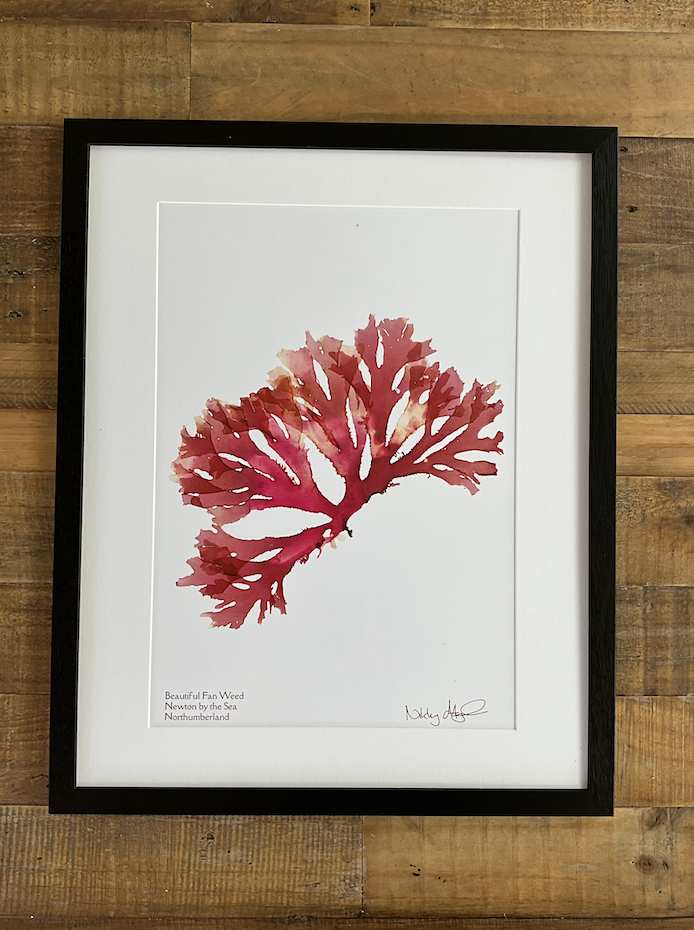
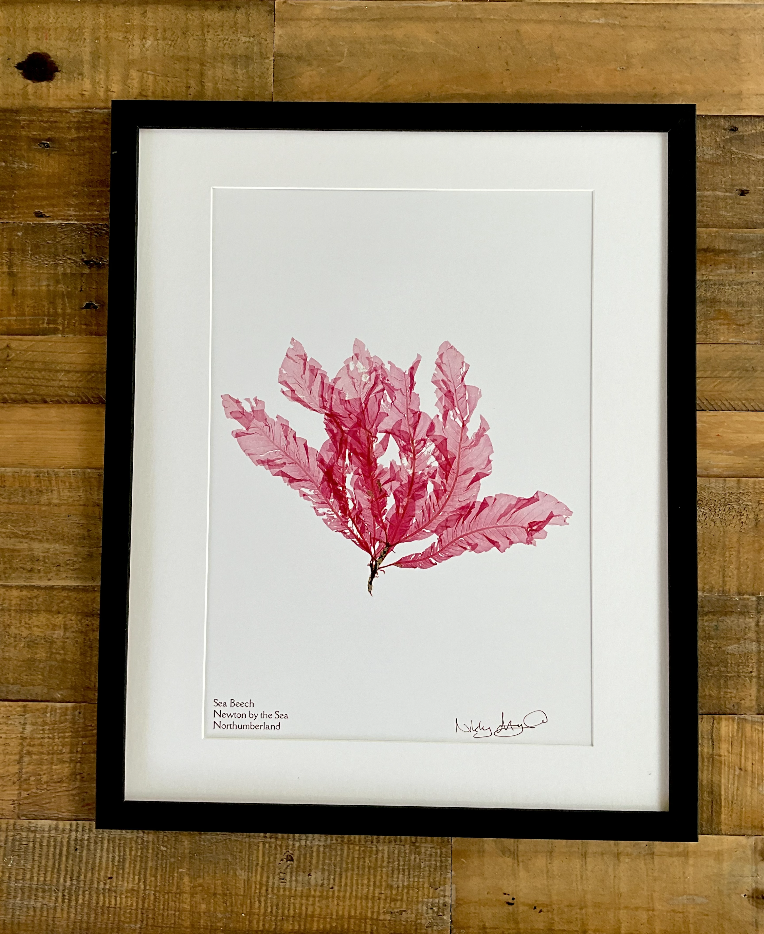
“I didn’t even know seaweed pressing was a thing before I read all that, but then I thought, how interesting,” she says. And that was that. The scraps of seaweed Nikky has picked up this morning are pretty colours, reds and ambers, though in all honesty they look a bit sad and rumpled compared to chunkier bladder wracks and the like. But these, the delicate sea beeches, fan weeds and sea oaks, are the ones she currently favours. And when they’re floating, they’re truly stunning.
That’s how Nikky does it; not like flowers where you painstakingly smooth out their petals before pressing, but by placing them in fresh water and then sitting them, somehow, over a piece of art paper and lifting, with all their perfect floating beauty captured forever.
There’s a beautiful, incredibly solid-looking Victorian weight press on her window ledge that a neighbour brought up from London. “He collects everything, even double decker buses, and when I showed him what I was doing he said I had to have it. Before I was just pressing under books and a kettle bell, but this is wonderful,” she says.
“It’s a very calming process. I’ve learnt purely by trial and error so I’m never completely sure how it’s going to come out but when it works they are so beautiful.”
Once out of the water and dried off a little with paper towels, she puts them inside the press in layers, each with a J Cloth on top. Every day, where possible, she adds additional layers from the beach. “These finer ones only take a couple of weeks before they’re ready,” she explains.
Then she writes on the art paper their common name and the place where they washed up (always Low Newton). “What I love is that I’m not cutting anything, or taking anything away that wouldn’t otherwise decay. They would just disappear on the beach otherwise, or be taken back into the sea. That’s what I’m addicted to, this idea that they’ve been through rough seas and storms and then washed up at low tide, and you’re saving something. There’s something so weather-beaten about them and yet so delicate and intact.”
And then they’re mounted and framed. There is no glue involved, no paint, nothing. “It’s amazing how they turn out,” she adds. “Some look like paintings on paper, some like intricate tapestries, some more three dimensional. Some rot, but that’s all part of what makes it fun. You can go to the beach and not find much at all some days, but every day the beach is different. It’s a very soulful place.”
She has a vision of making her website (in the process of being redone but you can still purchase her pressings and prints there) reflect the changes of the seasons. Different seaweeds come to the fore at different times of year. Her painted seascapes obviously change too.
We’re now in her living room, which is beautiful, full of lovely artworks, antiques, sculptures and interesting books. Out of the corner of my eye, to my horror, I notice that my dog Jim is causing a rumpus with Dennis (to put it politely). Nikky is beyond gracious. “Give them space,” she says as I grab him, “they’re fine.”
And that was my impression when I first met Nikky selling her work at a nearby open garden a few weeks previously – full of presence, and while obviously arty, fun and enormously friendly too.
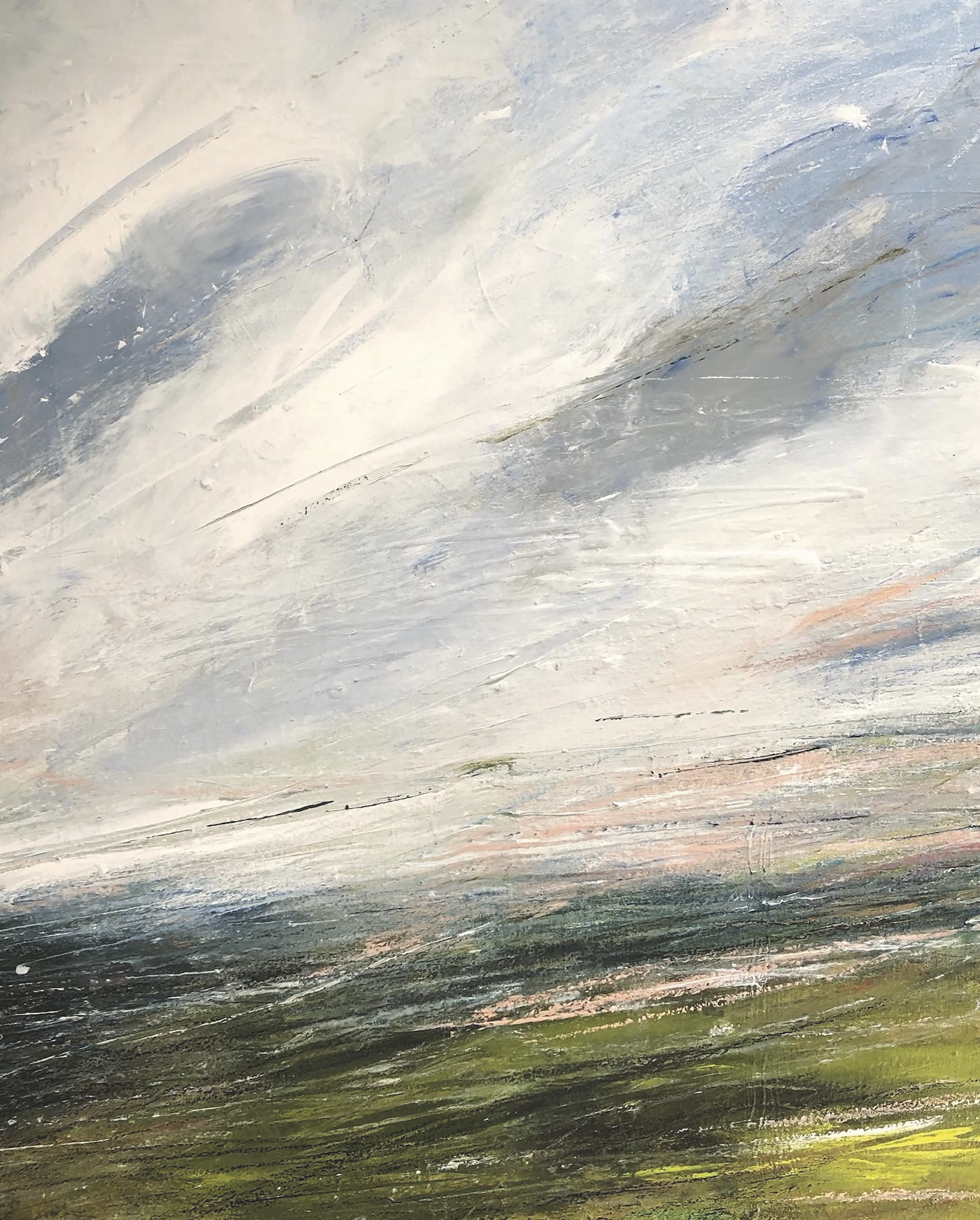
She is indeed very arty. Upstairs in the attic is her studio, its window looking over the wheat fields to the sea, paint splattered over the wooden floorboards and easels holding big, bold seascapes. “I do very wet paintings. I tend to put them on the floor and then on the table and move them around. Not on an easel so much as everything would just drip off. I don’t plan what it’s going to look like, ever. All my paintings have lots of layers and I work very fast and will finish a whole layer in one go, so that if it’s still or windy and the grasses are blowing I can get all of that down. I don’t want to overthink it. There’s a lot of energy and joy, but it can also be frustrating. So the seaweed is relaxing for me, and it’s easy to exhibit too. It’s nature. My paintings are personal and exposing, and very open to judgement.”
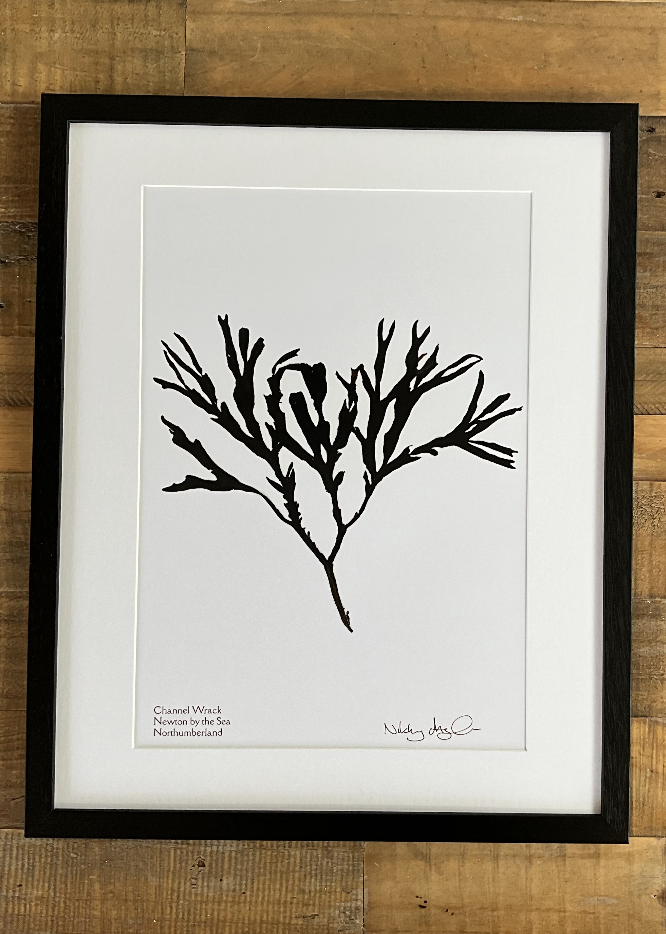
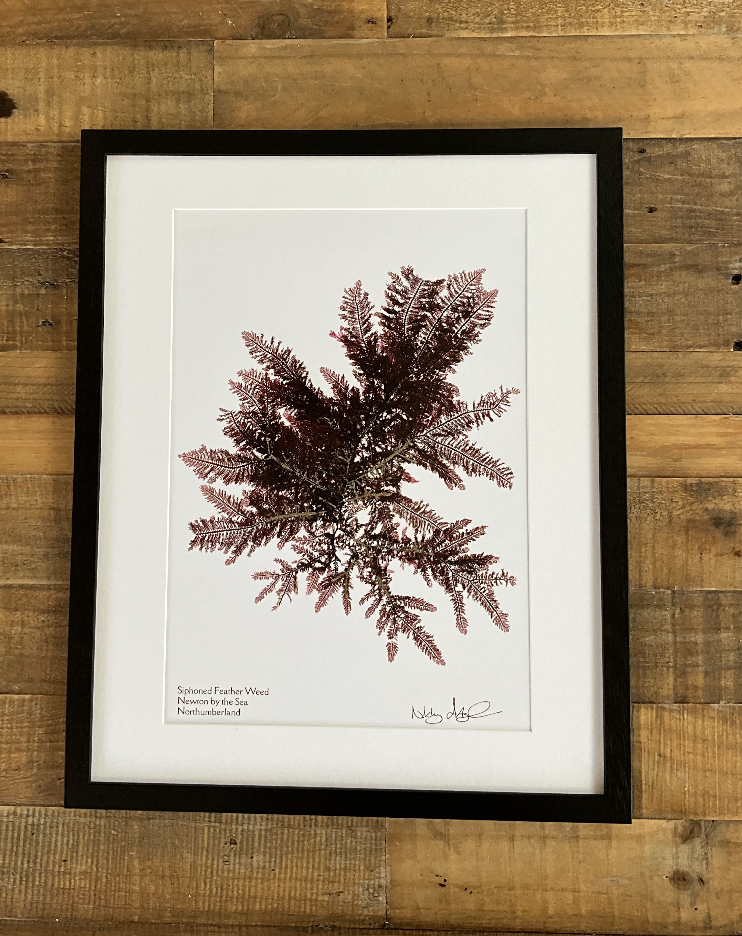
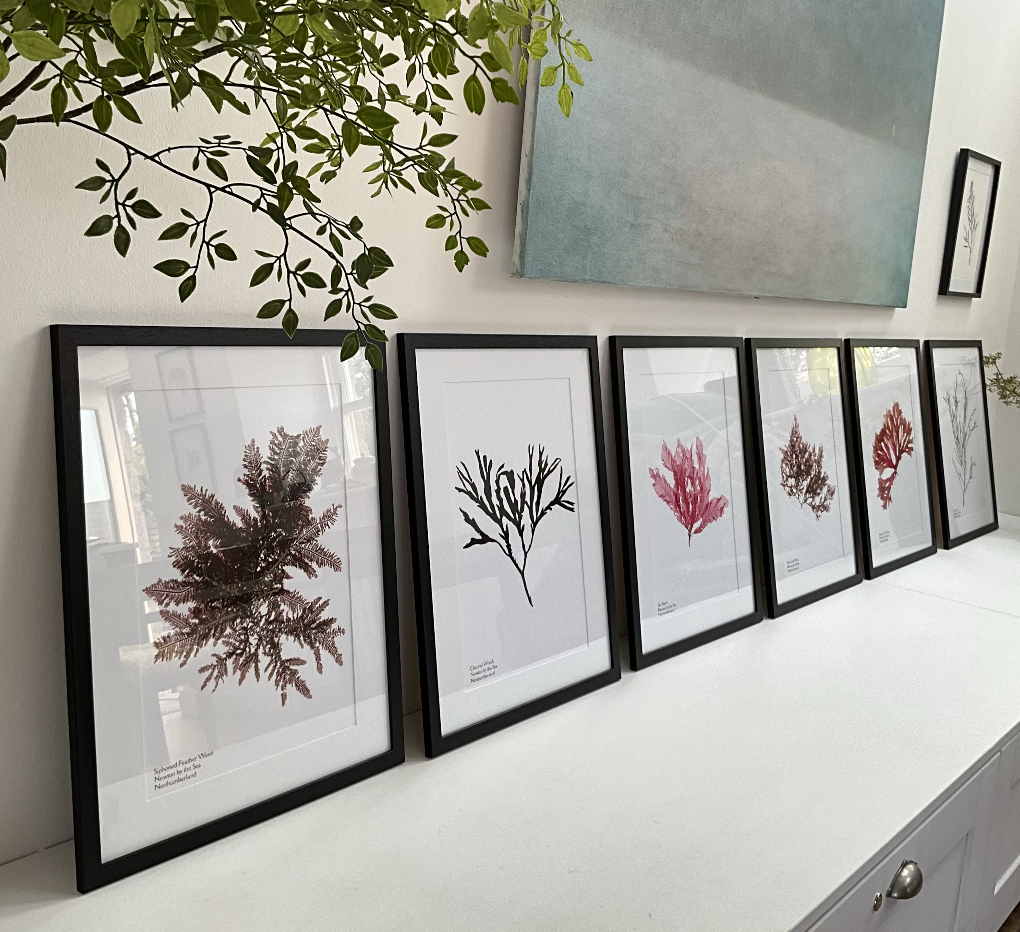
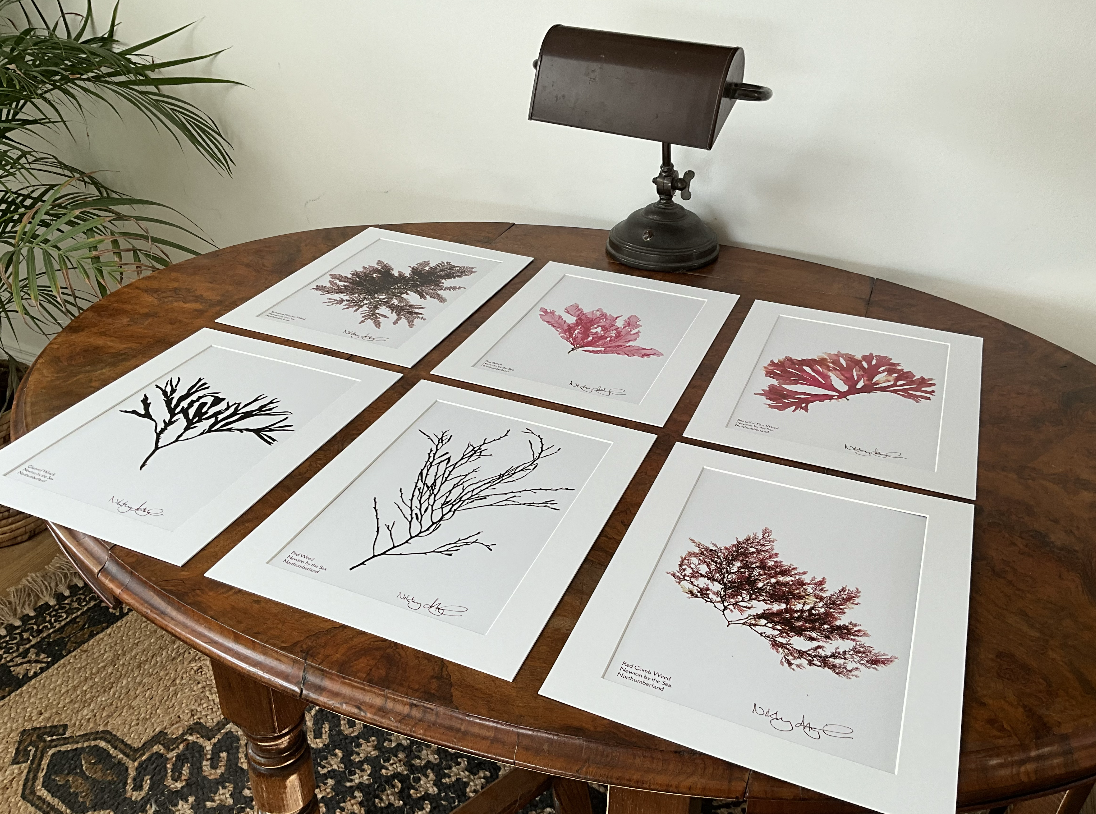
Dennis and Jim are a bit too close to the easels, I think, as we go outside to the little landing, where pressings and prints are stacked ready for sale. There are cards too, smaller versions of the prints. On them, pod weeds, red comb weeds, siphoned feather weeds and channel wrack. The sea beech almost looks like red horse chestnut, only delicate. The sea oak looks like a ghostly little oak tree branch. It’s all gorgeous.
Before Dennis came onto the scene, Nikky would go down to the beach with Daisy, a Jack Russel who passed away a year ago aged 17. Less demanding, Nikky had time to sketch out quick watercolours or pastel paintings in her little notebooks, bring them back to her studio, and work them up on big canvases.
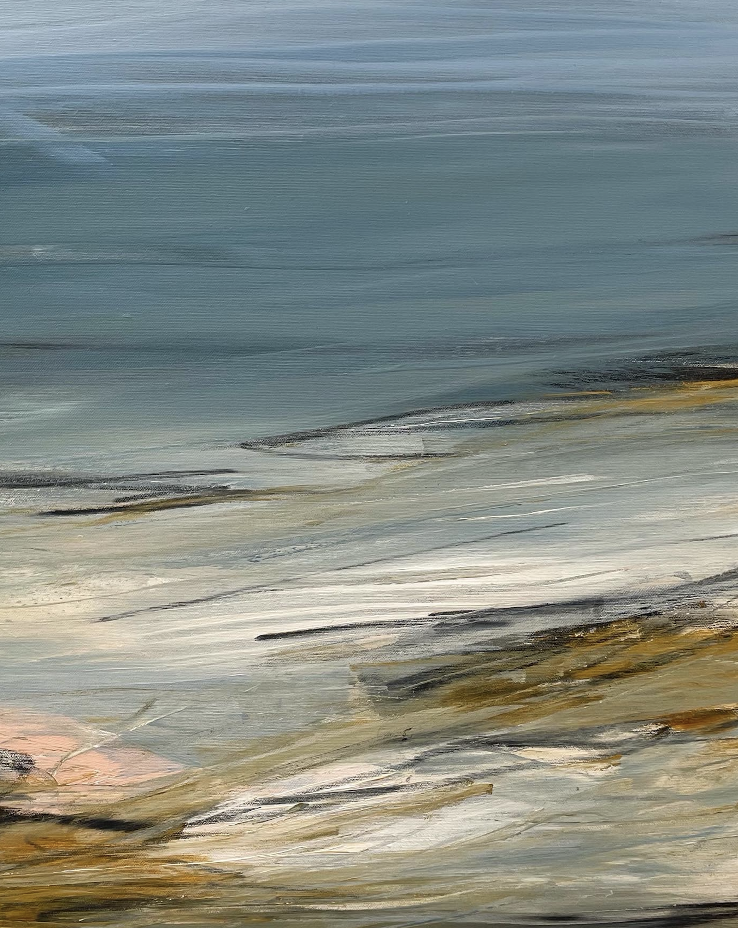
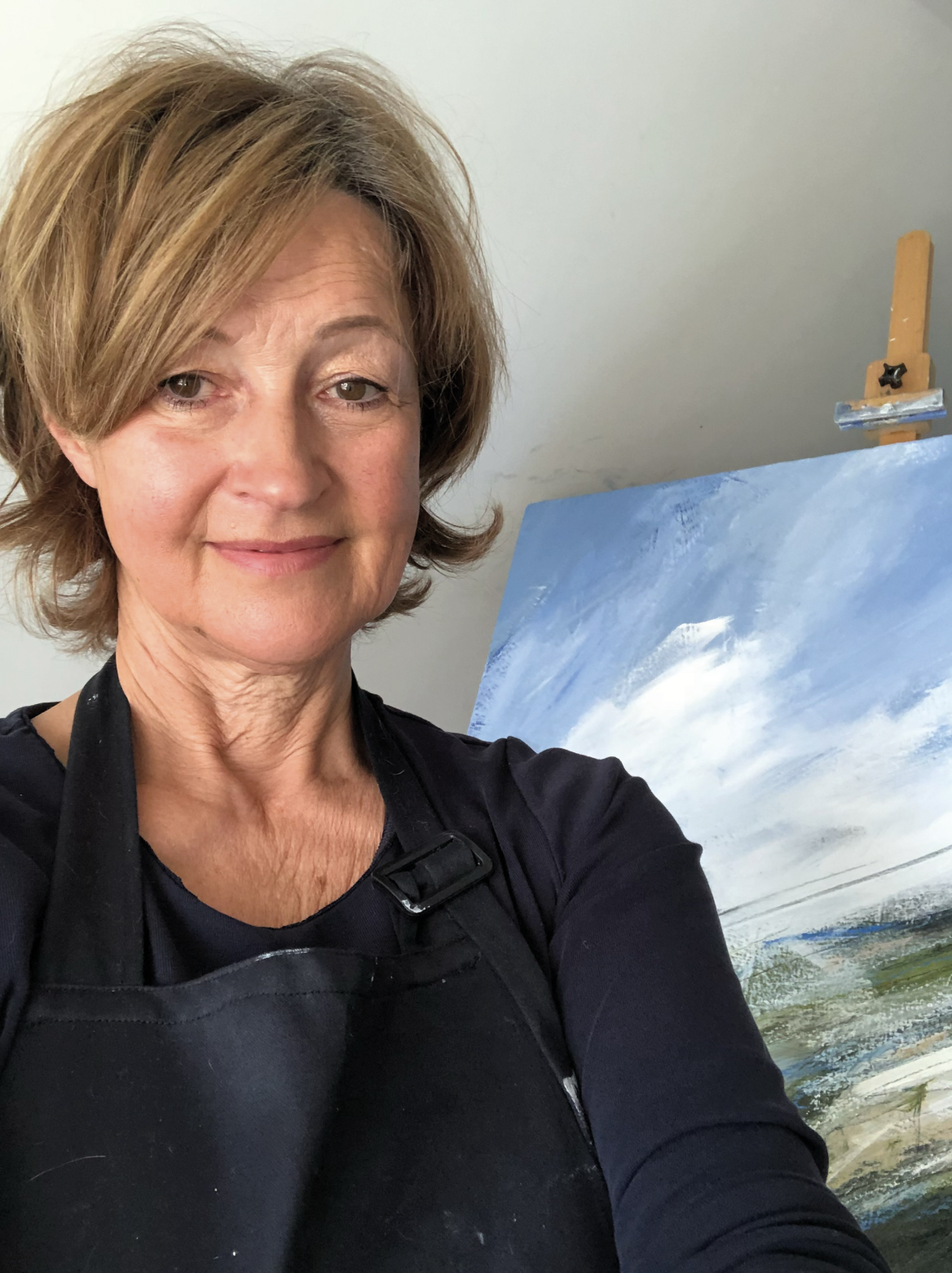
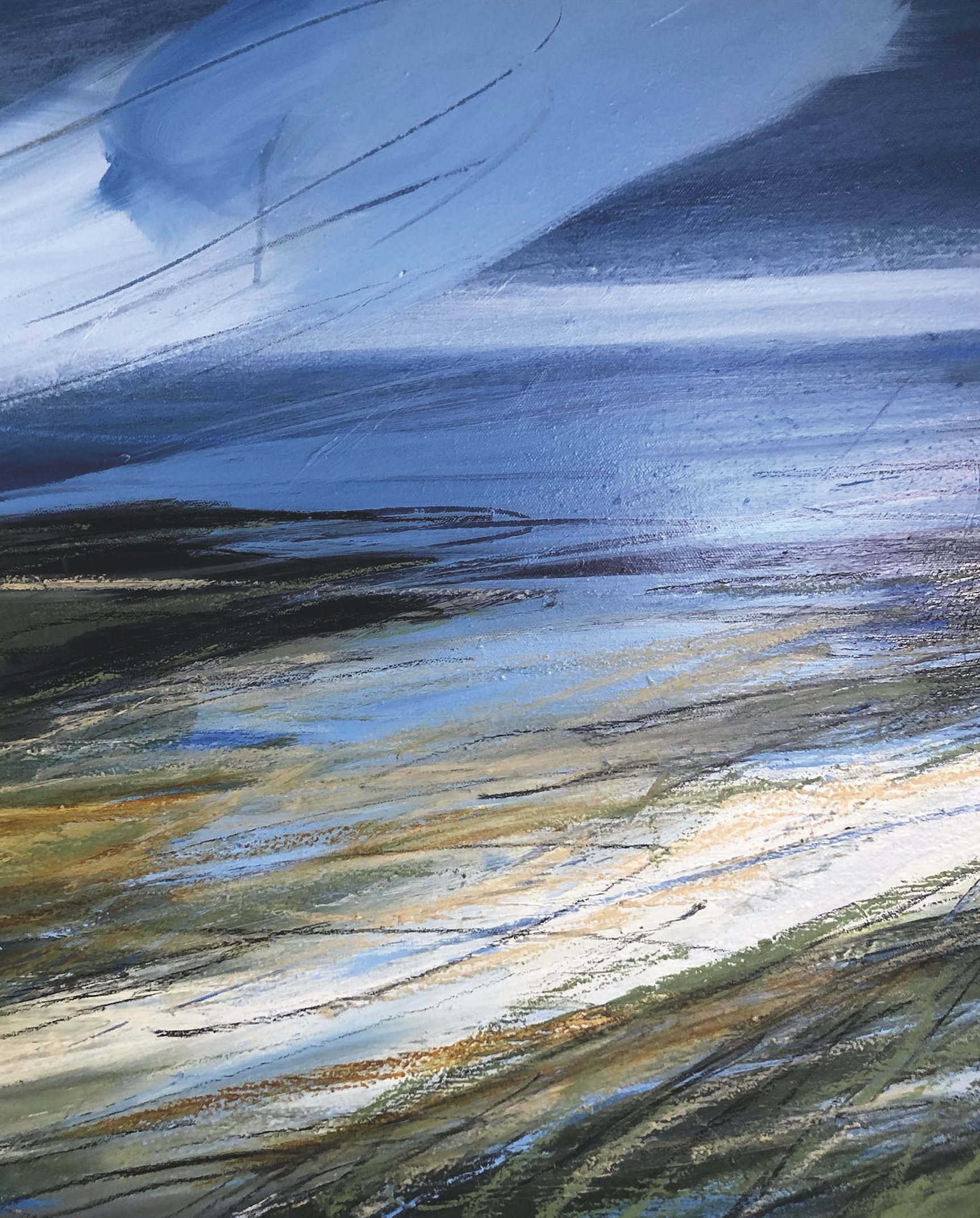
And then of course the seaweed happened and she hasn’t painted much since then, but you can tell the urge has returned. Don’t worry, though, it’s a question of slotting the painting in and she’s working hard to meet demand for her pressings. I ask her to choose one for me for my niece’s wedding present and write on it both of their names (I hope you’re not reading this, Claire!). They’re becoming a popular choice for gifts for anyone with affinity to our coastline.
Nikky, of course, isn’t the only artist doing seaweed pressings in Britain, and she’s linked up with a few people she knows of. There’s someone in Cornwall, another in Wales, one in Scotland, each with their own styles. But hers is local seaweed and that’s also what makes it special. She and her husband Johnny bought their High Newton home when their youngest daughter, now 27, was a baby, but work took them to Glasgow and the world of advertising for many years. Having been banned from choosing art even for O-Level by her scientist father, Nikky didn’t really start painting until after the children were born. When she did, she went on to study at Glasgow School of Art. She and Johnny have lived back in the cottage for around four years. But of course this is the place where they would spend their summers while the girls were growing up. “We would play for hours in the rock pools when the children were younger. Those are the best holidays in the world. They’d put their little wetsuits on and we’d all be out all day,” Nikky says. “The girls were home recently and they made seaweed face packs. I was calling them the seaweed sisters. It’s constantly a thing we are playing with.”
On the beach, Dennis tries to eat the seaweed. “He likes the big kelp things. Which isn’t good because it can make him sick,” Nikky says. But in many ways we have him to thank for Nikky discovering this lovely calling, as he gave her no time for sketching. “He is my buddy. He gets bored when I’m looking through the piles of sea kelp and I have to keep throwing a ball for him.” Driving home, Jim wet in the boot, I think about the man on the beach with his lobster, and seaside holidays with sandcastles, and of course rock pools. Things we never really grow out of. Nikky’s pressings capture all that loveliness.
• Nikky is planning a number of gallery pop-ups at St Mary’s Church in Low Newton(the tin church on the way to the beach) and may hold some seaweed pressing workshops there.
For details or to book, emaile her at nikky@daguilar.co.uk or visit her website at www.nikkydaguilar.co.uk and her Instagram account @nikkydaguilarart